
High-Start Winch Project
Easter Saturday, March 25, 1978, 9:00 a.m. Takeoff time.
A structure, assembled from round and square metal parts, was lifted out of a trunk with what appeared to be considerable effort and placed on our runway.
The time had come—our homemade winch was ready for its first tests and was now set to prove whether it could deliver on our expectations.
But let’s go back to how it all began. At our annual general meeting in February 1977, the decisive resolution was passed that our MG wished to acquire a high-launch winch. Since it was also decided at that same general meeting to finance the airstrip—which was mainly used by powered aircraft pilots—from the club’s funds going forward, the glider pilots had to be offered a corresponding benefit—
the winch. Dani Kunz and I were tasked with exploring commercial offers so that we could then submit a proposal to the board. Well—the available options on the market were, to put it mildly, modest. Furthermore, from the outset, we demanded high performance. Eventually, the trend toward large gliders—which had previously been only gradual—suddenly took off in our group as well. A test run of a potential winch in practical use did not go very well. On the one hand, the machine seemed underpowered to us, and it also malfunctioned, revealing a glaring design flaw.
From that point on, the idea took shape to take the design and construction of a winch into our own hands.
Another demonstration—namely, that of the Erlenbach group’s homemade winch in the fall of 1977—reinforced our view and, at the same time, gave us the idea for the basic concept.
In November, I began making sketches and drafts, researching the drive motor and the estimated total costs. Consequently, we (that is, some of the most active sailors in our group and the author) decided, in order to save time, to begin construction immediately and to guarantee financing in case the corresponding motion was rejected at the next general meeting (February ’78).
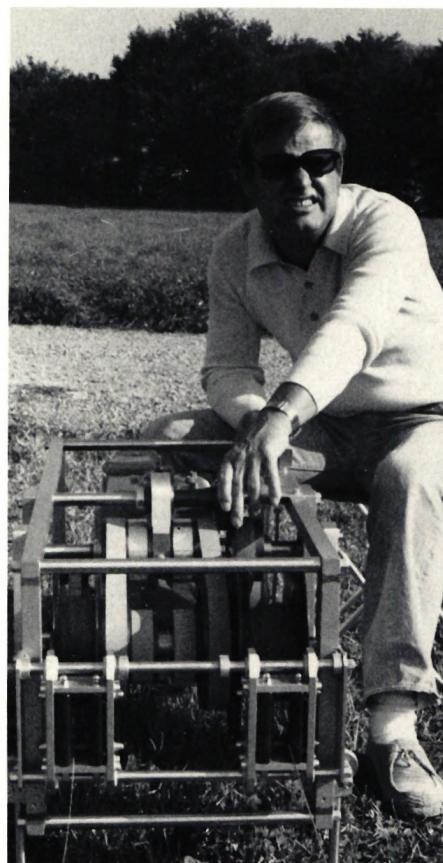
Launching system:
With a pulley, i.e., launching the models next to the winch, by hand, or from the ground.
Powerplant:
Briggs & Stratton single-cylinder four-stroke engine, 206 cm³
Cable-pull starter, magneto ignition
Net power: 3 kW (4 PS)
Operating speed: 2,200–3,600 min⁻¹
Max. torque: 1.05 kpm
Torque: 0.95/1.00 kpm at 2,200/3,600 min⁻¹
Cable pull:
40 kp at 3000 min⁻¹, empty haul drum
Cable speed:
5.4 m/sec (approx. 20 km/h) at 2,200 min⁻¹
8.9 m/sec (approx. 32 km/h) at 3,600 min⁻¹
(empty haul drum)
Rope drums:
1 main drum for 1,000 m of haul rope, Ø 1.5 mm
1 secondary drum for 1,000 m of retrieval cable, Ø 1.0 mm
The secondary drum is also designed for towing light models.
Cables:
Nylon braided rope, provisional
600 m, Ø 1.5 mm, tensile strength approx. 70 kp
300 m, Ø 1.0 mm, tensile strength approx. 25 kp
Clutches:
1 centrifugal clutch on the motor stub
1 double-plate clutch on the shift shaft for Drum 1 – Neutral – Drum 2
Transmission elements:
Flat belt; motor and drum shaft adjustable
Brakes:
1 flat-belt band brake on each drum
Materials:
Frame, pulleys, drums, etc., made entirely of Anticorodal B; all shafts, axles, and linkages made of CrNi 18/9 steel; all screws Promatized.
Total weight: approx. 70 kg
B. Haiden
From Bulletin No. 9 of the MG Dietikon.


News from HEBU

TEAM MANAGER "THIS" BOSSHARD
 Rodito Nussbaumer

YOU KNOW WHAT I MEAN? 125 YEARS OF THE SWISS AERO CLUB
 Emil Giezendanner

HORIZON HOBBY/LEMACO NEWS: MICRO OV-10 BRONCO 645 MM BY E-FLITE

PRIDE AND GOOD IDEAS
 Markus Nussbaumer

TRY-OUT DAY AT MFV WETTINGEN
Urs Keller
F3A EUROPEAN CHAMPIONSHIPS IN ST-MACAIRE, FRANCE
 Matthias Bosshard

52. 2026 ALPS CUP
Emil Giezendanner
ATOM, THE NEW DOUBLE-DECKER FROM CPLR
Matthias Bosshard
SUMMER FUN 2026 AT MG USTER
Martin Wunderli
What's New at Leomotion.com

COUPE DES ALPES – OBSERVE AND LEARN
Rodito Nussbaumer
TWIN TOWN PARTNERSHIP
Wolfgang Voeller
BY YOUTH, FOR YOUTH
Lorena Betschen
34th HAHNENMOOS ALPINE MODEL AIRPLANE CAMP
Res Dauwalder
CORSAIR F4U – A WARBIRD WITH A MEMORABLE LOOK
Jürgen Rosenberger, Jürgen Prinz
SMALL, MODEL-LIKE SAILBOATS
Res Dauwalder
WELCOME, NEW MEMBER!
Andrea Bolliger
FREE FLIGHT IN THE MIDDLE OF SUMMER
Urs Muntwyler
EURO CONTEST GLIDER ACRO TOUR AUSTRIA 2026

INSIGHTS INTO THE HISTORY OF SEAPLANES

THE PC-21 STORY
Emil Giezendanner
NEWS FROM HEBU
 Julia Bucher

FROM 0 TO 100
Markus Nussbaumer
MEMORIES
Wolfgang Völler
NOS REGION – A HUB FOR ELECTRIC AVIATION
Emil Giezendanner
DO YOU KNOW WHAT I MEAN IN THE LAND OF SMILES?
Emil Giezendanner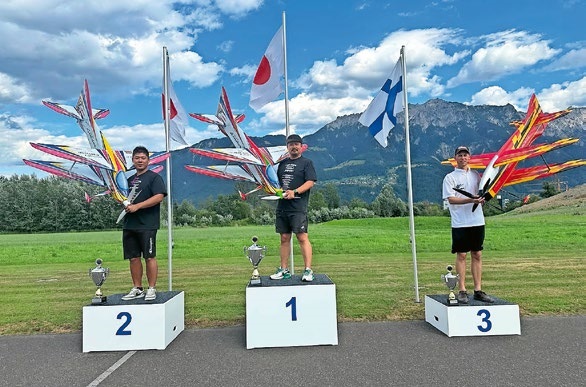
A SPECTACULAR F3A WORLD CUP IN THE PRINCIPALITY OF LIECHTENSTEIN
Emil Giezendanner