
M24 V380 – The big brother of the popular M24 V275
That’s how it is… I spent a lot of time out and about with him (the little one). He never really let me down—he always managed to catch the thermals or even the slightest breeze. I’ve had many wonderful thermal flights with him—over flat terrain with just a few seconds of motor climb, or even on a slope, in light wind or weak thermals. Will his big brother be just as good? I’ll only find out if I build one. Let’s get to it...
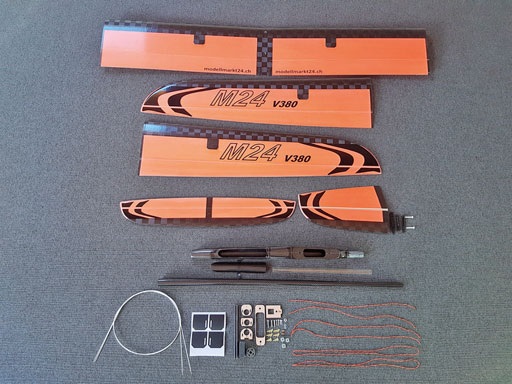
The empty weight of the M24-V380-ARF kit is just 1,270 g with a wingspan of 3.8 m. Ready to fly, it weighs about 1,900 g. That results in a wing loading of about 21 g/dm².
The wings are made of lightweight extruded XPS polystyrene, which is covered with high-quality fiberglass fabric at a 45° angle. This provides good torsional stiffness. Carbon struts in the wings, the elevator, and the horizontal stabilizer ensure excellent flexural strength. Mounts for the aileron and flaperon servos are milled out, and the servo cables are already routed. The wing consists of three sections; 8 mm Ø round carbon rods serve as wing spars, and the center section is secured to the fuselage with two countersunk screws. The motor bulkhead is slightly recessed and fits very well; the HLW mount is also cleanly machined and, like the motor bulkhead, is a 3D-printed part. FRP control horns for ailerons and flaps, frames and servo boards, lock nuts and various mounts, Bowden cables with 0.8 mm steel wire, a round carbon rod for securing the canopy, etc., round out the small parts set.
The fuselage consists of a carbon-fiber gondola connected to a carbon tube. The spacious interior is easily accessible through the canopy. Thanks to the built-in ballast tube, up to 640 g of weight (optional) can be added, allowing the M24 V380 to be flown in all weather conditions. The “Syner J mod.”profile, combined with the wing’s double V-shape, promises excellent thermal and gliding performance. The 4-flap wing allows experienced model pilots to further optimize performance during various flight phases (speed, thermals, butterfly, snap-flaps, etc.).
Thanks to its three-piece wing and removable tail units, the model also has a very small packed size. This makes the M 24 V380 exceptionally easy to transport. Since the entire model is very lightweight and manufactured using a positive molding process, the parts’ compressive strength is not very high. It is essential to protect the wings with wing bags to prevent dents during transport (optional). For those who enjoy long thermal flights and therefore
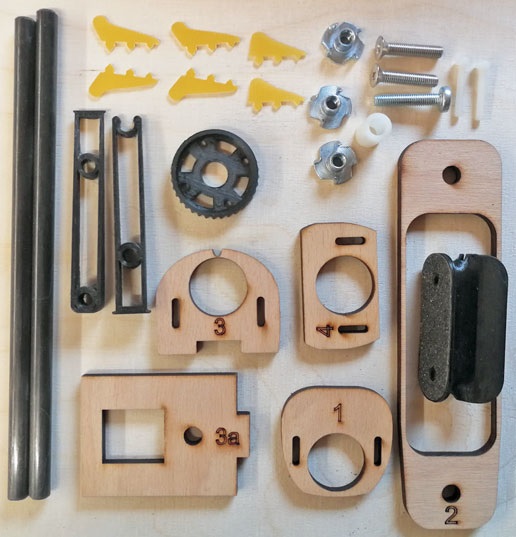
If you want to install a large battery, you often run into a problem with the center of gravity. The M24 offers a neat solution to this. In the tail tube, beneath the vertical stabilizer, there is a small compartment designed to securely house the counterweight. The screws on the vertical stabilizer secure the entire assembly in place.
| Wingspan: | 3,800 mm |
| Length: | 1,805 mm |
| Weight (ready to fly): | 1,895 g |
| Wing area: | 90.2 dm² |
| Wing loading: | approx. 21 g/dm² |
| Ballast/payload: | 64 to 640 g |
| Profile: | Syner J mod. |
| Center of gravity: | 95.5–100 mm |
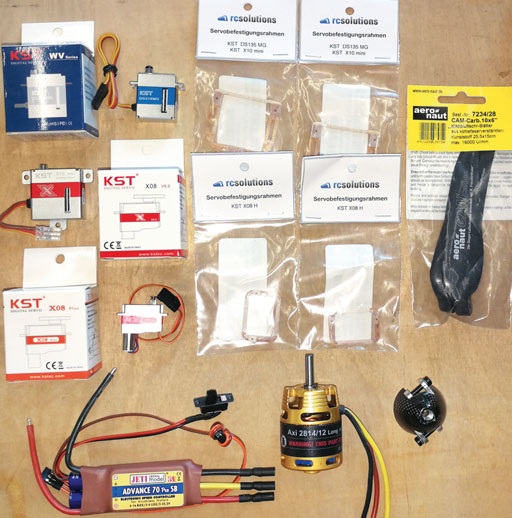
| H/S Servos: | KST DS213MG |
| Q/W Servos: | KST DS125MG |
| Motor: | AXI 2814/12 V2 Long Outrunner 1390 kV |
| Propeller: | CamCarbon 10×6 |
| Spinner: | Turbo Spinner Aluminum 34 mm Ø |
| ESC: | Jeti Advance Pro 70A SB HS |
| Battery: | Lipo 1600 mAh 3S |
| Receiver: | Jeti 7-Channel |
After a few days of building, I was able to complete the basic programming. First, I placed the model on the center-of-gravity scale. With the 1600-mAh/3S LiPo battery, the center of gravity (CG) was 92 mm from the leading edge of the wing. Since I didn’t have any reference settings, I adjusted the center of gravity and the control surfaces based on my intuition. I took the M24 V380 for its maiden flight on a beautiful, sunny day. The first takeoff went normally—I used engine power to gain altitude, adjusted the elevator trim a few clicks, and the M24 V380 was flying.
I immediately noticed that the center of gravity was off. So I climbed back to altitude and descended at a 45° angle. The model stabilized right away—the center of gravity was too far forward. In the large fuselage compartment, I was able to move the battery far enough back to achieve a center of gravity of 95.5 mm; now the model made a wide recovery arc and was properly balanced.
The built-in AXI motor is well-balanced and carries the model to altitude at a 45° angle. Flying becomes a real experience. When flying in circles, the M24 can be controlled very well with the rudder; the ailerons are only used to support the bank angle—simply brilliant... That’s how it should be. Flying over large areas is also a great pleasure; this is where the dynamics really come into their own. With the ailerons and elevator set approximately 2 mm up, the model flies in a dead straight line from the downwind area into the next thermal. Loops, turns, and fast flybys along the slope—this big guy handles it all, and I can imagine that next season, the M24 V380 will be used by some pilots in tough competition. Have fun with your M24 V380—maybe we’ll run into each other on a slope somewhere!


News from HEBU

TEAM MANAGER "THIS" BOSSHARD
 Rodito Nussbaumer

YOU KNOW WHAT I MEAN? 125 YEARS OF THE SWISS AERO CLUB
 Emil Giezendanner

HORIZON HOBBY/LEMACO NEWS: MICRO OV-10 BRONCO 645 MM BY E-FLITE

PRIDE AND GOOD IDEAS
 Markus Nussbaumer

34th HAHNENMOOS ALPINE MODEL AIRPLANE CAMP
Res Dauwalder
TRY-OUT DAY AT MFV WETTINGEN
Urs Keller
F3A EUROPEAN CHAMPIONSHIPS IN ST-MACAIRE, FRANCE
 Matthias Bosshard

52. 2026 ALPS CUP
Emil Giezendanner
ATOM, THE NEW DOUBLE-DECKER FROM CPLR
Matthias Bosshard
SUMMER FUN 2026 AT MG USTER
Martin Wunderli
What's New at Leomotion.com

THE PC-21 STORY
Emil Giezendanner
COUPE DES ALPES – OBSERVE AND LEARN
Rodito Nussbaumer
TWIN TOWN PARTNERSHIP
Wolfgang Voeller
BY YOUTH, FOR YOUTH
Lorena Betschen
CORSAIR F4U – A WARBIRD WITH A MEMORABLE LOOK
Jürgen Rosenberger, Jürgen Prinz
SMALL, MODEL-LIKE SAILBOATS
Res Dauwalder
WELCOME, NEW MEMBER!
Andrea Bolliger
FREE FLIGHT IN THE MIDDLE OF SUMMER
Urs Muntwyler
EURO CONTEST GLIDER ACRO TOUR AUSTRIA 2026

INSIGHTS INTO THE HISTORY OF SEAPLANES

NEWS FROM HEBU
 Julia Bucher

FROM 0 TO 100
Markus Nussbaumer
MEMORIES
Wolfgang Völler
NOS REGION – A HUB FOR ELECTRIC AVIATION
Emil Giezendanner
DO YOU KNOW WHAT I MEAN IN THE LAND OF SMILES?
Emil Giezendanner
Have you almost forgotten about aircraft that take off and land vertically?
Emil Giezendanner