
The F3K World Championship in Romania
Beni Reusser and Cedric Duss had the honor of representing Switzerland at the 2023 F3K World Championship in Romania.
Equipped with four Yodas and one Snipe2 each from Vladimir’s Model, we set out on our trip to Romania. We decided to travel by plane. The trip went smoothly, so we were able to spend Wednesday on-site shopping and getting settled. We even had enough time to use the hotel’s pool. Our flying field was located right in the middle of the local airfield. As a result, our first test flights weren’t possible until 4:00 p.m. With its varied terrain, the field promised an exciting World Championship. A preliminary competition was held before the World Championship, which we used to gain our first experience at the airfield and which also served as a dress rehearsal for the organizers.
So we started on Thursday morning with a short briefing, followed immediately by the preliminary competition. This will last two days. Twelve rounds are planned, with 69 pilots divided into five groups. Up to 14 models will be in the air at once.
The weather was hot and almost windless. The thermals had no clear center, which led to many collisions. We tried to stay out of the way, but my Yoda still got caught up in it. Both of us realized we were on a collision course and used the same evasion strategy, so we still ended up swapping nose strips in mid-air. Luckily, we were both able to finish the flight with a 1,000-point score each.
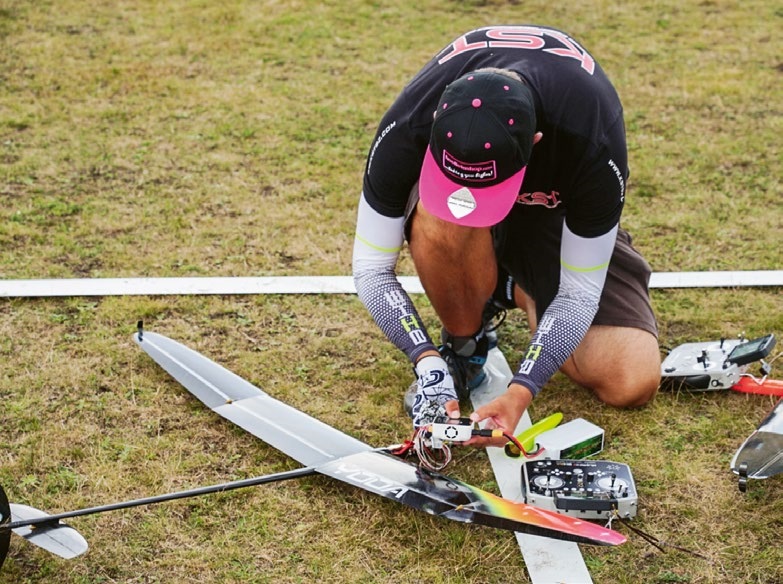
Since I only have the World Championship models, I had to repair this one again. I was able to use Rob’s Workshop for this. Our German neighbors, including Robert, had set up their own tent called “Rob’s Workshop” for repairs. It was perfectly equipped—he had absolutely everything with him! So I was able to get my model back in working order quickly. Rob was on hand throughout the entire World Championship to handle any repairs needed on all the juniors’ World Championship models! A big shout-out to Rob for his dedication!
After two grueling days, Henri Sander from Germany won the preliminary round with 10,997.5 points out of a possible 11,000. I was right on his heels, though, and managed to secure second place, trailing by just 1.9 points. Beni finished his first preliminary round in 50th place.
Now the World Championships are drawing closer. On Saturday, we had model processing scheduled for 12:00 p.m. Before that, we treated ourselves to a quick dip in the pool to cool off. Afterward, we drove to the field and completed the processing and registration. In the evening, the World Championships were officially opened with a small ceremony at the venue. A total of 22 nations, with 61 senior pilots—including two women—and 15 juniors, made the trip to Brasov.
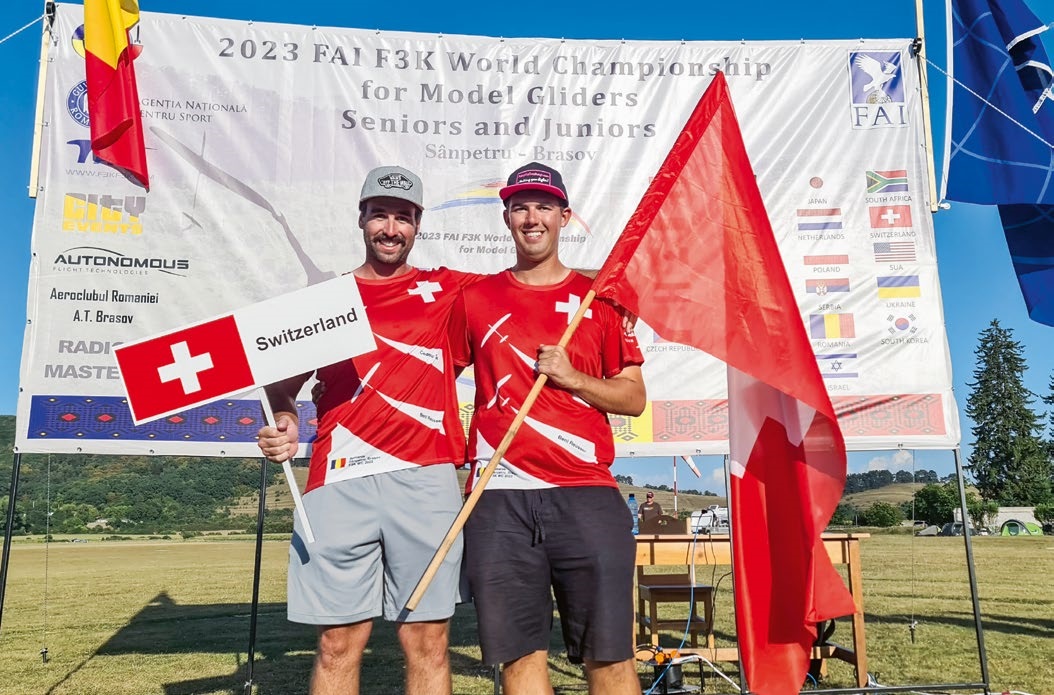
Before I had to go to the TM meeting, we took a team photo wearing our team shirts.
Over dinner, we analyzed the preliminary competition once more and went over our final thoughts for the World Championships. There are 18 preliminary rounds scheduled, spread over 4.5 days, so we’ll have a maximum of four rounds per day. The goal is to finish in the top 14 and thus qualify for the fly-off.
To achieve this, we’ll need to maintain a consistently high level of performance. The weather forecasts are also typical for a World Championship. The first two days were hot, with little wind—just like in the preliminary competition. On the infamous third day, however, the wind is expected to pick up. The rest of the forecast remains very uncertain and variable.
For us, this means we can’t afford to make any major mistakes on the first two days, because the World Championship doesn’t really get going until the third day. Many aren’t aware of this and are already flying at their limit from day one, so by the third day, their lack of concentration and consistency slowly becomes apparent. I, for one, am therefore trying to approach the preliminary round a bit more cautiously and only take risks when absolutely necessary. I’d rather have a flight that’s a few seconds too short than not make it back to the field within the allotted time. But enough theory—let’s see what the World Championships have in store.
On Sunday, we were able to start the World Championship right on time at 9:00 a.m.; conditions were very changeable. They varied completely from group to group. For us, the start of the World Championship went well. There was some unease among the other nations when the competition director informed all CX5-Pro pilots that the nose radius did not comply with the regulations. This had not been measured correctly in all cases during model processing. As a result, all CX5-Pro pilots had to adjust their noses.
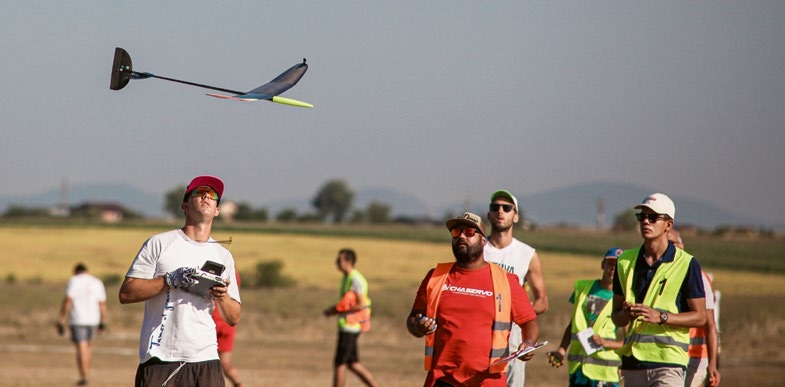
Day 2 of the World Championships wasn’t much different from the first. For me, it went off without a hitch. Beni lost a few points. But the World Championships are far from over. So let’s keep flying consistently!
Now the third day is already here, and the key is not to lose focus. As I’ve said before, the World Championships usually don’t really get going until now. According to the weather forecast, the wind was supposed to pick up around noon. Gusts of over 40 km/h were reported. I was up first in the morning’s first group. A few minutes before my run, the wind picked up significantly. This made the task much more challenging, and I had to give up a few points. Beni, like me, also struggled and had to give up a few points.
We’re almost there—the fourth day is just around the corner. Unfortunately, it turned out to be a wet day. The previous evening had already been marked by thunderstorms and heavy rain. A nearby lightning strike cut off our power, so the kitchen was left without heat. Luckily, we’d already stocked up on food.
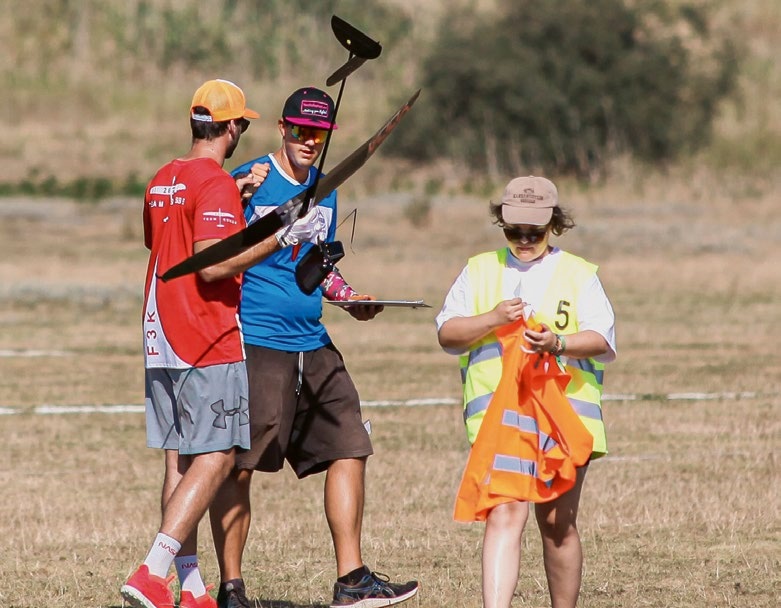
The view out the window that morning was more like looking into nothingness. There was thick fog, and visibility was no more than five meters. So we set out for the campsite a little later than planned. I had slept very poorly and didn’t feel well. I wasn’t the only one suffering; other participants also complained of feeling unwell.
By 1:00 p.m., there was still no improvement. So we spent half of the fourth day in the tent.
At 1:30 p.m., we finally set off again. For me, the half-day went by without any major setbacks. You could gradually sense Beni’s nerves getting the better of him, and unfortunately, he fell back a bit in the rankings.
The last two preliminary rounds are scheduled for tomorrow. To make sure I can hold onto my spot in the fly-off, I analyzed the standings again. My worst result is high enough that, in the worst-case scenario, I can include it in my score without being eliminated from the fly-off. This allowed me to approach the last two rounds with focus but without pressure. Whether I enter the fly-off in first or last place is irrelevant. The six fly-off rounds are what matter. So, after 17 preliminary rounds, I was in 2nd place and qualified for the fly-off.
For Beni, his first World Championship came to an end in 35th place after 17 rounds. This ranking is a remarkable achievement. A World Championship lasting 4.5 days and featuring all kinds of weather conditions should not be underestimated, both physically and mentally. So it was a fantastic performance by Beni! We didn’t have much time left, so we got started on the fly-off. The six fly-off tasks were drawn at random and promised an exciting fly-off, especially given the very unstable and rapidly changing weather. The first five rounds went surprisingly well, even though a rain front passed over us after two rounds. The wind also kept throwing us curveballs, suddenly picking up significantly out of nowhere.
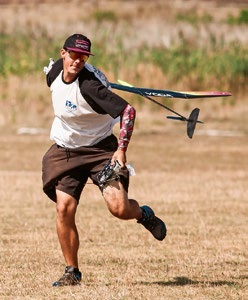
After five rounds, I was in 6th place. This wasn’t all that surprising, since I’d lost a total of 4.3 seconds. But everyone knew that the final round of poker could completely shake up the entire standings. The weather wasn’t stable enough to safely pull off a so-called “all-in”—that is, staying in the air for a full 15 minutes. So I saw my chance in a defensive tactic: setting my three freely chosen times high enough that I could reasonably be sure to meet them. In my case, those were 4 minutes, 4 minutes, and 3 minutes 18 seconds. Even though that only adds up to 11 minutes and 18 seconds, I’m very satisfied. Because I didn’t believe anyone would fill the full 15 minutes. However, I was proven wrong. Six pilots took the “all-in” risk, and Anthony Rotteleur from France actually pulled it off. With this incredible flight, he more than earned the world championship title.
My plan worked out very well, because all the other pilots ahead of me had taken too many risks and thus taken themselves out of the race. So my decision to fly defensively paid off, and I was able to finish the fly-off in second place. Third place went to Eitan Rotbart from Canada.
In the evening, the awards ceremony took place on the hangar forecourt. Fortunately, the rain didn’t start until right at the end of the ceremony. The banquet followed afterward. Unfortunately, it wasn’t organized very well. There wasn’t much space in the hangar, and the food arrived very late and in small portions.
Still, it was a nice way to wrap up this World Championship!
We used Friday to rest and pack our gear neatly and securely. In the evening, we drove to Brasov to grab dinner in the city. Saturday was the day of our return trip. So we boarded the plane again and flew back to Zurich. There, we were warmly welcomed by Stefan Fluck. Thank you so much for your shuttle service, Stefan! And with that, our World Championship adventure came to an end. One more amusing observation about the World Championships. The number 2 followed me very closely. 2nd place in the preliminary competition, 2nd place in the preliminary round, 2nd place in the fly-off—and all of that with pilot number 2.
I’d like to take this opportunity to thank everyone involved for their support. Special thanks to Beni Reusser, Ryan Höllein, and Klaus Schlömmer for their support on the field.
To the SMV for their organizational support, and also to my employer, the Army Logistics Center in Thun, for their flexible vacation scheduling and support. And, of course, to all the other sponsors, such as Vladimir’s Model, KST Digital Technology, and Der Himmlische Höllein.
Without all of you, a project like this would never have been possible! Thank you so much!
Izabella Krawczyk from Poland captured the World Championships for us with amazing photos. We don’t want to keep some of them from you, so we’re happy to present them here! Thank you so much, Iza!
We’re already looking forward to the 2025 World Championships in Berlin, Germany. The next season will reveal who gets to participate. We can’t wait!
And with that, we’re heading into the winter break. See you soon!


News from HEBU

HORIZON HOBBY/LEMACO NEWS: MICRO OV-10 BRONCO 645 MM BY E-FLITE

PRIDE AND GOOD IDEAS
 Markus Nussbaumer

TEAM MANAGER "THIS" BOSSHARD
 Rodito Nussbaumer

YOU KNOW WHAT I MEAN? 125 YEARS OF THE SWISS AERO CLUB
 Emil Giezendanner

F3A EUROPEAN CHAMPIONSHIPS IN ST-MACAIRE, FRANCE
 Matthias Bosshard

ATOM, THE NEW DOUBLE-DECKER FROM CPLR
Matthias Bosshard
SUMMER FUN 2026 AT MG USTER
Martin Wunderli
TRY-OUT DAY AT MFV WETTINGEN
Urs Keller
What's New at Leomotion.com

52. 2026 ALPS CUP
Emil Giezendanner
TWIN TOWN PARTNERSHIP
Wolfgang Voeller
34th HAHNENMOOS ALPINE MODEL AIRPLANE CAMP
Res Dauwalder
CORSAIR F4U – A WARBIRD WITH A MEMORABLE LOOK
Jürgen Rosenberger, Jürgen Prinz
SMALL, MODEL-LIKE SAILBOATS
Res Dauwalder
WELCOME, NEW MEMBER!
Andrea Bolliger
FREE FLIGHT IN THE MIDDLE OF SUMMER
Urs Muntwyler
COUPE DES ALPES – OBSERVE AND LEARN
Rodito Nussbaumer
EURO CONTEST GLIDER ACRO TOUR AUSTRIA 2026

BY YOUTH, FOR YOUTH
Lorena Betschen
INSIGHTS INTO THE HISTORY OF SEAPLANES

THE PC-21 STORY
Emil Giezendanner
NEWS FROM HEBU
 Julia Bucher

FROM 0 TO 100
Markus Nussbaumer
MEMORIES
Wolfgang Völler
NOS REGION – A HUB FOR ELECTRIC AVIATION
Emil Giezendanner
DO YOU KNOW WHAT I MEAN IN THE LAND OF SMILES?
Emil Giezendanner
Have you almost forgotten about aircraft that take off and land vertically?
Emil Giezendanner