
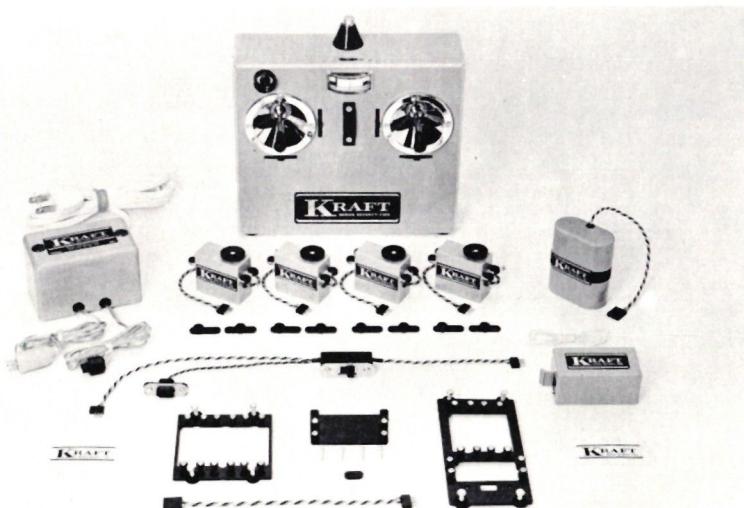
The Kraft RC System Series 72
Since the author was staying in the United States during 1971, he had an excellent opportunity to compare the quality of American RC systems. Assuming that it is hardly worth skimping on a remote control system, he was interested only in the recognized top-of-the-line models. Undoubtedly, this includes the Kraft brand, which had introduced the proportional control system that is now in widespread use.
Over the past few years, Kraft systems have reached such a high level of reliability that a revolutionary new development was hardly expected. This made the introduction of the 72 Series all the more striking; unlike previous series, it features the following characteristics:
1. Transmitter with a 3-stage RF section, ultra-linear control potentiometers, and a retractable antenna.
2. Servos with IC bridge amplifiers.
3. Double superheterodyne receiver.
4. Largely fail-safe battery with reduced charging time.
Regarding the transmitter, it complies with PTT regulations, which was achieved through the use of a 3-stage RF section and a transformer-based charger. The housing has been further reduced in size and equipped with a retractable antenna. The control potentiometers are a new development, featuring improved linearity and smoother operation.
The servos, available in four different sizes, now feature an IC bridge amplifier. Due to the polarity reversal circuit, the center tap on the battery is no longer necessary, making the servo much less sensitive to defective battery cells. This principle has become widely established in American RC systems, in stark contrast to Europe, where the Stone Age still prevails in this regard.
Kraft Systems is now, relatively late to the game, offering servos with IC bridge amplifier circuits for the first time. Phil Kraft explains this decision by noting that the types previously used by other manufacturers had certain shortcomings that made further development necessary.
The result of this development work is indeed astonishing: no fewer than 57 semiconductor elements are housed in the IC amplifier—roughly the same number previously found in an entire 5-channel system.
In terms of its functions, the circuit is divided into a reference pulse generator, an associated voltage stabilization stage, a bridge amplifier, and a pair of Schmitt trigger stages. The effect achieved through this effort is sensational, as the resolution exceeds ±1/4%, the response speed has been increased, and the control force is 2.5 kg! Within the range of possible operating temperatures, the deviation remains within the resolution. The force, which is roughly double that of earlier models, required the use of heavy-duty gearboxes, and the dramatically increased accuracy made it necessary to replace the wire-wound control potentiometers previously used in the transmitter with precision carbon-film potentiometers, since the servo is capable of resolving the individual wire windings step by step. The best part: No higher price compared to the 71 Series servos!
Another innovation was the introduction of a dual superheterodyne receiver for RC systems. Equipped with MOSFET transistors, it proved highly effective in areas where conventional systems failed, thanks to its immunity to image frequencies and harmonics. Furthermore, its resistance to temperature and voltage fluctuations far exceeds the norm. Whether the hefty premium is worth it, however, is up to the individual. In any case, according to Phil Kraft, the experience gathered over the course of about a year in the U.S. serves as an excellent endorsement for the Doppelsuper.
The nickel-cadmium battery has also been redesigned. In this new version, they are virtually insensitive to vibration and shock; furthermore, they can withstand higher pressure, which allows for a higher charging current and thus shorter charging times. The new battery is described as the key improvement in terms of the reliability of the entire system.
Early this year, three complete 6-channel systems—equipped with dual superheterodyne receivers and KPS-10 servos—were stolen directly from Phil’s “witch’s kitchen” in Vista and transported to Switzerland. Since then, we’ve logged quite a few flying hours with them; we’ve flown gliders, scale models, and RCMM models—both for fun and at regional and national championships. The only downside was that the transmitter suffered damage after being left unprotected in the pouring rain for an extended period during a competition. The water that got inside caused a short circuit that reversed the control inputs, which significantly shortened the landing approach. Once it had dried out, however, everything worked perfectly again.
Apart from this incident, the systems operated without any problems, even when other systems were reacting to external signals. The servos operate powerfully and with such precision that even the slightest trim adjustments take effect immediately. Their speed is a decisive advantage during 4-stroke rolls and spins as well as during landings in turbulent conditions. Anyone who was handed the transmitter was impressed by how much more precisely the models could be controlled.
Conclusion: Perfectionist Phil Kraft and his team have proven, through the development of the 72 Series, that the better is the enemy of the good.


News from HEBU

TEAM MANAGER "THIS" BOSSHARD
 Rodito Nussbaumer

YOU KNOW WHAT I MEAN? 125 YEARS OF THE SWISS AERO CLUB
 Emil Giezendanner

PRIDE AND GOOD IDEAS
 Markus Nussbaumer

ATOM, THE NEW DOUBLE-DECKER FROM CPLR
 Matthias Bosshard

SUMMER FUN 2026 AT MG USTER
Martin Wunderli
F3A EUROPEAN CHAMPIONSHIPS IN ST-MACAIRE, FRANCE
Matthias Bosshard
52. 2026 ALPS CUP
Emil Giezendanner
TWIN TOWN PARTNERSHIP
Wolfgang Voeller
CORSAIR F4U – A WARBIRD WITH A MEMORABLE LOOK
Jürgen Rosenberger, Jürgen Prinz
TRY-OUT DAY AT MFV WETTINGEN
Urs Keller
HORIZON HOBBY/LEMACO NEWS: MICRO OV-10 BRONCO 645 MM BY E-FLITE

EURO CONTEST GLIDER ACRO TOUR AUSTRIA 2026

BY YOUTH, FOR YOUTH
Lorena Betschen
INSIGHTS INTO THE HISTORY OF SEAPLANES

SMALL, MODEL-LIKE SAILBOATS
Res Dauwalder
What's New at Leomotion.com

COUPE DES ALPES – OBSERVE AND LEARN
Rodito Nussbaumer
34th HAHNENMOOS ALPINE MODEL AIRPLANE CAMP
Res Dauwalder
WELCOME, NEW MEMBER!
Andrea Bolliger
FREE FLIGHT IN THE MIDDLE OF SUMMER
Urs Muntwyler
THE PC-21 STORY
Emil Giezendanner
NEWS FROM HEBU
 Julia Bucher

FROM 0 TO 100
Markus Nussbaumer
MEMORIES
Wolfgang Völler
NOS REGION – A HUB FOR ELECTRIC AVIATION
Emil Giezendanner
Have you almost forgotten about aircraft that take off and land vertically?
Emil Giezendanner
DO YOU KNOW WHAT I MEAN IN THE LAND OF SMILES?
Emil Giezendanner