
RC Aerobatics (F3A) in Chesapeake, Virginia, USA
You may have already read about the most interesting results from this F3A World Championship in a short article in the November issue of Aero-Revue. The best pilots came out on top, and the field in the middle of the standings is large, with narrow point margins—where form on the day and luck play at least as big a role as skill and technique! The current format of top-level competitions in the aerobatics scene has outgrown the limitations imposed by its program. Finding new approaches is a must, both in the short and long term.
Diaries are of interest, at most, to participants and those directly involved; the same goes for rankings. However, trends, developments, and “highlights” can and should also appeal to and interest non-competitive model aviators, who—within the limits of their personal circumstances and individual skills—devote themselves no less passionately and tenaciously to their favorite hobby. This perspective—and the opportunity to share firsthand information—forms the basis of this article. Furthermore, I believe that you will be able to read diaries and analyses of successes and failures in other model aviation publications from German-speaking countries.
These syntheses—the interplay of technology, creativity, and engineering skill—are becoming increasingly perfect across the board. General prosperity—with money playing, at most, a minor and peripheral role—has greatly boosted the model-making industry’s drive for innovation. This statement holds true across the board and is evident at virtually every model airfield, in clubs, and at hobby shops. World Championships—both as competitions and with all their “side activities” (business, exchange of experiences, etc.)—are, of course, predestined to serve as barometers of trends. So what did this World Championship bring?
Four-stroke engines are slowly becoming mainstream; they are no longer just a “privilege” of a select few who were forced to use them by environmental regulations. Top pilots such as Wolfgang Matt, all the Japanese pilots, and others—as I’ve learned in conversations—now use four-stroke engines out of conviction. Among the finalists, one-third of the pilots—and half of the top ten—used four-stroke engines. In my view, this is a forward-looking development that should give a boost to technical progress in all power units as well as their individual components—and here I’m thinking primarily of sound-dampening accessories. This applies not only to the industry but also to every dedicated model airplane pilot. The clear favorite among the four-stroke engines used, with 90% of the field, is the “Yamada YS-120.” This engine not only features a powerful and reliable fuel pump but also a simple form of forced induction. This is not a turbo, Comprex, or G-charger as rumors claim, but rather a clever utilization of the pressure differentials that inevitably arise in the crankcase. In a future issue, as part of a technical article, I will attempt to explain a bit more about the principle and how it works
and to report on the design of this engine.
It would be presumptuous not to also mention the progress made in the development of two-stroke engines at this point. While these may seem somewhat less spectacular, they are by no means less efficient. For example, while the diameters of most propellers in use four years ago were in the range of 10″, they are now already in the range of 11½–12″. The rotational speeds have dropped from over 12,000 to under 11,000 rpm, and flight performance has by no means suffered as a result. This
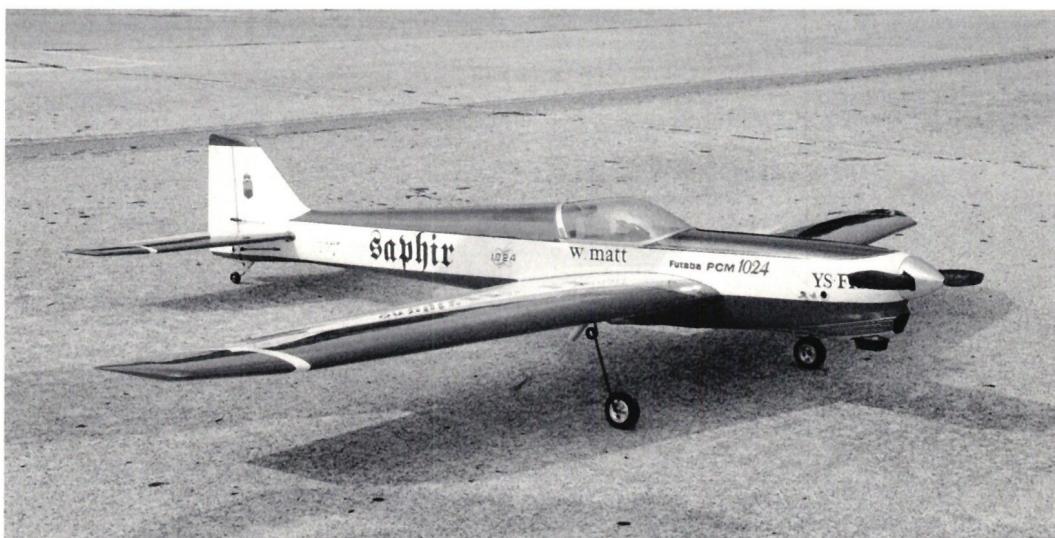
clearly shows that a great deal has been achieved here through refinements and improvements that aren’t necessarily obvious at first glance. Valve timing has been adjusted to achieve maximum torque at lower RPMs, and the engine geometry has generally been modified to feature a longer stroke than in so-called racing engines. It is actually incorrect to refer to these as long-stroke engines, since the ratios are practically square (with a stroke only slightly greater than the bore!). This observation in no way detracts from the success of the measures taken; it is merely intended to put the actual ratios into proper perspective.
Furthermore, manufacturers have also realized that the fuel supply problems caused by high acceleration forces can only be reliably solved using dependable pumps. No automaker—let alone an aircraft manufacturer—would ever think of relying solely on a carburetor’s “suction capacity” for fuel supply, not to mention performance-enhancing measures. Actually, one must (or should!) ask when circulating lubrication will be discovered for the four-stroke model engine. Technically, this is entirely feasible, as A. Köppel proved years ago. Just 1–2% oil additive in the fuel! Utopia or soon-to-be reality? I don’t know.
Back to reality! It is now finally a (proven) fact that power units with four-stroke engines are among the most reliable of all. Performance has not been a point of debate since the introduction of OS’s Surpass generation. This statement also applies without reservation to today’s generation of two-stroke engines used in aerobatics. However, the technical nature of power delivery will continue to spark occasionally heated discussions in both camps, where, unfortunately, emotions often run high, stifling any objectivity before it can take root.
The criticism implied in the previous sentence becomes clearer and, in part, substantiated in this section. As required by the regulations, sound level measurements were also conducted at this World Championship—for all drivers and before each heat. The measures taken
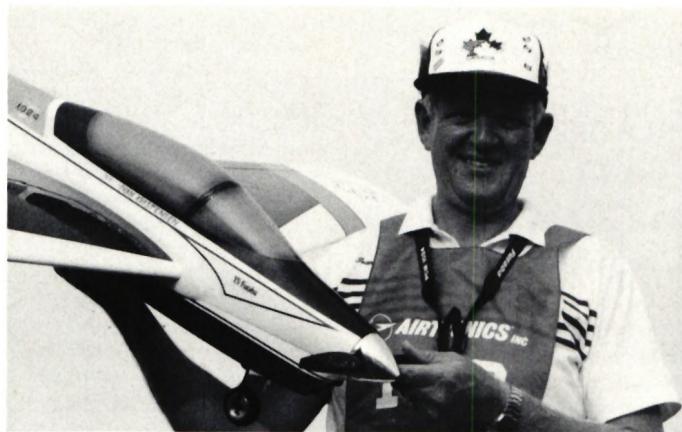
The organizer’s technical requirements, as well as the airfield and environmental conditions, made it possible to obtain reliable and therefore meaningful results. With the exception of one measurement (out of over 400 official measurements), all values were below the required limit. It is also encouraging that the majority of participants were measured well below the required maximum value, and levels 6 dB(A) quieter were by no means an exception or a rarity! This has once again impressively demonstrated that F3A pilots, even during casual weekend flying at our local model airfields, are among those who—to put it plainly—have “unlimited power with less noise” (lots of power, little noise!). It should not—and must not—be overlooked here that today’s high-performance four-stroke engines were consistently found in the upper range of the measured sound levels!
While the international bonus/penalty system for scoring “noise perception” by the judges did not bring either advantages or disadvantages to most pilots, it has at least spurred activity worldwide. As a result, vibration-dampening engine mounts have become standard across the board. For many of today’s common engine types, such engine flanges and mounts are commercially available—yet another typical example of how active competitive flying truly benefits everyone. It is well known that propellers account for a very large portion of noise emissions—and, depending on RPM, may even be the largest source. With the already lower RPMs and the use of high-quality propellers, this source of noise has also been brought under control. So it’s no surprise that, as far as the eye could see, all one could see were Asano propellers, and the GRP and CFRP propellers that appeared sporadically in between were mostly Asano copies! Of course, I am fully aware that these propellers are used not because of the expected noise reduction, but rather because of their high efficiency and excellent overall performance. The fact that they are available in any size (diameter and pitch)—for example, in ⅛- or even ¹/₁₆-inch increments—is another reason for their current status as the top choice. For the less experienced hobby pilot, for whom these propellers are far too expensive, I’d like to emphasize once again that it’s not the propeller brand that brings about a significant reduction in noise level, but rather lower propeller tip speeds (lower RPMs!).
Only computer-based control systems are used now, and the debates that took place just a short time ago about the merits or demerits of such systems have disappeared. The clear leader among the control systems in use was the Futaba PCM-1024, followed by JR. Looking at the newly released Futaba FC-28, anyone familiar with the international competition scene will recognize that this company has masterfully incorporated the improvements demanded by pilots. I am convinced that this transmitter will be a worldwide success.
In fact, only three models were able to break the uniformity of today’s F3A model scene: two biplanes and an American high-tech model with a gear-driven motor! The basic idea behind these developments is easy to see! The goal is to achieve speeds that are as consistent as possible in all phases of flight. This is, of course, particularly difficult during vertical descent. Tobias Schulz (Germany) and Tony Frackowiak (USA)—both of whom, incidentally, were finalists (finishing 13th and 9th, respectively)—attempted to meet this challenge by using a biplane, naturally designed specifically to meet the needs of F3A flight. It’s safe to say they both succeeded, and their models also provided a welcome change of pace. Whether biplanes will remain in use in the future remains to be seen, as—
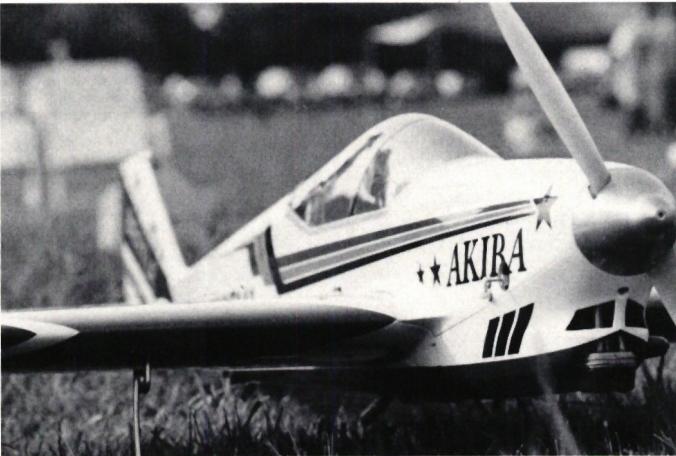
which, of course, comes with other flight-related difficulties and drawbacks. A renaissance of biplanes is certainly desirable, but large-scale aerobatics has shown us something different—not to say “better”—in recent years! Dean Koger’s (USA) approach to solving the problem described is not new, but it is technically excellent. A large propeller and a low RPM are intended to provide the necessary “braking effect.” To achieve this, he uses a Webra RS engine, which runs at approximately 16,000 revolutions per minute in this system. Using a simple timing belt, an intermediate shaft, and another double timing belt, he reduces the motor speed by a ratio of 1:2.25, which results in approximately 7,000 RPM on the propeller shaft. A custom-made 16x14.5" CFRP propeller is mounted on this shaft. To keep the motor running during rapid throttle reductions, an additional flywheel is mounted on the motor shaft. The entire powertrain weighs 1 kg and is fully integrated into the fuselage. Despite this, the aircraft weighs only 4 kg. Noise measurements on the ground show surprisingly low values of around 92 dB(A) according to FAI standards. In flight, however, the picture is somewhat different: on the one hand, there is a completely different type of noise; on the other hand, caused by the engine (high RPM) and the gearbox, there is an emission of unpleasant high frequencies that can be heard from a great distance and would drive affected residents at most airfields up the wall. This is a typical example of why noise emissions should not be assessed solely on the basis of sound pressure level.
To conclude this section, it should also be noted that Hanno Prettner’s EZ model (Supra Star) has become widely popular and should thus gradually prove the many critics and naysayers wrong regarding the purpose, validity, and quality of this type of aircraft.
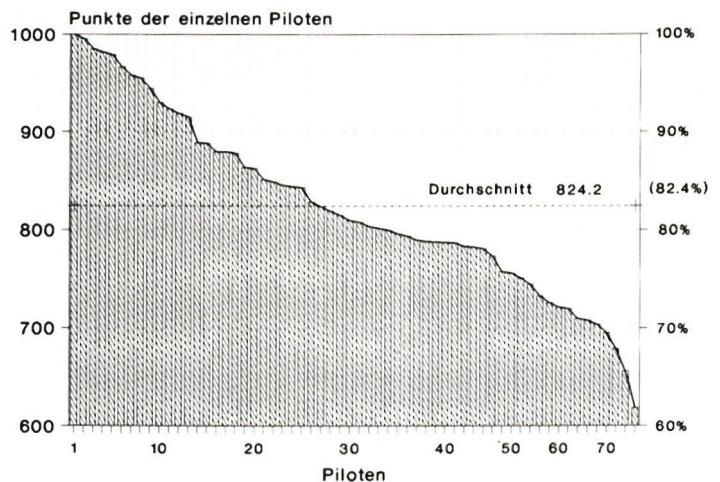
The flight program, which remained in effect through 1991, was introduced in 1988 (on a four-year cycle); while it was no longer new to pilots and judges, this was the first World Championship to use this flight program. Not only the equipment used, but also the pilots have achieved a high average level of flying skill. As the graph shows, the average score for the entire competition is over 82% of the maximum possible points. This figure clearly demonstrates that this program, like earlier ones, no longer guarantees a truly selective elimination process. The program is too simple, and the pilots’ individual training has become an unsatisfying routine exercise lacking personal challenge. The meeting of the CIAM F3A Committee held during the World Championship showed that this problem has been recognized and that solutions for improvements are being worked on. However, these will not take effect until 1992 at the earliest.
As already mentioned in the previous issue of this magazine, the organization of this World Cup left much to be desired. By comparison, the Netherlands, France, and Sweden performed significantly better. It’s likely that people simply expected too much from the U.S., the land of unlimited possibilities, even though its announcements and potential had actually raised high hopes. More than 20 teams from around the world arrived up to a week early to familiarize themselves with the geographical and meteorological conditions for flying. Nevertheless, the organizer made only two airfields available for training—airfields that were completely unsuitable, even dangerous, for RC aerobatics! I found this to be an affront to the participants, some of whom had traveled under conditions of great hardship. The response from the AMA president—when confronted about this shortcoming—that this was “common practice” falls into the same category. At times, additional training could be squeezed in at the official World Championship airfield, but due to the understandably high demand, this amounted to at most one flight per participant. The poor ad hoc organization of these training sessions then led to a total failure due to inadequate frequency coordination, even though this was handled by the AMA president himself. Whether this role was appropriately and sensibly filled by the president of the world’s largest model aviation organization—with over 150,000 members—is open to question. While the term “management” is certainly an American invention, there was little evidence of it in practice.
But now to the more interesting and encouraging facts! Once again, Hanno Prettner and Wolfgang Matt were able to demonstrate their leadership and class. Although Wolfgang Matt was still in third place in the standings after the four preliminary flights, he was able to hold his own in the final flights thanks to his steady nerves and calm demeanor, easily working his way up to second place overall. Heartfelt congratulations!
Hanno Prettner’s lead was never in doubt, as he scored the maximum 1,000 points in five of the seven rounds.
The Japanese team made a very strong impression, finishing in 5th through 7th place individually and taking second place in the team standings.
The German team was unable to maintain either its individual or team standings from previous years. Their favorite, Bertram Lossen, failed to score a 1,000 and consequently finished “only” in eighth place.
A total of 81 pilots from 30 nations participated. In this field, Switzerland did not fare too badly, finishing 11th in the team standings—ahead of countries such as the Netherlands, France, Ireland, and Spain.
The change introduced with the new Sporting Code (FAI regulations)—which now allows 20% of participants to advance to the finals, up from 10% previously—has proven to be a complete “flop.” The three final flights to be completed become boring and confusing; they lack the necessary excitement, and direct comparisons are nearly impossible. I know of no other sport that needlessly alienates its audience with such nonsense. I am well aware, however, that the FAI is unlikely to share my opinion. In this case, the FAI should not give in to pressure from the pilots—who, of course, want as many as possible to make it to the finals—but rather accommodate the wishes of the spectators.
Werner Burger
| Drivers (Rank) | Points |
|---|---|
| 1 | 1,000 |
| 10 | ~950 |
| 20 | ~900 |
| 30 | ~850 |
| 40 | ~820 |
| 50 | ~780 |
| 60 | ~720 |
| 70 | ~650 |
| 81 | ~600 |
Average: 824.2 (82.4%)


News from HEBU

HORIZON HOBBY/LEMACO NEWS: MICRO OV-10 BRONCO 645 MM BY E-FLITE

PRIDE AND GOOD IDEAS
 Markus Nussbaumer

TEAM MANAGER "THIS" BOSSHARD
 Rodito Nussbaumer

YOU KNOW WHAT I MEAN? 125 YEARS OF THE SWISS AERO CLUB
 Emil Giezendanner

F3A EUROPEAN CHAMPIONSHIPS IN ST-MACAIRE, FRANCE
 Matthias Bosshard

ATOM, THE NEW DOUBLE-DECKER FROM CPLR
Matthias Bosshard
SUMMER FUN 2026 AT MG USTER
Martin Wunderli
What's New at Leomotion.com

52. 2026 ALPS CUP
Emil Giezendanner
TWIN TOWN PARTNERSHIP
Wolfgang Voeller
34th HAHNENMOOS ALPINE MODEL AIRPLANE CAMP
Res Dauwalder
CORSAIR F4U – A WARBIRD WITH A MEMORABLE LOOK
Jürgen Rosenberger, Jürgen Prinz
SMALL, MODEL-LIKE SAILBOATS
Res Dauwalder
TRY-OUT DAY AT MFV WETTINGEN
Urs Keller
WELCOME, NEW MEMBER!
Andrea Bolliger
FREE FLIGHT IN THE MIDDLE OF SUMMER
Urs Muntwyler
COUPE DES ALPES – OBSERVE AND LEARN
Rodito Nussbaumer
EURO CONTEST GLIDER ACRO TOUR AUSTRIA 2026

BY YOUTH, FOR YOUTH
Lorena Betschen
INSIGHTS INTO THE HISTORY OF SEAPLANES

THE PC-21 STORY
Emil Giezendanner
NEWS FROM HEBU
 Julia Bucher

FROM 0 TO 100
Markus Nussbaumer
MEMORIES
Wolfgang Völler
NOS REGION – A HUB FOR ELECTRIC AVIATION
Emil Giezendanner
DO YOU KNOW WHAT I MEAN IN THE LAND OF SMILES?
Emil Giezendanner
Have you almost forgotten about aircraft that take off and land vertically?
Emil Giezendanner