
OS Wankel Engine
The OS Wankel Solves Noise and Vibration Problems
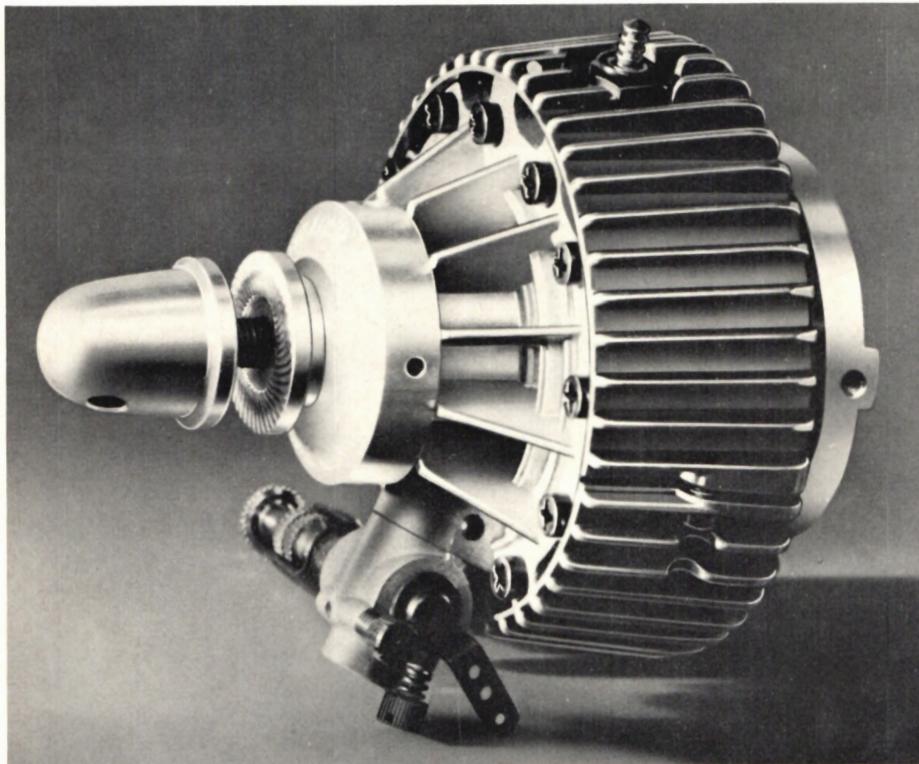
If you’re confident enough to make an appearance with an engine smaller than 10 cm³, if your servos have already suffered from engine vibrations, if loud engines are an abomination to you and your neighbor, and if, finally, you’re not averse to everything new from the outset, then you’re probably just like me. If it were cheaper, you would have given the OS Wankel engine a try long ago. Over the past two years, I’ve had several opportunities to gain my first experiences with the innovative OS-Wankel-Gaupner-Middle Stick flight system using a model selflessly loaned to me by Hans Waefler (also known for his long-distance flights in the tradition of Lindbergh) who selflessly lent it to me. My experiences were consistently positive; the system worked flawlessly, and the audience was impressed. Is the price—which has since been reduced but is still quite steep—justified? I believe so, because this engine cannot be compared to conventional reciprocating engines; it sets entirely new standards in terms of quiet operation, performance, and controllability. Achieving these goals required a great deal more engineering work than the further development of previous glow-ignition engines, and measured against this effort, the Wankel is still a bargain.
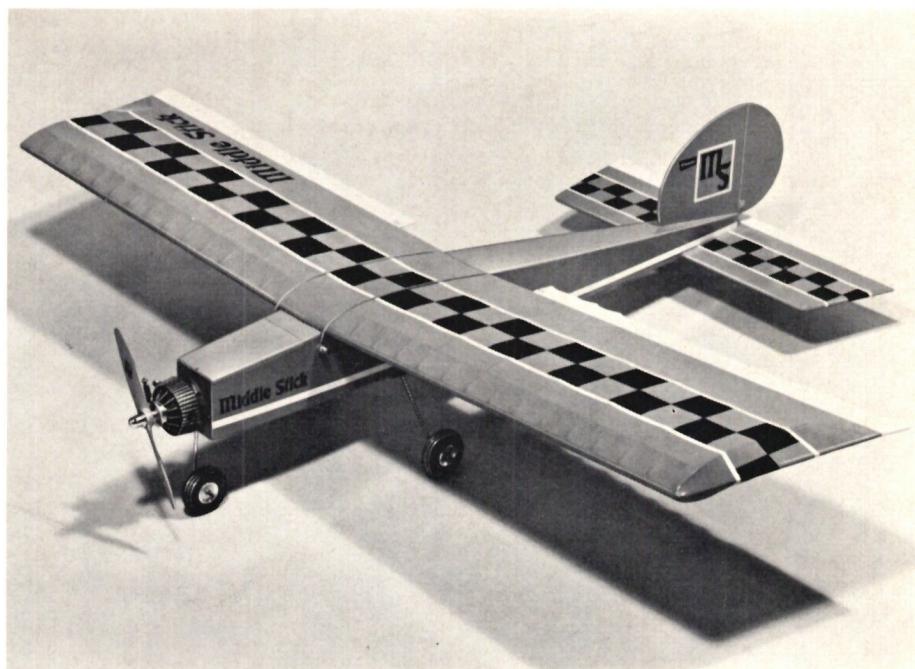
For the purpose of in-depth testing, we expressed to Graupner our desire to obtain such an engine, along with the Middle-Stick kit, at a slightly reduced price in order to publish a short report on it. This request was promptly and generously granted, and upon receiving the materials, work began immediately on assembling the model. Thanks to its simple, functional design and the detailed assembly instructions, the process presented no difficulties; the wood was of good quality and neatly pre-cut. For the sake of experimentation, a few modifications to the airframe were also planned. The V-shape of the wing was reduced by half; the ailerons and the trailing edges of the wings were fitted with Kavan plastic strips, which allow for an almost gap-free connection; the fuel tank was lowered, and the engine mounting ring was mounted on three rubber elements to reduce noise transmission to the airframe. High flight speeds were expected, which is why the wing was covered with a heavy-duty fabric.
Once assembly was complete and the paint had dried sufficiently, we headed straight to the airfield, where a final check was carried out. Once again, everything worked perfectly on the ground, so we filled the tank with the famous 10% fuel mixture. Then we quickly headed home again to retrieve the forgotten electric starter, without which things wouldn’t go well. Back at the airfield, we went through the usual procedures, and immediately the engine sputtered along a bit rich. By closing the jet needle, the engine reached about 1,500 RPM with a Nylon Super 9 x 5 propeller; then the throttle was reduced, and the idle was checked by raising and lowering the nose (of the model). Since there’s no adjustment screw, there’s nothing to adjust; it maintains 3,000 to 3,500 RPM flawlessly. Since it’s well known that you should let a new engine run in a bit, I played around with it a little and rolled it around on the ground for a few minutes. The spontaneous response to throttle input is unusual: emitting a cloud of smoke, the engine jumps from the lowest idle to maximum RPM almost instantly, causing the model to lurch forward.
After a few minutes, my patience ran out, and I refueled it. Now it took to the air for the first time—and did so like a rocket. The engine and model behaved as if they’d been in operation for a long time; no corrections were necessary. Overall impression: Exceptionally fast and agile, very quiet.
Since the author has already dealt with sound damping for model engines, it made sense to conduct corresponding investigations here as well. As a four-stroke engine, a Wankel engine is fairly insensitive to backpressure from the muffler. The original muffler is, after all, strikingly small. In this case, a SILEX auxiliary muffler was cobbled together and mounted under the fuselage. It was connected to the original muffler via a 13-cm-long section of rubber tubing (8 x 10 mm) secured with clamps. The test run yielded an extremely interesting result: astonishing noise reduction plus an increase in performance. The only sound clearly audible was the propeller noise radiating toward the propeller blades, which amplified into a siren-like sound when one’s fingers came too close. Comparative thrust and RPM measurements were then taken with and without the after-silencer, yielding the following values:
| Tachometer | Heathkit Thumb Tach |
| Thrust gauge | Angler Spring Scale |
| Fuel | CES-Super (10% nitromethane, 20% Castrol M) |
| Glow plug | Graupner 1606 (Wankel Special Spark Plug) |
| Propeller | Nylon Super 9 x 5 (balanced) |
| Exhaust silencer | SILEX with 8 x 10 mm inlet, 3 outlet tubes 4 x 5 x 15 mm |
| Temperature | 5° C |
The flights are performed using the Nylon Super 9 x 5. With this, the 2-kg model, after a short run-up, performs two vertical rolls (upward!) and flies very fast overall.
At this point, we can only speculate about its service life. In any case, no negative issues have been reported to date. Since the rotor reaches only 5,000–6,000 rpm, the stress on the parts remains very low. The sealing strips can, of course, be replaced. In terms of its design, the engine is generally more resistant to crashes than conventional engines. One potential issue is sealing strips that have become stuck together after a prolonged period of inactivity, which would make starting difficult due to insufficient compression. It is therefore recommended to add Glo-Life to the fuel, which prevents any carbon buildup. Dripping a few drops of engine oil into the engine after use certainly won’t hurt either. Over time, nitromethane produces some nitric acid, which can cause internal corrosion in any engine left unused for a long period unless it has been flushed out beforehand or at least well-oiled. Of course, the Graupner special glow plug should be used.
In summary: The OS Wankel is a very powerful and fast engine for its size, with absolutely reliable starting and throttling characteristics, ideal for models weighing between 2 and 3 kg. Its smooth operation is extremely gentle on the servos, and with minimal additional effort, an exceptionally low noise level can be achieved.
| Only with original SD | Original + additional SD | |
|---|---|---|
| RPM | 14,800 | 15,200 |
| Thrust kp | 1.65 | 1.75 |
| TF Super M 9 x 6 | TF Wood 10 x 5 | TF Power Prop 10 x 6 | Tornado 7 x 8, three-bladed | |
|---|---|---|---|---|
| RPM | 12,500 | 12,700 | 10,400 | 15,000 |
| Thrust (kp) | 1.6 | 1.75 | 1.5 | 1.0 |
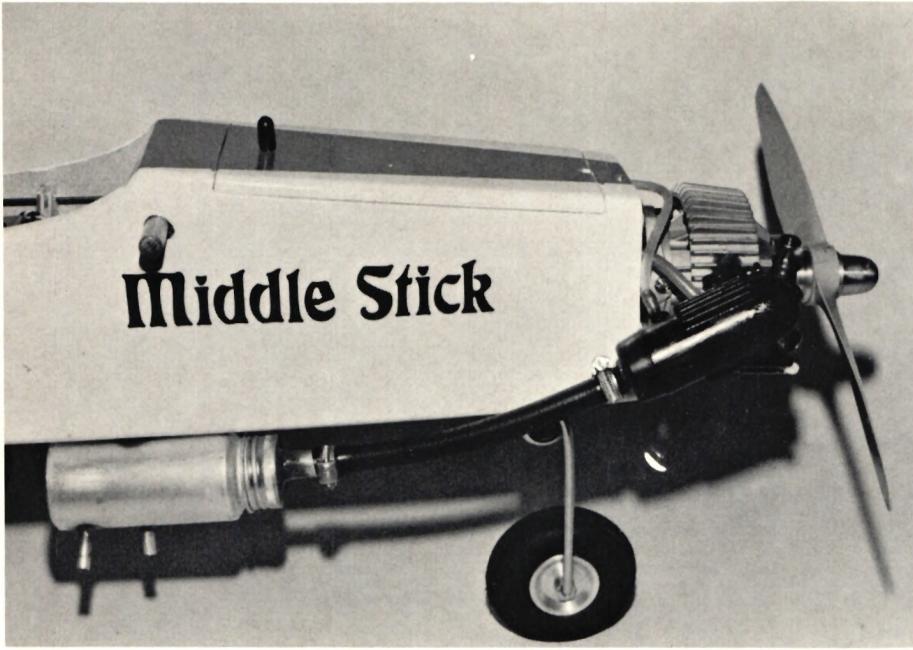
The auxiliary muffler, which can be built yourself using the simplest of materials, was described in detail in MFS 3/74. Complete kits are available at various specialty stores for a modest price.
As is well known, the editorial staff of MFS feels obligated, in the interest of preserving RC motor model aviation, to promote its operation with as little disruption as possible. With the development of the Wankel engine for model aircraft, a huge step forward has now been taken in addressing the noise problem; from this perspective, it is more than a shame that this engine is leading such a neglected existence, particularly in this country. Enquiries with model shops have now revealed that bulk orders qualify for an additional price reduction on top of the recently introduced 10% discount. As a service to its more or less voluntary subscribers, MFS is therefore offering to act as an intermediary and invites everyone to indicate their potential interest in purchasing a Wankel engine—without obligation—by sending a postcard to the MFS editorial office as soon as possible. Model shop owners are likewise encouraged to submit a corresponding offer to the editorial office. The editorial office will provide a SILEX auxiliary silencer kit with each engine. The response to this survey and the corresponding sources of supply will be reported in the next issue. H. St.


News from HEBU

TEAM MANAGER "THIS" BOSSHARD
 Rodito Nussbaumer

YOU KNOW WHAT I MEAN? 125 YEARS OF THE SWISS AERO CLUB
 Emil Giezendanner

ATOM, THE NEW DOUBLE-DECKER FROM CPLR
 Matthias Bosshard

SUMMER FUN 2026 AT MG USTER
Martin Wunderli
F3A EUROPEAN CHAMPIONSHIPS IN ST-MACAIRE, FRANCE
Matthias Bosshard
52. 2026 ALPS CUP
Emil Giezendanner
TWIN TOWN PARTNERSHIP
Wolfgang Voeller
PRIDE AND GOOD IDEAS
 Markus Nussbaumer

CORSAIR F4U – A WARBIRD WITH A MEMORABLE LOOK
Jürgen Rosenberger, Jürgen Prinz
TRY-OUT DAY AT MFV WETTINGEN
Urs Keller
HORIZON HOBBY/LEMACO NEWS: MICRO OV-10 BRONCO 645 MM BY E-FLITE

EURO CONTEST GLIDER ACRO TOUR AUSTRIA 2026

BY YOUTH, FOR YOUTH
Lorena Betschen
INSIGHTS INTO THE HISTORY OF SEAPLANES

SMALL, MODEL-LIKE SAILBOATS
Res Dauwalder
What's New at Leomotion.com

COUPE DES ALPES – OBSERVE AND LEARN
Rodito Nussbaumer
34th HAHNENMOOS ALPINE MODEL AIRPLANE CAMP
Res Dauwalder
WELCOME, NEW MEMBER!
Andrea Bolliger
FREE FLIGHT IN THE MIDDLE OF SUMMER
Urs Muntwyler
THE PC-21 STORY
Emil Giezendanner
NEWS FROM HEBU
 Julia Bucher

FROM 0 TO 100
Markus Nussbaumer
MEMORIES
Wolfgang Völler
NOS REGION – A HUB FOR ELECTRIC AVIATION
Emil Giezendanner
Have you almost forgotten about aircraft that take off and land vertically?
Emil Giezendanner
DO YOU KNOW WHAT I MEAN IN THE LAND OF SMILES?
Emil Giezendanner