
What is RC aerobatics?
In hardly any other competitive discipline is there as much confusion over terminology as in RC aerobatics. The term “F3A” is often used to refer to RC powered aerobatics in general. This does not correspond in any way to today’s reality, and we would do well to modernize our understanding somewhat in order to better distinguish between the various classes and avoid discriminating against any of them.
Of course, F3A is the oldest and arguably best-known RC aerobatics class. The first FAI World Championships were held as early as 1960 in Dübendorf. It was a sensation back then. Starting in 1963, what was then the only event featuring RC models was held every two years. Incidentally, this class has never been called “RC1” either in Switzerland or by the FAI. The 31st F3A World Championships will be held in Italy this summer. Around 100 participants are once again expected (currently 111).
The flying requirements are very high. Suitable sites must be available for regular training. The models are usually purchased ready-made or semi-assembled. Installing the power system and control system requires a great deal of experience. With a little luck, beginners may be able to find used models.
- Maximum wingspan: 2 m
- Maximum fuselage length: 2 m
- Maximum weight without fuel (internal combustion engine): 5 kg1)
- Preliminary Schedule P
- Final Schedule F (World Cup/European Championship semifinals and finals)
- 2 different Unknown Schedules (World and European Championship finals)
- Advanced Schedule A (easier program for national competitions)
- Programs change every 2 years
- Performance time: 8 min.
- The programs are performed within a “window” defined by angles.

One of the newer RC aerobatics classes. No championship status as of 2020.
- Scale model of a manned aerobatic aircraft
- Minimum wingspan: 2.1 m
- Minimum wingspan for biplanes: 1.8 m
- Maximum takeoff weight: 25 kg
- Well-known program
- 2 different unknown routines
- No set execution time, but the figure sequence must begin one minute after takeoff. The landing must occur no later than two minutes after the end of the sequence.
- Freestyle programs (4 min.)
- As with the known and unknown programs, the freestyle sequence should last 4 minutes.
- Flying takes place along an X-axis = main axis (parallel to the safety line and judges’ line) and a Y-axis (center line).
Note: The American large-scale aerobatics scene, IMAC, has developed largely independently of the FAI Class F3M and has successfully broken free from the “F3A stranglehold,” particularly in terms of flight space, 3D maneuvers, and displays. These new approaches have now been partially adopted by the FAI. It should not be overlooked that IMAC is also gaining increasing interest in Europe.
Aerobatics with large-scale models requires above-average technical and flying skills. For weight reasons, most of these models are made of wood and foil. Beautiful commercially available models made of GF/CFK are usually somewhat heavier, but this can be compensated for by the powerplant. Depending on the model’s size—typically 2.5 to 3 meters—the utmost attention must be paid to structural integrity and the forces involved, as the stresses during maneuvers are extremely high. Most models are equipped with internal combustion engines, whose high power output also results in significant noise and therefore places corresponding demands on training areas. However, modern engine technology, muffler systems, and suspension systems are bringing about remarkable improvements in this area as well. As is always the case, RPM and propeller diameter are crucial factors—and this applies equally to large electric motors. RPMs around 5,000 prove to be ideal. The transportation issue must be resolved from the very beginning.
The youngest class in the FAI Aerobatics World Championships. This year marked the 4th World Championship in Heraklion (as we reported in MFS 3-19). The field has made giant strides over the past 10 years. This applies not only to the models—whose weight has been reduced to about one-third or less during this time—but also to the flying itself. Models weighing less than 60 grams! Many competition pilots build their own marvels. An exceptionally challenging feat of craftsmanship.
- Maximum wingspan: 1.5 m
- Maximum fuselage length: 1.5 m
- Maximum weight, including battery: 300 g
- Preliminary Schedule for F3P-AP
- Final Schedule F3P-AF
- Performance time: 5 minutes
- Schedule F3P-AA: an easier program for national competitions
The precision of the maneuvers can be judged with near-centimeter accuracy in the small flying area and over the short distances to the pilot and the judge. This places the highest demands on piloting skills. Regular training in suitable indoor facilities—and thus easy access to such facilities—is essential. In addition, during training flights—and this applies to all aerobatics classes—hardly any other models can use the airspace.
This class has been held at World Championships as a supplementary event up until now. This year, it will be held as a World Championship for the first time.
- Like F3P
Anyone who thinks you can just show up at these competitions, watch around a bit, and play some music is sorely mistaken. In addition to the highest level of flying skill, a sense of harmony and rhythm is required. The maneuvers—based on your own imagination—must be executed cleanly. The music must match the maneuver—for example, smooth maneuvers don’t go with a “boom-boom” beat! In short: Freestyle is also a matter of character.
Aerobatics with jet models have been particularly spectacular and appealing to spectators since the dawn of the gas turbine era. To date, no FAI World Championships have been held in this class. The Jet Masters have, to some extent, anticipated this. However, the provisional F3S regulations allow for international and national championships. Unfortunately, this provision is rarely utilized—possibly due in part to the large flight areas required for gas turbine models.
- Drive: Turbine or electric impeller
- Maximum wingspan: 3,500 mm
- Maximum length: 3,500 mm
- Maximum takeoff weight: 25 kg
- Battery voltage for electric propulsion when uncharged: 72 volts
- Flight programs:
- F3S Basic
- F3S Preliminary
- F3S Final
- F3S Freestyle, criteria similar to F3P AFM
The level of competition among Switzerland’s top F3A pilots is very high. Three to four pilots are capable of finishing in the top ten at world championships. Another ten have what it takes to compete in the middle of the pack at major international competitions. In other words, the pool of top talent isn’t exactly abundant here either. To improve this situation, three experienced competitive pilots and World Championship participants—Wolfgang Matt, Emil Giezendanner, and Felix Andres—have joined forces to launch the Sport Class. As mentioned earlier, the Sport Class is not F3A, but it could serve as preparation for the competitive goals of becoming an F3A, F3M, or F3P pilot. The program was launched last year. The number of participants ranges from 5 to 10.
- No restrictions
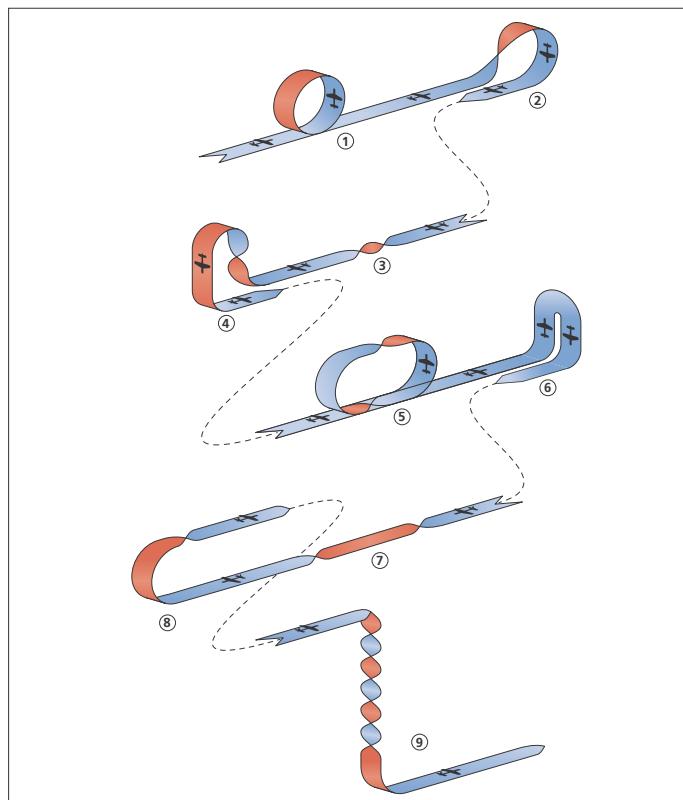
- Programs: simple turning figure program
The joy of aerobatics lies in learning to perform maneuvers that are as close as possible to the (geometrically) defined figures with your model. This requires practice, perseverance, and a bit of self-criticism. Initial experiences have shown that it’s not just flight coaching that’s a crucial factor for success, but also support with installing the propulsion and control components as well as adjusting the flight settings. There are significant gaps in this area. For these reasons, future programs for promoting junior pilots must also address technical knowledge of model aircraft. The effort required is considerable, but the work is rewarding. Good luck!
*Emil Giezendanner*
For the sake of simplicity, I have omitted some aerobatic classes. These include glider aerobatics, which is popular and appealing here, as well as the scale aerobatics competitions organized by the International Miniature Aerobatic Club (IMAC) of the American Model Flying Association and the F3A-X competitions organized by the DMFV.
And finally: On the weekend of September 6–7, the Coupe des Alpes—the 46th International F3A Friendship Flying Competition—will take place at the Pfäffikon airfield. Please mark your calendars.
1) Takeoff weight, including the power battery but excluding combustion fuel.


News from HEBU

TEAM MANAGER "THIS" BOSSHARD
 Rodito Nussbaumer

YOU KNOW WHAT I MEAN? 125 YEARS OF THE SWISS AERO CLUB
 Emil Giezendanner

HORIZON HOBBY/LEMACO NEWS: MICRO OV-10 BRONCO 645 MM BY E-FLITE

PRIDE AND GOOD IDEAS
 Markus Nussbaumer

34th HAHNENMOOS ALPINE MODEL AIRPLANE CAMP
Res Dauwalder
TRY-OUT DAY AT MFV WETTINGEN
Urs Keller
F3A EUROPEAN CHAMPIONSHIPS IN ST-MACAIRE, FRANCE
 Matthias Bosshard

52. 2026 ALPS CUP
Emil Giezendanner
ATOM, THE NEW DOUBLE-DECKER FROM CPLR
Matthias Bosshard
SUMMER FUN 2026 AT MG USTER
Martin Wunderli
What's New at Leomotion.com

COUPE DES ALPES – OBSERVE AND LEARN
Rodito Nussbaumer
TWIN TOWN PARTNERSHIP
Wolfgang Voeller
BY YOUTH, FOR YOUTH
Lorena Betschen
CORSAIR F4U – A WARBIRD WITH A MEMORABLE LOOK
Jürgen Rosenberger, Jürgen Prinz
SMALL, MODEL-LIKE SAILBOATS
Res Dauwalder
WELCOME, NEW MEMBER!
Andrea Bolliger
FREE FLIGHT IN THE MIDDLE OF SUMMER
Urs Muntwyler
EURO CONTEST GLIDER ACRO TOUR AUSTRIA 2026

INSIGHTS INTO THE HISTORY OF SEAPLANES

THE PC-21 STORY
Emil Giezendanner
NEWS FROM HEBU
 Julia Bucher

FROM 0 TO 100
Markus Nussbaumer
MEMORIES
Wolfgang Völler
NOS REGION – A HUB FOR ELECTRIC AVIATION
Emil Giezendanner
DO YOU KNOW WHAT I MEAN IN THE LAND OF SMILES?
Emil Giezendanner
A SPECTACULAR F3A WORLD CUP IN THE PRINCIPALITY OF LIECHTENSTEIN
Emil Giezendanner