
Swiss F4C Scale Championship in Alpnach
The Swiss F4C Championships took place at the military airfield in Alpnach. The championship was so popular that the registration window had to be closed on August 5 due to capacity constraints. Of the 40 registered pilots, 35 ultimately competed in the F4C (9), F4 Jet (8), F4 Heli Scale (7), and F4 Heli Semi Scale (11) categories. Five pilots had to cancel at the last minute because their aircraft were not ready in time or were damaged during practice.
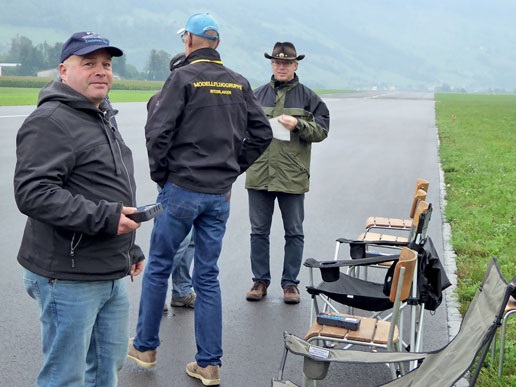
After the volunteers and pilots arrived and completed the mandatory registration on Saturday morning, anxious glances at the sky were just as frequent as checks of the various weather apps that were available.
But all the apps were more or less in agreement: the weather gods were running late with the dry weather we’d ordered, and rain and strong gusts of wind up to 45 km/h were forecast for the entire day. As a result, no
flying competitions take place on Saturday. The glider construction evaluation, however, began on time and proceeded without a hitch.
Prominent guests arrived at 10:00 a.m. at the invitation of the organizing committee for an informative reception: Major General Bernhard Müller (Chief of the Air Force), Colonel Werner Tarnutzer (Commander of Alpnach Airfield), Mr. C. Amstad (Member of the Cantonal Council and Landammann of Obwalden), Mr. G. Durrer (Deputy Chief of Police of Obwalden), Mr. M. Moser (Municipality of Alpnach), as well as
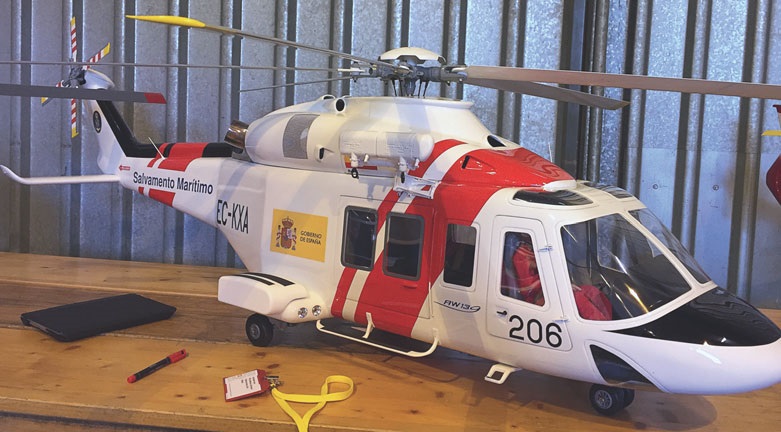
various sponsors. After expressing gratitude to the representatives of the Air Force and the Army Logistics Base for their excellent, long-standing support, as well as to the sponsors, attendees took a tour of the model aircraft exhibition, the “parking areas” for fixed-wing aircraft, and the helicopters. All participants were amazed by the number and level of detail of the models. We were also able to showcase various stages of construction—from the raw model to the finished super-scale model—to demonstrate the intensity
of this sport and its breadth.
Despite the bad weather, around 200 visitors made their way to the airfield and enjoyed the treats from the refreshment stand instead. Since all the models were easily accessible and clearly visible, it was still a highlight for the visitors because they could interact with the pilots in a very casual setting and had a wonderful view of the models.
The evening pilots’ dinner at a nearby restaurant was held under the motto: “Eat everything so we’ll have nice weather on Sunday.” But this wasn’t so easy, because the portions were already large, and a delicious dessert was also served.
That night, the organizing committee drew up a very, very tight flight schedule (10-minute intervals for fixed-wing models, 15-minute intervals for helicopters) and shortened the breaks to allow all participants two scoring flights, so that a championship could be decided in all categories.
Then, on Sunday, a ray of hope: At the 7:30 a.m. briefing, it wasn’t raining yet, and after consulting various
weather apps, it was decided together with the pilots to start the competition at 8:00 a.m. The judges supported the plan and were provided with coffee and croissants at the flight line to compensate for delays after a flight and to avoid breaks. All pilots were motivated and strictly adhered to the schedule, arriving at the launch site right on time with their engines and turbines running to minimize delays as much as possible. Right on time at 8:00 a.m., the dark blue “cloud” observed on the weather app passed very close to Obwalden, and it drizzled lightly for about 20 minutes. After that, the sky gradually cleared, temperatures rose, and it remained dry. As temperatures rose, more and more spectators began arriving at the airfield; the parking lot (taxiway) was already overflowing by 11:00 a.m., and by noon we had about 500 visitors on the airfield, who eagerly followed the competition and, during the lunch break, watched the demonstration flights by the aerobatic pilots and applauded enthusiastically. A heartfelt thank you to the Brü-
Marcel and Andi Hotz, as well as Daniel Gyr, for the fantastic demonstration of the “cold-air blowers”—that is, electric impeller jets. In terms of performance, they were on par with the “hot-air blowers.”
Thanks to the tight schedule and excellent teamwork, we were only 8 minutes behind schedule by 12:00 PM after 19 participants in the fixed-wing category; the helicopters were even 20 minutes ahead of schedule. This meant that all 35 pilots were able to complete their first flight in the morning. After lunch at 1:00 p.m., the electric models took off first (due to noise restrictions), while
the jet models took to the air at 2:00 p.m. Right on schedule at 4:15 p.m. (fixed-wing) and 4:25 p.m. (helicopter), the tightly organized competition was successfully concluded, and all pilots had completed their two scoring flights. We’d like to take this opportunity to once again extend a big thank you to the pilots for their great cooperation.
After the fixed-wing competition, there was some free flying on the main runway, and this opportunity brought a happy smile to the face of more than a few pilots after the strenuous and precise aerobatic flying.
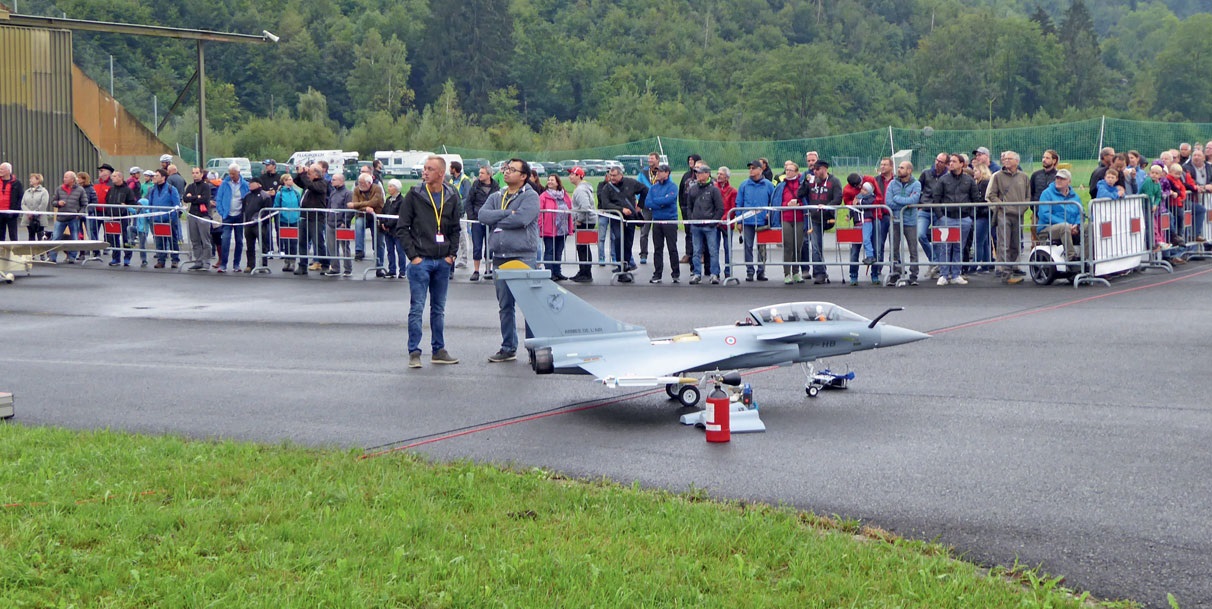
Around 1,000 visitors were welcomed at the airfield on Sunday. This was a fantastic turnout for the event, especially after Saturday’s bad weather. The event concluded without any incidents or accidents. Thanks to all the participating pilots who took “Safety First” seriously—and in one case even decided to abort a competition flight as a precaution, prioritizing safety. The feedback from visitors was consistently positive. The happy
and beaming faces of both the little ones and the “big” kids spoke volumes. The media coverage in newspapers and on television was also a great success and proof of this competition’s appeal.
In summary, it can be said that this was a fantastic event and great publicity for our sport. However, the logistical challenges of coordinating 35 pilots, the ever-larger models, and the
resulting need for ever-larger airspace, as well as the space required for the models on the ground, did, however, highlight the limitations of even a military airfield. The occasional regulatory incompatibilities also posed a particular challenge in planning the schedule.
A tip for future organizers: Take out separate transportation or property insurance through SMV/Allianz, since all items loaned by members and external individuals, such as
F4C: 1. Andreas Lüthi
2. Walter Gähwiler 3
. Gody Fischer
F4 Jet: 1. Andreas Schär
2. Adrian Senn
3. Walter Gähwiler
F4 Heli Scale:
1. Roland Kaufmann
2. Michael Tschiemer
3. Reto Marbach
F4 Semi-Scale Helicopter:
1. Josef Gisler
2. Michael Tschiemer
3. Jürgen Kleiner
Tents, screens, laptops, and other provided or borrowed equipment—as well as the club’s own equipment—are not insured and can therefore place a particularly heavy burden on the income statement.
Despite all this, we’d love to organize it again ☺. Until next time: See you in Alpnach.
*Rainer Beckerbauer*
You can find more information at www.mgow.ch/f4c.


News from HEBU

TEAM MANAGER "THIS" BOSSHARD
 Rodito Nussbaumer

YOU KNOW WHAT I MEAN? 125 YEARS OF THE SWISS AERO CLUB
 Emil Giezendanner

HORIZON HOBBY/LEMACO NEWS: MICRO OV-10 BRONCO 645 MM BY E-FLITE

PRIDE AND GOOD IDEAS
 Markus Nussbaumer

TRY-OUT DAY AT MFV WETTINGEN
Urs Keller
F3A EUROPEAN CHAMPIONSHIPS IN ST-MACAIRE, FRANCE
 Matthias Bosshard

52. 2026 ALPS CUP
Emil Giezendanner
ATOM, THE NEW DOUBLE-DECKER FROM CPLR
Matthias Bosshard
SUMMER FUN 2026 AT MG USTER
Martin Wunderli
What's New at Leomotion.com

COUPE DES ALPES – OBSERVE AND LEARN
Rodito Nussbaumer
TWIN TOWN PARTNERSHIP
Wolfgang Voeller
34th HAHNENMOOS ALPINE MODEL AIRPLANE CAMP
Res Dauwalder
CORSAIR F4U – A WARBIRD WITH A MEMORABLE LOOK
Jürgen Rosenberger, Jürgen Prinz
SMALL, MODEL-LIKE SAILBOATS
Res Dauwalder
WELCOME, NEW MEMBER!
Andrea Bolliger
FREE FLIGHT IN THE MIDDLE OF SUMMER
Urs Muntwyler
EURO CONTEST GLIDER ACRO TOUR AUSTRIA 2026

BY YOUTH, FOR YOUTH
Lorena Betschen
INSIGHTS INTO THE HISTORY OF SEAPLANES

THE PC-21 STORY
Emil Giezendanner
NEWS FROM HEBU
 Julia Bucher

FROM 0 TO 100
Markus Nussbaumer
MEMORIES
Wolfgang Völler
NOS REGION – A HUB FOR ELECTRIC AVIATION
Emil Giezendanner
DO YOU KNOW WHAT I MEAN IN THE LAND OF SMILES?
Emil Giezendanner
A SPECTACULAR F3A WORLD CUP IN THE PRINCIPALITY OF LIECHTENSTEIN
Emil Giezendanner