
MAC Scene · Large-Scale Aerobatics: “The Invitational TOC-2” in the U.S.
Whenever the term “TOC” comes up among model airplane enthusiasts, everyone always pricks up their ears. The TOC in Las Vegas has produced legends that are still the talk of the town among the older generation of model aircraft enthusiasts, even across national borders. This makes it all the more important to carry these memories into the future and build on them through today’s competitions. So, let’s start with the history:
The history of the legendary TOC, the “Tournament of Champions,” dates back to 1974. The founders—William Bennett, a casino owner, and John Schroeder, a model aircraft enthusiast—reached the pinnacle of their exclusive and prestigious competition in Las Vegas in the early 2000s. The world’s best pilots were invited to Las Vegas each year. The setting was not only glamorous but also featured the now IMAC-based aircraft with a wingspan of approximately
3 m wingspan, powered by two-cylinder or four-cylinder engines ranging from 150 ccm to 220 ccm, the competition reached a new level of flying excellence and, with prize money steadily increasing to as much as $200,000, was also highly attractive from a commercial standpoint.
Following the death of William Bennett in 2003, the TAS, or “Tucson Aerobatic Shootout,” was launched in Tucson, Arizona, as a successor event. Although the prize money has been significantly reduced, this contest—organized by Kevin Garland and David Johnson, owners of Desert Aircraft—is still regarded in the IMAC scene as
a worthy and successful successor to the TOC. As before, it is generally held every two years. Participation is considered an honor among pilots. In addition to the TAS, John Schroeder also hosts his own freestyle-focused invitational in Clo-
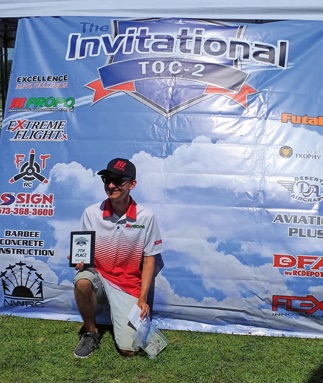
vercreek (Tennessee) periodically hosts these events on his beautiful farm. This, combined with annual summer camps for young people, has further revitalized the IMAC scene. Today's top pilots, such as Kal Reifsnyder, Rhett Lambert, JJ Hedrick, and others, have emerged from this scene in recent years.
Clovercreek has been a thing of the past since 2019, following the untimely death of John Schroeder and his wife Tina’s subsequent decision to relinquish his legacy. In addition to the TAS in Tucson, “The Invitational TOC-2” has now been launched in Fredericksburg, Virginia, on the East Coast. Under the leadership of Gil Major—who had already played a key role at Clovercreek—and Frank Noll, the charm of the
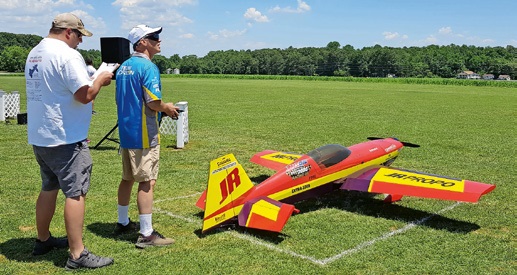
The paralyzing COVID period came to an end. At the beginning of June 2022, top pilots from the U.S. were joined—upon invitation—by elite pilots from Australia, Brazil, Israel, Italy, and, last but not least, Mel Nipkow from Switzerland for a gathering showcasing the highest level of aviation skill. Unfortunately, the Japanese were still unable to attend due to COVID-19 restrictions.
The competition program, serving as a qualifier for Sunday’s final day, included two known programs, one unknown program, and one freestyle program on each of the three preceding competition days. Unlike the usual IMAC rules, a requirement was that the dynamic flight programs and the freestyle program had to be completed using the same model aircraft. The only changes permitted between the two disciplines were to the propeller and the aircraft’s center of gravity by repositioning the batteries. As for the known programs, two were defined, naturally at the “Invitational Level”—which is considered one level higher than the standard Unlimited level. In the run-up to the contest, the central question in the community was which type of aircraft would be best suited for both dynamic and freestyle flying. In the months leading up to the contest, online forums were abuzz: Who would choose which model, and which American would lend a prized aircraft from his hangar to which foreign competitor, given the travel distances involved? There was also the question of which ARF models were even available on the market. This is because, as a matter of principle, classic IMAC models—that is, “kit-built” ones—are generally not used for freestyle...
flew—these models are simply too valuable. With one exception (Aaron “Bones” Garle of Australia, who flew a classic IMAC model [MX2 “kit-built” by JTEC]), virtually all pilots opted for ARF models with wingspans ranging from 2.60 m to 3.10 m, powered by engines ranging from 120-cc two-cylinder to 200-cc four-cylinder engines.
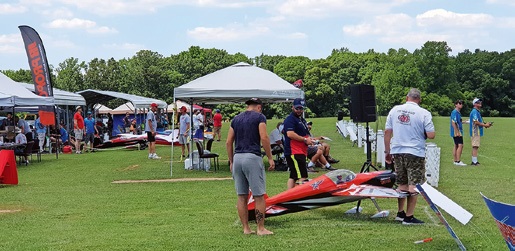
The welcome back to the international competition scene after a two-year hiatus was very warm. During the practice flights, the pilots—especially those flying aircraft borrowed at the last minute—had to build confidence and fine-tune their models. A challenge for all pilots was certainly the limited flight area and having to fly against the sun for the entire morning each day. For the first time, it was also possible to observe how the competition approached and executed the Messer flight maneuvers—which are extremely difficult in the vertical plane and must be flown in various variations—in terms of control techniques.
The pilots quickly adapted to the generally very challenging conditions. It was impressive to see how the pilots supported one another to keep improving throughout the competition—that’s just typical of the IMAC community. They helped each other troubleshoot minor technical issues and actively shared their flying experiences. As the qualifying rounds took place under beautiful weather conditions, the standings steadily solidified over the course of the three days. Things got really exciting for the seventh and final spot in the finals. And sure enough: at the very last minute, Mel Nipkow (Switzerland) secured a spot in the finals. →
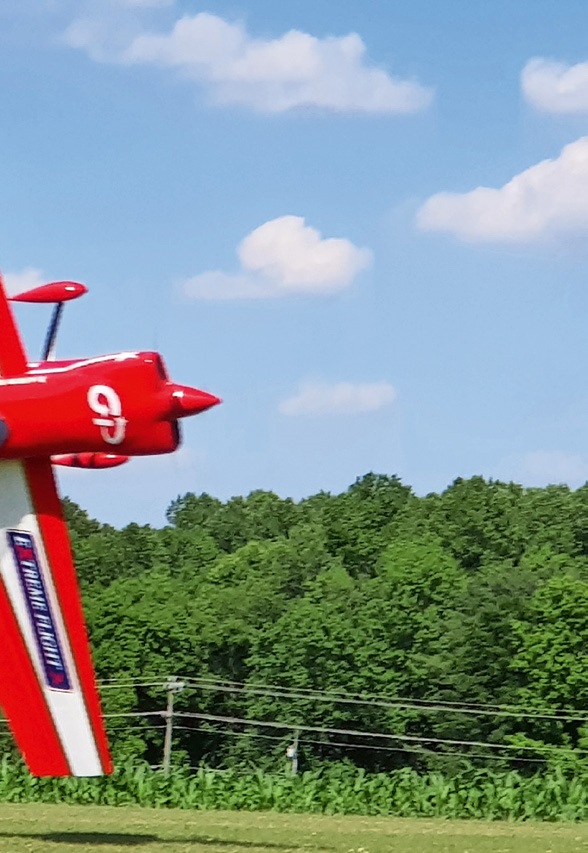
Once again, Mel demonstrated top efficiency and absolute competitive tenacity in the decisive moments. His training with the ExtremeFlight ARF model—an Extra 300 with a 3.20 m wingspan—borrowed from family friend Kim Quenette and equipped with his own JR servos and DA 200L motor, was a steady progression. In addition to getting to know the model, it was also important to consider that Mel had only one Unlimited competition “under his belt.” The preparatory training with the two Invitational programs
was correspondingly intensive; doubts had to be addressed, the equipment optimized, the model’s fine-tuning tested and adjusted, and flight tactics worked out. Occasional “relaxation flights” of astonishing quality with a 104" AJ Laser put the model choice to a serious test. In the end, common sense prevailed: It’s better to fly a model that you’ve come to know better and better through many training flights in all flight attitudes—including its weaknesses—than to embark on a last-minute adventure with an uncertain outcome.
On this basis, Mel achieved his major goal: reaching the final day in this proven world-class field. Once again, Mel understood how to compensate for his relatively modest training effort—compared to that of the competing pilots—with determination, a focus on the essentials, and ice-cold execution of his plans, thereby achieving his very personal, ambitious goal.
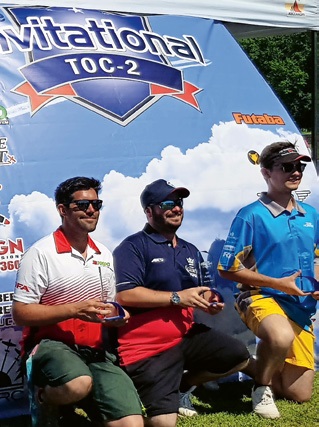
As the well-deserved winner of the TOC-2, Italian Sacha Cecconi took first place with an AJ Slick 2.60 m, powered by a DA 120, ahead of Californian Santiago Perez with an ExtremeFlight Slick 2.90 m, powered by a DA 200MG[!], and was thus able to stand alongside
They received great honor and a generous prize purse, which was distributed on a sliding scale to all finalists. It was impressive to see how the two pilots—who soon emerged as the favorites—pushed each other to new heights. Santiago shone with his spirited style, which was evident in the transitions and strikingly high speed of his dynamic routines, as well as in his spectacular freestyle performances. In contrast, Sascha shone with the finesse of his overall piloting skills, which was beautifully demonstrated by the precision in his dynamic routines and his very harmonious freestyle performances. The duel between Sascha and Santiago that unfolded in the end thus produced a European champion on American soil—something that Sascha Cecconi himself had long considered impossible!
Sacha Cecconi’s success is certainly a boon to the IMAC scene and shows that the European flying style is competitive with the American one. However, Gernot Bruckmann had already proven this in 2018 and 2019 with his victories at the TOC in Tucson. But because Gernot Bruckmann was such an exceptional case, people didn’t really want to acknowledge this.
It was good to see that the IMAC scene is alive and well. The TOC-2 is set to continue on a larger scale and at a more suitable flying site. In October 2022, the TAS will take place again in Tucson. In Europe, several major IMAC competitions were held during the current season. Plans for the first European Championship, scheduled for 2023 in Poland, are currently being finalized. And then another World Championship is set to follow.


News from HEBU

TEAM MANAGER "THIS" BOSSHARD
 Rodito Nussbaumer

YOU KNOW WHAT I MEAN? 125 YEARS OF THE SWISS AERO CLUB
 Emil Giezendanner

PRIDE AND GOOD IDEAS
 Markus Nussbaumer

ATOM, THE NEW DOUBLE-DECKER FROM CPLR
 Matthias Bosshard

SUMMER FUN 2026 AT MG USTER
Martin Wunderli
F3A EUROPEAN CHAMPIONSHIPS IN ST-MACAIRE, FRANCE
Matthias Bosshard
52. 2026 ALPS CUP
Emil Giezendanner
TWIN TOWN PARTNERSHIP
Wolfgang Voeller
CORSAIR F4U – A WARBIRD WITH A MEMORABLE LOOK
Jürgen Rosenberger, Jürgen Prinz
TRY-OUT DAY AT MFV WETTINGEN
Urs Keller
HORIZON HOBBY/LEMACO NEWS: MICRO OV-10 BRONCO 645 MM BY E-FLITE

EURO CONTEST GLIDER ACRO TOUR AUSTRIA 2026

BY YOUTH, FOR YOUTH
Lorena Betschen
INSIGHTS INTO THE HISTORY OF SEAPLANES

SMALL, MODEL-LIKE SAILBOATS
Res Dauwalder
What's New at Leomotion.com

COUPE DES ALPES – OBSERVE AND LEARN
Rodito Nussbaumer
34th HAHNENMOOS ALPINE MODEL AIRPLANE CAMP
Res Dauwalder
WELCOME, NEW MEMBER!
Andrea Bolliger
FREE FLIGHT IN THE MIDDLE OF SUMMER
Urs Muntwyler
THE PC-21 STORY
Emil Giezendanner
NEWS FROM HEBU
 Julia Bucher

FROM 0 TO 100
Markus Nussbaumer
MEMORIES
Wolfgang Völler
NOS REGION – A HUB FOR ELECTRIC AVIATION
Emil Giezendanner
Have you almost forgotten about aircraft that take off and land vertically?
Emil Giezendanner
DO YOU KNOW WHAT I MEAN IN THE LAND OF SMILES?
Emil Giezendanner