
Joy reigns at 256 km/h
Ronny Dünki
Since the V1200 was featured in one of the recent issues, I’d like to share my experiences with it. Since I fly with Futaba, I bought a “PNP” version—that is, one without a built-in receiver.
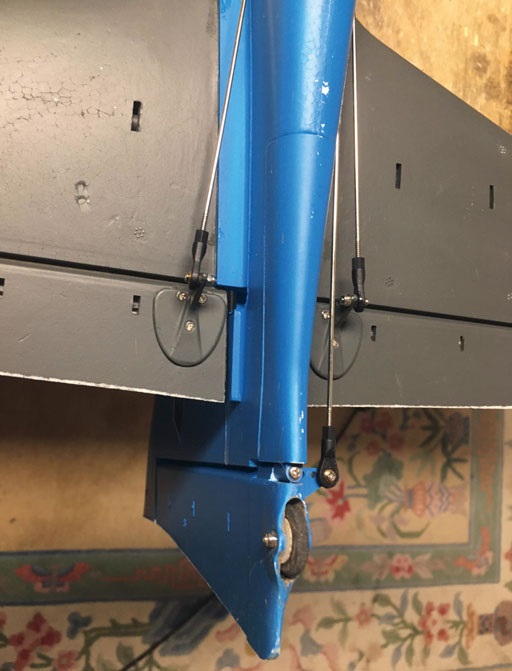
As is typical for E-flite, the kit is very well made and requires almost no work, except that you should sand down the “brows” on the wing edges. Screw on the wings, install the horizontal stabilizer and the elevator linkage—and you’re almost done. I recommend securing the horizontal stabilizer with a bit of ZAP. The retractable landing gear looks pretty delicate, but more on that later. One negative aspect that stood out was the heavy weight of the airframe—a full 2,000 g without the battery. Install the Futaba receiver, including the GPS module, and perform a function check. Although two aileron servos and two flap servos are installed, only one channel is needed for each, since they’re each connected with V-cables. I was worried that there would be endless tweaking, but that wasn’t the case, as everything was precisely preset at the factory. I connected the landing flaps to a three-position switch, reduced the servo speed slightly, and trimmed the elevation down by about 1 mm or 2 mm via the mixer to compensate.
All the cables coming from the built-in 100-A controller with a fan are only needed for telemetry in the BNF version with a Spektrum receiver. I used the specified control travel limits, but with 50% Expo on the ailerons and elevator and 25% on the rudder. The center of gravity setting proved to be correct during flight.
First, I had to take a few measurements to see what the ESC and motor were capable of. After all, I’d bought a speed model, not a “bedtime story”! With 4S, it sounded too sluggish to me, so I went straight to 5S. With the 10×8 APC propeller installed, this resulted in a current of 70 A at 13,500 rpm while stationary. Something like that can’t get very fast, so I installed a 10×10 APC propeller. This resulted in 88 A and 12,800 rpm, yielding a power draw of 1,600 W. Still, I wasn’t satisfied; after all, it’s got a 100-A ESC installed. But since I didn’t have a 6S battery, I tried connecting two 3S batteries in series to see what would happen. And lo and behold: With 6S, this resulted in a current of 120 A at 21 V and a speed of 15,000 rpm, which corresponds to an input power of 2.5 kW. Okay, a little more current than allowed, but “no risk, no fun”; I’ll know when it starts smoking.
The maiden flight was to be conducted using a 5S 4500 40C battery. This brought the model’s weight to nearly 2,600 g, resulting in a fairly high wing loading. In any case, a hand launch—as described in the instruction manual: “Launch using the handle”—is hardly feasible under these conditions. Since the model has a very long “nose” and the fuselage itself is short, I expect a pronounced pitch-up during takeoff. The landing gear is very close to the center of gravity, so the propeller could easily scrape the grass. Fortunately, we have an asphalt runway at MG Sulzer.
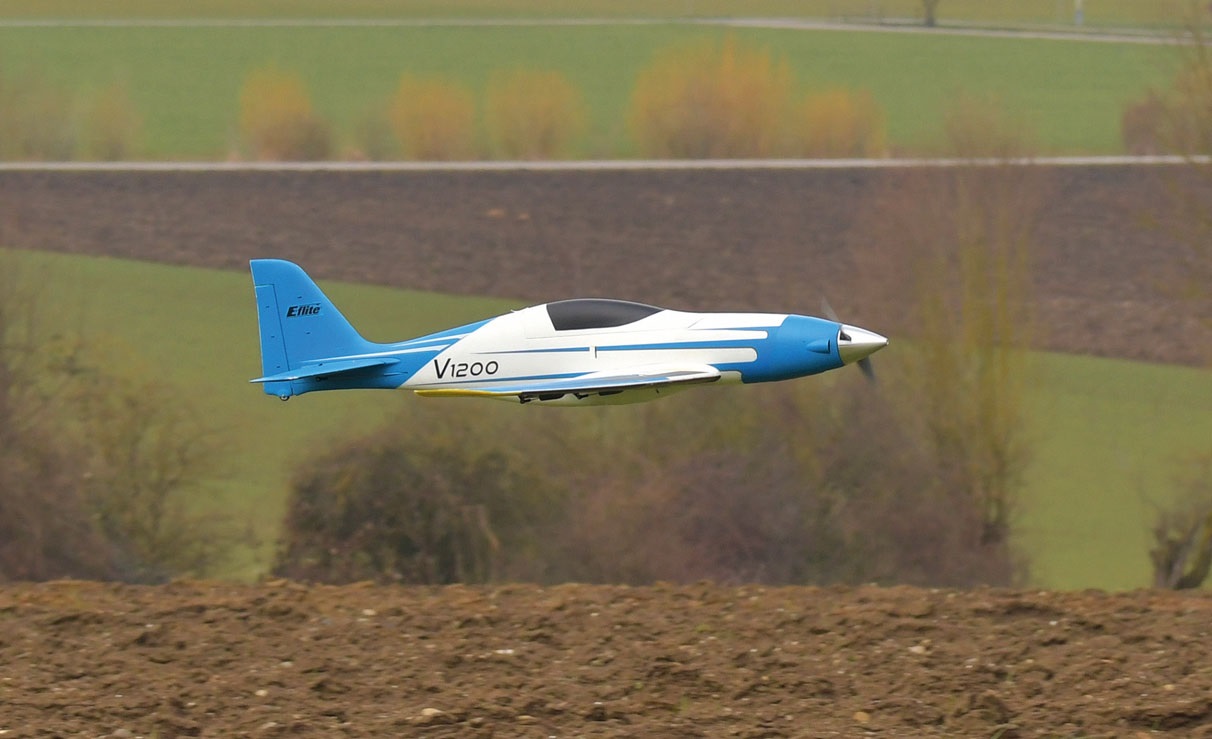
At takeoff, apply throttle slowly, as the model tends to veer off course immediately. It doesn’t take more than half throttle, and after just a few meters, the V1200 is in its element. What immediately stood out was that the model flies like a “board”—that is, it’s completely stable in the air; wonderful! A gyro would only get in the way here, not help; I also barely had to adjust the trim. Naturally, I wanted to know how fast the plane was, just in case it didn’t make it through its maiden flight unscathed. So I lined up for a run and did a loop at a height of 2 m above the runway. A respectable 212 km/h—not bad, but still not quite what I’d hoped for. I spent the rest of the flight time getting used to the handling characteristics and making a couple of simulated approaches.
For the landing, I extended the landing gear on the downwind leg and set the flaps to the first position, which caused a bit of ballooning. When turning in, I reduced throttle significantly, approached on a flat path, and fully extended the flaps during the final approach, then reduced throttle all the way to “idle.” I was going a little too fast, so I veered into the grass while rolling out, causing the V1200 to nose-dive immediately. Still, I was satisfied with the maiden flight and the landing. Only the landing gear didn’t take well to the grass and had to be carefully straightened out again. I conclude from this that the model is only suitable for hard-surface runways, unless you have a golf green on the field.
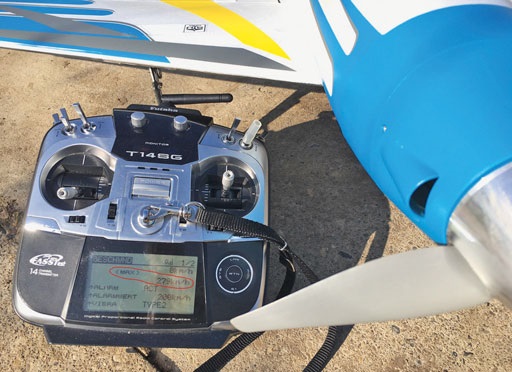
Now it was time to use the Leomotion 6S battery. For performance and weight reasons, I opted for a 6S 3300 mAh 70C battery weighing just under 500 g—slightly lighter than the 5S. On a beautiful, windless day after Christmas, the time had finally come. The takeoff went as described above—and be sure not to give too much throttle, or else the wings will stall. Then I took a run-up, with my colleague Ch.H. by my side to read the speed. You could tell just by the sound of the propeller that this was going to turn out exactly as I’d hoped. What a result: 256 km/h on the display—joy reigned! The landing was unspectacular on the asphalt, since you can approach quite slowly. The lowest voltage during flight was 20.4 V, and with the 3300-mAh battery, you can achieve a flight time of 3 minutes, with a remaining capacity of about 20%. By the end of February, I had logged over 25 flights, with the fastest—with a tailwind—reaching 279 km/h.
Although I’m not a fan of foam-body models—the V1200 is a beautifully designed and fantastic ready-to-fly model that has given me a lot of enjoyment so far. However, an experienced pilot should be at the controls. A hard-surface runway would be advantageous to ensure a fun experience rather than frustration. It would be nice if E-flite chose a more visible color scheme for the V1200, since white and blue aren’t very easy to spot in the sky. They should also take another look at the retractable landing gear and opt for a slightly sturdier version in future updates. ■
Ronny is a member of MG Sulzer


News from HEBU

TEAM MANAGER "THIS" BOSSHARD
 Rodito Nussbaumer

YOU KNOW WHAT I MEAN? 125 YEARS OF THE SWISS AERO CLUB
 Emil Giezendanner

F3A EUROPEAN CHAMPIONSHIPS IN ST-MACAIRE, FRANCE
 Matthias Bosshard

52. 2026 ALPS CUP
Emil Giezendanner
PRIDE AND GOOD IDEAS
 Markus Nussbaumer

ATOM, THE NEW DOUBLE-DECKER FROM CPLR
Matthias Bosshard
CORSAIR F4U – A WARBIRD WITH A MEMORABLE LOOK
Jürgen Rosenberger, Jürgen Prinz
SUMMER FUN 2026 AT MG USTER
Martin Wunderli
TRY-OUT DAY AT MFV WETTINGEN
Urs Keller
TWIN TOWN PARTNERSHIP
Wolfgang Voeller
BY YOUTH, FOR YOUTH
Lorena Betschen
SMALL, MODEL-LIKE SAILBOATS
Res Dauwalder
What's New at Leomotion.com

HORIZON HOBBY/LEMACO NEWS: MICRO OV-10 BRONCO 645 MM BY E-FLITE

COUPE DES ALPES – OBSERVE AND LEARN
Rodito Nussbaumer
EURO CONTEST GLIDER ACRO TOUR AUSTRIA 2026

INSIGHTS INTO THE HISTORY OF SEAPLANES

34th HAHNENMOOS ALPINE MODEL AIRPLANE CAMP
Res Dauwalder
WELCOME, NEW MEMBER!
Andrea Bolliger
FREE FLIGHT IN THE MIDDLE OF SUMMER
Urs Muntwyler
THE PC-21 STORY
Emil Giezendanner
NEWS FROM HEBU
 Julia Bucher

FROM 0 TO 100
Markus Nussbaumer
MEMORIES
Wolfgang Völler
NOS REGION – A HUB FOR ELECTRIC AVIATION
Emil Giezendanner
Have you almost forgotten about aircraft that take off and land vertically?
Emil Giezendanner
DO YOU KNOW WHAT I MEAN IN THE LAND OF SMILES?
Emil Giezendanner