
Elektro-max by Graupner
Construction and Flight Report
Upon closer inspection of the kit, one noticed how exceptionally well-equipped it was. Glue, Bowden cables, clips, wheels, etc., were all included in the kit.
| Wingspan approx. | 1,438 mm |
| Overall length approx. | 944 mm |
| Total surface area approx. | 32.45 dm² |
| Flight weight, depending on equipment, approx. | 1,750 g |
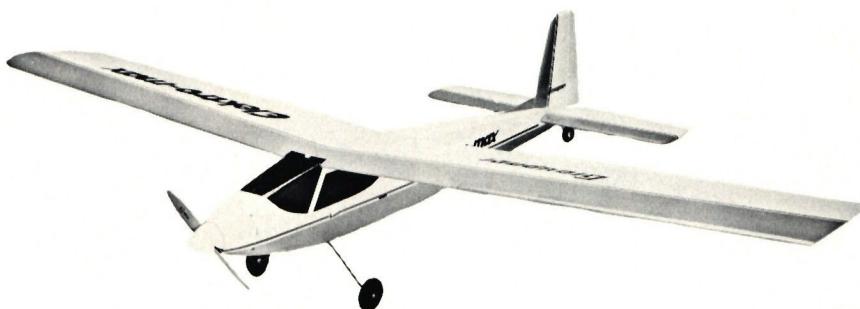
The balsa wood is of excellent quality, and all the cutouts are very cleanly executed. Of course, the pre-machined rib blocks are something truly special—they’re crafted with great precision. A clear blueprint and illustrated assembly instructions with an exploded view make the building process considerably easier.
Building the fuselage with its various reinforcements involves quite a bit of work and, in my opinion, is a bit too complicated when compared to other electric model fuselages. You have to work very precisely, especially with the one-sided removable cowl, otherwise it will never fit properly. I wasn’t really sold on the suggestion in the RC installation diagram to place the receiver on top of the drive batteries, so I cut a slot in the intermediate floor at the front of the fuselage for the receiver battery, allowing all the remote control components to be housed there. If you don’t want to mount the servos to the bottom, you absolutely must glue the servo board in place between the two fuselage halves and the frames when gluing them together, because you won’t be able to reach it afterward. The sockets for the nylon screws must be glued in straight; otherwise, the screws will jam or won’t grip at all.
According to the assembly instructions, the wing is supposed to be built on its back, which I didn’t like. So I simply built it on the lower skin instead. Wing assembly goes quite quickly, but it’s essential to build it without warping.
The fully symmetrical horizontal stabilizer, constructed with ribs, is fully covered and also presents no particular difficulties.
After sanding and priming, I covered my model with lightweight, colored paper.
First, the servos were installed and connected to the control surfaces. Now the motor could be screwed on (tighten them securely, otherwise the screws will come loose during flight). For the motor switch, I opted for a two-position switch. Next, the receiver, receiver battery, and motor switch were installed. The flight battery is then also placed inside the model. It is essential to secure these, as they could otherwise shift around in the high-capacity battery compartment during flight. I solved this problem by gluing two strips to the fuselage wall and sliding a strip of plywood underneath them.
The center of gravity must now be determined precisely. However, there is very little leeway for repositioning the RC components.
Since I don’t have a runway available for flying, I decided to omit the landing gear. My model weighed 1,650 g ready to fly with a 225-mA/h receiver battery—but without the landing gear.
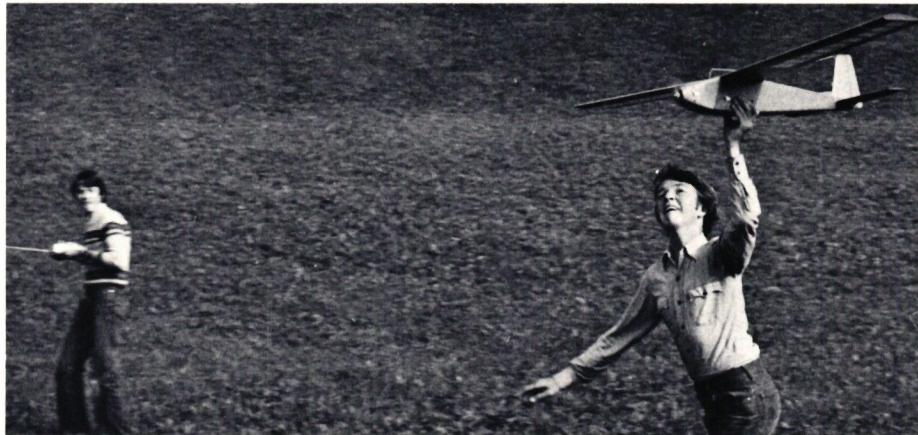
The first flight took place on a day with light winds. With the engine running at full throttle, the model was launched against the wind with a strong throw, sending it soaring. After the first few laps, I was surprised by its excellent climb rate. I then turned off the motor and was impressed by the good glide angle, though this requires flying at a fairly high speed. At slow speeds, however, the Elektro-Max becomes very temperamental, which is likely
is due to its rather thin airfoil. It then skids across the wing and immediately goes into a spin if you don’t react as quickly as possible. The model is extremely lively and agile and responds very well to the controls. When landing, you have to approach quickly, cut the power briefly, and touch down. After a few flights, you’ll have the model under control and can try out some aerobatic maneuvers. Loops, spins, inversions, and slip rolls can be flown quite well with a little practice.
With the Elektro-Max, model airplane enthusiasts get an agile, fast sport model that is sure to win over fans thanks to its low cost. However, it’s worth mentioning again here: this model is not easy to fly and can therefore only be recommended for more advanced pilots.


News from HEBU

TEAM MANAGER "THIS" BOSSHARD
 Rodito Nussbaumer

YOU KNOW WHAT I MEAN? 125 YEARS OF THE SWISS AERO CLUB
 Emil Giezendanner

ATOM, THE NEW DOUBLE-DECKER FROM CPLR
 Matthias Bosshard

SUMMER FUN 2026 AT MG USTER
Martin Wunderli
F3A EUROPEAN CHAMPIONSHIPS IN ST-MACAIRE, FRANCE
Matthias Bosshard
52. 2026 ALPS CUP
Emil Giezendanner
PRIDE AND GOOD IDEAS
 Markus Nussbaumer

CORSAIR F4U – A WARBIRD WITH A MEMORABLE LOOK
Jürgen Rosenberger, Jürgen Prinz
TRY-OUT DAY AT MFV WETTINGEN
Urs Keller
TWIN TOWN PARTNERSHIP
Wolfgang Voeller
EURO CONTEST GLIDER ACRO TOUR AUSTRIA 2026

BY YOUTH, FOR YOUTH
Lorena Betschen
INSIGHTS INTO THE HISTORY OF SEAPLANES

SMALL, MODEL-LIKE SAILBOATS
Res Dauwalder
What's New at Leomotion.com

HORIZON HOBBY/LEMACO NEWS: MICRO OV-10 BRONCO 645 MM BY E-FLITE

COUPE DES ALPES – OBSERVE AND LEARN
Rodito Nussbaumer
34th HAHNENMOOS ALPINE MODEL AIRPLANE CAMP
Res Dauwalder
WELCOME, NEW MEMBER!
Andrea Bolliger
FREE FLIGHT IN THE MIDDLE OF SUMMER
Urs Muntwyler
THE PC-21 STORY
Emil Giezendanner
NEWS FROM HEBU
 Julia Bucher

FROM 0 TO 100
Markus Nussbaumer
MEMORIES
Wolfgang Völler
NOS REGION – A HUB FOR ELECTRIC AVIATION
Emil Giezendanner
Have you almost forgotten about aircraft that take off and land vertically?
Emil Giezendanner
DO YOU KNOW WHAT I MEAN IN THE LAND OF SMILES?
Emil Giezendanner