
A smile on their lips
Completely unhurried and far removed from commercialism, this fall brought me a new experience in model aircraft building. For a long time, I thought that gliding was something only for absolute specialists with exclusive, secret knowledge—and that it could only be achieved using exotic materials. How else could it be possible to keep a model weighing only about 3 grams in the air for several minutes?
Okay, back in school, in the 1970s, we also used to build rubber-powered model cars. You could buy them in nicely printed paper bags at the toy store. The pre-cut balsa wood parts were printed on one side and just had to be assembled using plastic connectors. After a few days, however, the excitement faded; the flight performance wasn’t exactly thrilling, and what was offered back then in the colorful Graupner catalogs looked much more enticing. With a little more allowance, the little Uhu came within reach, and so the journey continued along the path of bigger, faster, better...
But 100 years before I took my first steps with toy airplanes, things were already quite different in France. In 1871, the Frenchman Alphonse Pénaud developed his Planophore. This was likely the prototype for all subsequent rubber-powered model airplanes. The model had a wingspan of about 45 cm, weighed only 16 grams, and flew remarkable distances of up to 60 meters. Pénaud took his own life at the age of just thirty. His ingenious ideas, however, live on to this day, even in “real” aviation. Even at the end of the 19th century, his Planophore models were still being sold in large quantities as toys. One of them is known to have ended up in the hands of a certain Wilbur Wright. The rest of the story is well known to anyone interested in the subject.
But back to the present. Christian Gugger has once again announced his model airplane building course this year. Thanks to a fortunate turn of events and the wonderful hospitality of MFG Balsthal, the course was able to take place at the workshop in Balsthal. Nine participants gathered for three exciting days of building and ended up with a flight-ready model in their hands! Christian sourced all the materials for us from Heinz Eder in Germany in kit form. All the materials fit into a modest cardboard box. No Styrofoam waste and no fancy glossy packaging. The most valuable aspect of this course was Christian’s expertise and his passion for sharing it with us. It’s not “rocket science,” but rather a wealth of experience—without which building such a model would cost a great deal in the form of trial and error (and time). The plans were already laid out on the prepared building boards and covered with adhesive tape along the glue lines to ensure the delicate parts wouldn’t stick to the surface. Secured with large nuts, the balsa wood parts could then be glued together. A single drop of UHU Hard diluted with acetone—in a 1:1 ratio—is all it takes, and the adhesive soaks into the wood beautifully. You might say, “I can do that much faster with superglue.”
That’s true, but if something goes wrong, the bond made using this method can easily be dissolved with a drop of acetone. Great! I’ll definitely use this method again in other projects.
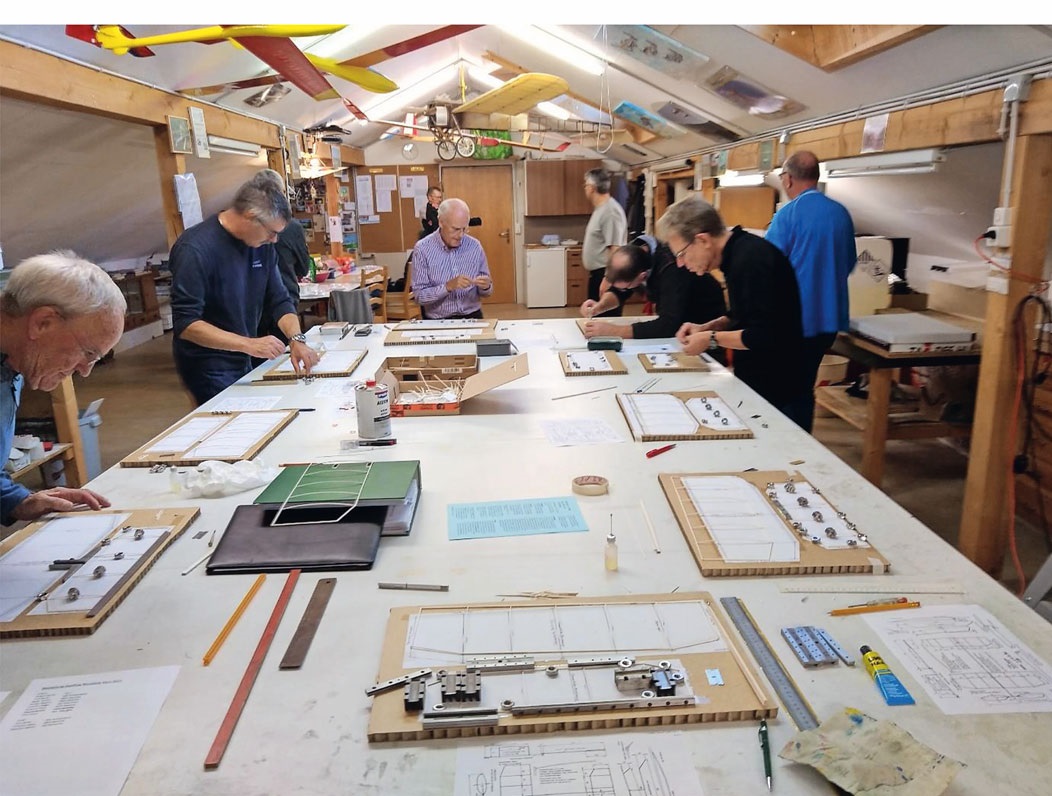
Of course, we were all curious to see how the Mylar film—which is only 0.9 µm thick—would be applied to the equally delicate frame. With the right technique, that worked surprisingly well, too. A subframe rubbed with lard is placed on top of the film spread out on a cotton cloth. This way, the film adheres to the frame but doesn’t stick to it. This allows for minor adjustments to be made by hand. The frame is given a homeopathic dose of spray adhesive and is then placed on the taut film. Using a hot soldering iron, the finished wing is then cut out of the film inside the subframe. This isn’t rocket science either, but watch out if you don’t apply the spray adhesive far enough away from the film. It took some effort to fold up the “wing ears.” Using a razor blade, I had to cut into the balsa parts all the way to the center and then snap off the rest. Once fixed in the correct position, a single drop of glue and a tiny bit of Japanese paper were enough to stiffen it. Now the covering didn’t look quite as wrinkle-free. Even though this wouldn’t have affected flight performance, Christian naturally had a solution ready. A tiny bit of thin wallpaper paste, delicately applied with a brush to the rib at the bend, made the wrinkles disappear as if by magic.
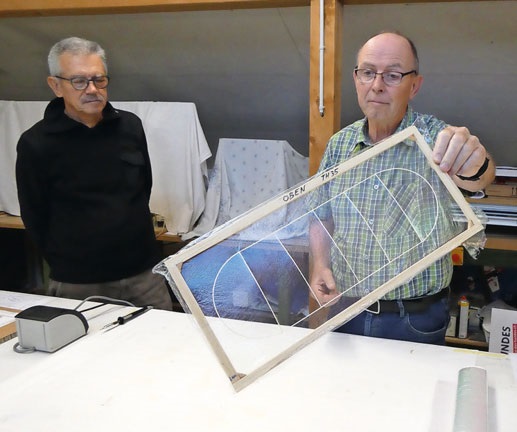
Then as now, the ingredients for success are perseverance, the belief that it will work, and the natural materials balsa wood and rubber. To this day, there are no more effective materials for this purpose—it’s amazing what nature produces. Incidentally, the F1M-L model built according to Bruno Wächter’s design has a wingspan of 46 cm—almost the same as the Planophore’s—and, at 62.5 cm, is only 11.5 cm longer than it. On the third day of building, the time had finally come: the models were ready to fly and were given a rough adjustment right there in the workshop. During lunch, which Brigitte and Reto Senoner served us, the anticipation—but also a certain tension—was clearly palpable.
In the afternoon, the tension gave way to immense joy as we saw that every model flew beautifully. And everyone had a smile on their face. That sense of satisfaction is indescribable and the greatest reward for all the work.
At this point, we’d like to once again extend a huge thank you to Christian Gugger, whose tremendous dedication opened the door to indoor flying for us, and to MFG Balsthal for hosting this unforgettable model-building course.
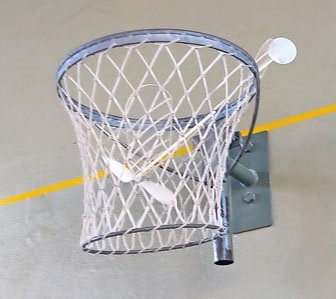
Even if this looks promising from the perspective of the athletes among us, the intended goal would be flights as long as possible...


News from HEBU

TEAM MANAGER "THIS" BOSSHARD
 Rodito Nussbaumer

YOU KNOW WHAT I MEAN? 125 YEARS OF THE SWISS AERO CLUB
 Emil Giezendanner

HORIZON HOBBY/LEMACO NEWS: MICRO OV-10 BRONCO 645 MM BY E-FLITE

PRIDE AND GOOD IDEAS
 Markus Nussbaumer

34th HAHNENMOOS ALPINE MODEL AIRPLANE CAMP
Res Dauwalder
TRY-OUT DAY AT MFV WETTINGEN
Urs Keller
F3A EUROPEAN CHAMPIONSHIPS IN ST-MACAIRE, FRANCE
 Matthias Bosshard

52. 2026 ALPS CUP
Emil Giezendanner
ATOM, THE NEW DOUBLE-DECKER FROM CPLR
Matthias Bosshard
SUMMER FUN 2026 AT MG USTER
Martin Wunderli
What's New at Leomotion.com

THE PC-21 STORY
Emil Giezendanner
COUPE DES ALPES – OBSERVE AND LEARN
Rodito Nussbaumer
TWIN TOWN PARTNERSHIP
Wolfgang Voeller
EURO CONTEST GLIDER ACRO TOUR AUSTRIA 2026

BY YOUTH, FOR YOUTH
Lorena Betschen
CORSAIR F4U – A WARBIRD WITH A MEMORABLE LOOK
Jürgen Rosenberger, Jürgen Prinz
SMALL, MODEL-LIKE SAILBOATS
Res Dauwalder
WELCOME, NEW MEMBER!
Andrea Bolliger
FREE FLIGHT IN THE MIDDLE OF SUMMER
Urs Muntwyler
INSIGHTS INTO THE HISTORY OF SEAPLANES

NEWS FROM HEBU
 Julia Bucher

FROM 0 TO 100
Markus Nussbaumer
MEMORIES
Wolfgang Völler
NOS REGION – A HUB FOR ELECTRIC AVIATION
Emil Giezendanner
DO YOU KNOW WHAT I MEAN IN THE LAND OF SMILES?
Emil Giezendanner
Have you almost forgotten about aircraft that take off and land vertically?
Emil Giezendanner