
4th International Militky Cup
The Pfäfikon Electric Aircraft Meet cannot take place on May 21–22, as originally planned, but must be moved up to Ascension Thursday, May 19.
The schedule is as follows: Thursday, May 19, 8:30 a.m.—Meet at the old Pfäffikon model airfield (near the Schützenhaus); (marked access routes from the village entrance).
- 9:00 a.m. 1st round, Cat. A: Electric aerobatics
10:15 a.m. 1st round, Cat. B: Electric gliding
11:45 a.m. 2nd round, Cat. A: Electric aerobatics
1:00 p.m. 2nd round Cat. B: Electric Gliding
2:30 p.m. 3rd round, Cat. A: Electric Aerobatics
3:45 p.m. 3rd round, Cat. B: Electric Gliding 5
:15 p.m. Approx. end of competition flights
6:30 p.m. Group dinner at Restaurant Krone, Pfäffikon (town center)
8:00 p.m. Announcement of results, presentation of trophies and commemorative gifts
8:30 p.m. Casual get-together
Friday, May 20: Return trip for international participants; possibly—if desired—a group recreational flight in the morning.
Those interested should request the event brochure with registration form from their club president or directly from:
Pfäffikon Model Flying Club Electric Flight Meeting
P.O. Box
8335 Hittnau
Definition
RC electric model aircraft may only be powered by electric motors. They must be controllable from the ground via a radio remote control. An engine shut-off device is mandatory.
Solar cells are permitted.
SpecificationsMax. wingspan: 5.0 m; max. weight
: 5.0 Kp; all
other specifications are unrestricted
Each competitor is allowed one false start. The competitor may repeat the launch up to a maximum of 10 seconds after handing over the model or after takeoff in the case of a ground launch.
The takeoff attempt must be repeated within 3 minutes.
The maximum flight time is 3 minutes. No scores are awarded for the maneuvers. Two officials evaluate each maneuver according to the following criteria: completed — partially completed — not completed. All maneuvers must be flown within a designated area. Maneuvers flown over the spectators are considered “not fulfilled.” Each maneuver must be announced loudly and clearly. The pilot has only one attempt per maneuver. The maneuvers must be flown in the prescribed order.
Figure Program
Partially Not | |||
1. Takeoff | 20 | 10 | 0 |
2. Twist (3 rotations) | 30 | 10 | 0 |
3. 2 looping spins | 30 | 20 | 0 |
4. Turn | 30 | 10 | 0 |
5. Slow roll (approx. 4 sec.) | 40 | 20 | 0 |
6. 2 pulled loops | 20 | 10 | 0 |
7. Four-point roll | 60 | 20 | 0 |
8. Combined Immelmann | 50 | 20 | 0 |
9. 3 horizontal rolls | 60 | 30 | 0 |
10. Inverted flight (approx. 5 sec.) | 20 | 10 | 0 |
11. Cuban Eight | 50 | 20 | 0 |
12. Rectangular Field | 30 | 10 | 0 |
13. Landing | 30 | 20 | 10 |
15 m | 30 m | except |
The model is launched by hand with the propeller stationary and flies over the start-finish line.
2. Climb (1 min.)As the model crosses the start-finish line, the engine is started, and the 60-second measurement period begins.
The engine must run for exactly 60 seconds. If the engine runs for longer than 60 seconds, the pilot receives 1 penalty point for each second over the limit.
Immediately following the 60 seconds of powered flight, there is a 3-minute gliding flight. During this time, the engine may only be started to slow down (reverse thrust), which must always be reported to the timekeeper in advance. The 180-second gliding flight period ends when the model crosses the start-finish line at a maximum altitude of 3 meters. Each second over or under this time results in a 1-point deduction. Maximum score: 180 points.
Note: During the landing approach (up to 10 seconds before crossing the start-finish line), the pilot may operate the engine for both braking and powered flight.
4. Distance Flight (3 min.)Timing for the 3-minute distance flight begins when the model flies over the start-finish line.
The model flies back and forth as many times as possible between the start-finish line and a turning line (distance: 150 meters). The motor may be turned on and off at will for this purpose. For every full 150 meters completed within the 3-minute time limit (until the pilot signals completion), the pilot receives 20 points.
The model now flies over the start-finish line with the propeller stationary at a maximum altitude of 3 meters. As the model crosses the line, the motor is turned on, and the 60-second measurement period begins. If the motor runs for longer than 60 seconds, the pilot receives 1 penalty point for each second. The model flies around a distance marker (350 m). If the model successfully completes this distance within the 60-second engine runtime (until the signal to stop is given), the pilot receives 100 points.
6. Endurance Flight (3 min.)Immediately afterward, the 3-minute gliding time begins. During this time, the engine may only be started to brake (reverse thrust), which must always be reported to the timekeeper in advance.
The 180-second gliding time ends when the model touches the ground. Each second over or under this time results in a 1-point deduction.
If the model cannot fly past the distance marker within the 60-second engine runtime—that is, if it does so only during the glide time—the pilot receives 40 points.
Note: During the approach (up to 10 seconds before touching down), the pilot may use the engine for both braking and powered flight.
7. Target Landing15-meter circle: 20 points
30-meter circle: 10 points
Outside: 5 points


News from HEBU

EURO CONTEST GLIDER ACRO TOUR AUSTRIA 2026

TEAM MANAGER "THIS" BOSSHARD
 Rodito Nussbaumer

YOU KNOW WHAT I MEAN? 125 YEARS OF THE SWISS AERO CLUB
 Emil Giezendanner

F3A EUROPEAN CHAMPIONSHIPS IN ST-MACAIRE, FRANCE
 Matthias Bosshard

HORIZON HOBBY/LEMACO NEWS: MICRO OV-10 BRONCO 645 MM BY E-FLITE

PRIDE AND GOOD IDEAS
 Markus Nussbaumer

BY YOUTH, FOR YOUTH
Lorena Betschen
34th HAHNENMOOS ALPINE MODEL AIRPLANE CAMP
Res Dauwalder
TRY-OUT DAY AT MFV WETTINGEN
Urs Keller
52. 2026 ALPS CUP
Emil Giezendanner
TWIN TOWN PARTNERSHIP
Wolfgang Voeller
ATOM, THE NEW DOUBLE-DECKER FROM CPLR
Matthias Bosshard
CORSAIR F4U – A WARBIRD WITH A MEMORABLE LOOK
Jürgen Rosenberger, Jürgen Prinz
SUMMER FUN 2026 AT MG USTER
Martin Wunderli
What's New at Leomotion.com

THE PC-21 STORY
Emil Giezendanner
COUPE DES ALPES – OBSERVE AND LEARN
Rodito Nussbaumer
SMALL, MODEL-LIKE SAILBOATS
Res Dauwalder
WELCOME, NEW MEMBER!
Andrea Bolliger
FREE FLIGHT IN THE MIDDLE OF SUMMER
Urs Muntwyler
INSIGHTS INTO THE HISTORY OF SEAPLANES

NEWS FROM HEBU
 Julia Bucher

FROM 0 TO 100
Markus Nussbaumer
MEMORIES
Wolfgang Völler
NOS REGION – A HUB FOR ELECTRIC AVIATION
Emil Giezendanner
DO YOU KNOW WHAT I MEAN IN THE LAND OF SMILES?
Emil Giezendanner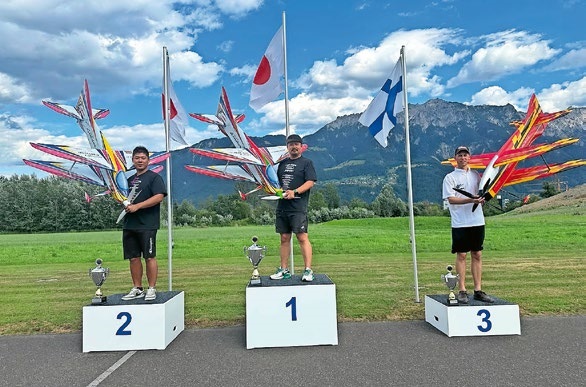
A SPECTACULAR F3A WORLD CUP IN THE PRINCIPALITY OF LIECHTENSTEIN
Emil Giezendanner