
The World of Indoor Flying
Winter has returned to our part of the world. The days have grown shorter, and the indoor season is in full swing. I thought it was time to share the experiences I’ve gained. What’s described here are my practical experiences. It’s meant to inspire and spark interest in exploring indoor flying in greater depth.
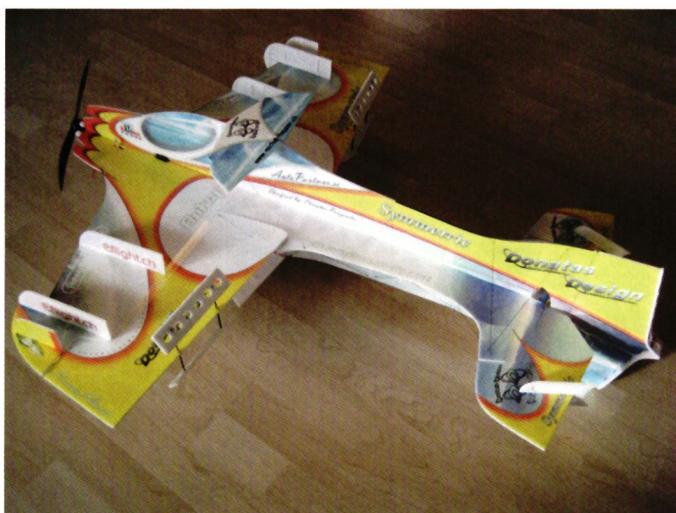
Over the past few years, one model has always been a staple for me: the Clik from RC-Factory. I’m still very happy with this plane and thrilled by its flight characteristics. But as they say, “the greatest enemy of the good is the better.” One day, I decided to start looking for a new indoor model. And lo and behold, the Symmetric from Donatas Design really caught my eye. As the model’s name suggests, its design is completely symmetrical. Both sides of the fuselage—above and below the wings—as well as the vertical stabilizer are exactly the same on both sides. Only the landing gear and the color scheme differ. It’s a very interesting concept with promising flight characteristics. And so I built this plane myself.
The model is constructed using the “classic cross-fuselage design.” The Depron parts included in the kit are supplied with the underside pre-cut. This allows for a very low takeoff weight without requiring time-consuming cutting work on the kit. The included parts and accessories are all in good condition and of high quality. The assembly instructions can be downloaded from www.eflight.ch under “Downloads.” They are really well-designed and well-illustrated.
Indoor models can generally be divided into two distinct groups. On the one hand, there are the agile 3D—or even 4D—aircraft with variable-pitch propellers, which are capable of reverse thrust. These typically require few, if any, add-ons, such as air brakes. Brakes, as described here, are not ideal—or can even be disruptive—on this type of model.
On the other hand, there are indoor models designed for precise, consistent flight of aerobatic maneuvers. The Symmetric, among others, falls into this category. For these models, such brakes are a way to keep the airspeed constant and low. A takeoff weight as low as possible is, of course, a prerequisite for achieving these flight characteristics. This allows aerobatic maneuvers to be flown cleanly and in a controlled manner.
Not all brakes are created equal. As is so often the case, there’s a downside to every advantage. The drawback of these attachments is that they remain effective even during climbs or when the control surfaces are fully extended. This is where the fascination of indoor flying truly comes into its own. There are no limits, and amazing things can be created with surprisingly few resources. Take, for example, the air brakes I’ve installed on my model.
Here I’ll describe the air brakes on my Symmetric. I mounted them on the ailerons in the outer third. This keeps them out of the propeller airflow, which is important for “torque rolls
.” I’ve tried to tailor these modifications to my flying style to get closer to the desired “constant speed.” The brakes aren’t included in the kit as-is.
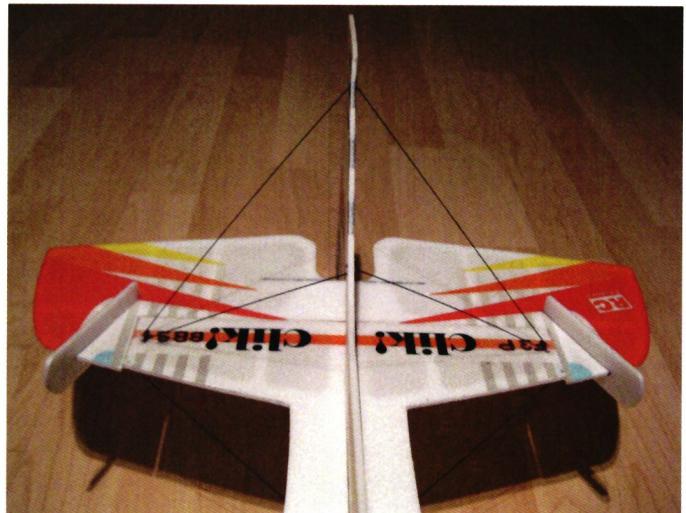
Figure 1 shows the configuration during straight-line flight. The attachments above and below the two ailerons provide their full braking effect. The braking effect decreases as the ailerons are extended, as shown in Figures 2 and 3—
| Wingspan: | 850 mm |
| Fuselage length: | 960 mm |
| Takeoff weight: | 121 g |
| Battery: | 2S Desire Power V8 XP 300 mAh 35C |
| Motor: | ePower 2202 / 1525U/V |
| Receiver: | 2.4 GHz R6004FF |
| Servo: | 3 Futaba FS31 servos |
| ESC: | ePower 7A |
clearly. When the aileron is fully extended, the braking effect is practically eliminated, since the Depron part faces the direction of travel.
Thus, the brake only engages when needed. If the
brakes are simply mounted at the end of the aileron, as is often seen, they will engage even when the aileron is fully extended. This can have a negative effect during roll maneuvers.
From air brakes to stabilizers. These components are designed to help guide the aircraft in flight. Their purpose is to ensure that the model flies smoothly and
remains easy to control. These components are mounted on the ailerons or elevator, among other places. They are also attached to the leading edge of the wings or along the top of the fuselage.
Here are a few possible variations. Figures 1 and 2 show the stabilizers on the Symmetric, and Figure 3 shows them on the Clik. The size and angle of attack of these stabilizers can be adjusted to achieve the desired effect based on individual needs. Their position also plays a role. In my search for the optimal setup, I cut out a few of these attachments. In the hangar, I first tested the model without any attachments. Then I gradually “attached” the prepared attachments in various locations. This allows the entire setup to be fine-tuned.
Indoor flying is a relatively new branch of model aviation. Nevertheless, it has now carved out a solid place for itself in the world of model aviation. The possibilities for trying out new things and contributing your own ideas are virtually limitless. You can achieve a lot with relatively little effort. So let’s get to it. At this point, a heartfelt thank you for the kind support from www.eflight.ch.
Good luck and best regards: Michel Hauser


News from HEBU

TEAM MANAGER "THIS" BOSSHARD
 Rodito Nussbaumer

YOU KNOW WHAT I MEAN? 125 YEARS OF THE SWISS AERO CLUB
 Emil Giezendanner

HORIZON HOBBY/LEMACO NEWS: MICRO OV-10 BRONCO 645 MM BY E-FLITE

PRIDE AND GOOD IDEAS
 Markus Nussbaumer

34th HAHNENMOOS ALPINE MODEL AIRPLANE CAMP
Res Dauwalder
TRY-OUT DAY AT MFV WETTINGEN
Urs Keller
F3A EUROPEAN CHAMPIONSHIPS IN ST-MACAIRE, FRANCE
 Matthias Bosshard

52. 2026 ALPS CUP
Emil Giezendanner
ATOM, THE NEW DOUBLE-DECKER FROM CPLR
Matthias Bosshard
SUMMER FUN 2026 AT MG USTER
Martin Wunderli
What's New at Leomotion.com

THE PC-21 STORY
Emil Giezendanner
COUPE DES ALPES – OBSERVE AND LEARN
Rodito Nussbaumer
TWIN TOWN PARTNERSHIP
Wolfgang Voeller
EURO CONTEST GLIDER ACRO TOUR AUSTRIA 2026

BY YOUTH, FOR YOUTH
Lorena Betschen
CORSAIR F4U – A WARBIRD WITH A MEMORABLE LOOK
Jürgen Rosenberger, Jürgen Prinz
SMALL, MODEL-LIKE SAILBOATS
Res Dauwalder
WELCOME, NEW MEMBER!
Andrea Bolliger
FREE FLIGHT IN THE MIDDLE OF SUMMER
Urs Muntwyler
INSIGHTS INTO THE HISTORY OF SEAPLANES

NEWS FROM HEBU
 Julia Bucher

FROM 0 TO 100
Markus Nussbaumer
MEMORIES
Wolfgang Völler
NOS REGION – A HUB FOR ELECTRIC AVIATION
Emil Giezendanner
DO YOU KNOW WHAT I MEAN IN THE LAND OF SMILES?
Emil Giezendanner
Have you almost forgotten about aircraft that take off and land vertically?
Emil Giezendanner