
TRS 4 – “The Tragic Mechanic”
No model builder who undertakes the legendary four-rotor gyrocopter TRS 4, the “tragic gyrocopter,” as a building project will ever be able to claim fidelity to the original or authenticity—there is simply no tangible original image of this legendary flying machine. Even the Bückeburg Helicopter Museum has no records whatsoever regarding this one-of-a-kind aircraft.
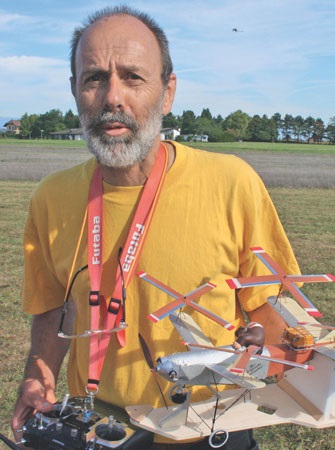
As a boy who loved model building, I certainly formed my own imaginative picture in the 1950s of the reckless abandon with which Wilhelm Olrik apparently vanished in such a tragic and spectacular manner. Time and again, we children would pester our grandmother during our Sunday coffee-and-cake gatherings to tell us the story of “Uncle Wilhelm” and his devil’s box. Even after hearing it a hundred times, the tale still sent pleasant shivers down our spines...
Although the Dane Wilhelm Olrik was in no way related to our family, he was always referred to in our stories as “Uncle Wilhelm”—after all, our maternal grandmother was friends with his sister. Uncle Wilhelm—a tinker, inventor, designer, and eccentric—was actually a pastry chef by trade, but his main interest lay in aviation tinkering. The only one of his creations that actually flew was the
autogyro described here actually took to the skies, but we children were no less fascinated by a flying machine that was supposedly powered by a converted dough mixer and was meant to mimic the flapping of birds’ wings.
My grandfather, Max Fiedler—himself an avid aviator in the 1920s and 1930s—was, as an engineer, always fascinated by Olrik’s curious inventions. Olrik was probably a bit older than my grandfather and was likely about 42 years old during his gyrocopter escapades.
The first version of his gyrocopter is said to have been built in 1935, but it never got beyond a few short hops and ultimately tipped over during a “landing.” After numerous redesigns and modifications, legend has it that in 1937, on the Danish coast, that single, disastrous flight finally took place.
According to eyewitnesses, as reported in a magazine, Olrik is said to have “flown out over the open sea into—
"while hanging upside down and fumbling with tools," they attempted to regain control of the device. However, it was "uncontrollable, yet flew steadily straight ahead and disappeared over the horizon above the North Sea"—much to the horror of the spellbound audience. Olrik had already written in that very magazine about the “tragic tinker,” a nickname that would later stick to the flying machine itself.
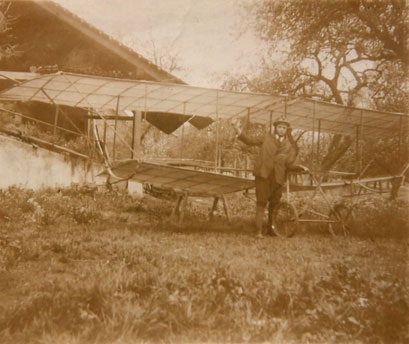
Inventor Wilhelm Olrik in front of the hang glider he built himself (1913), shortly “before the crash in the vineyard,” as a note on the back of the photograph reveals.
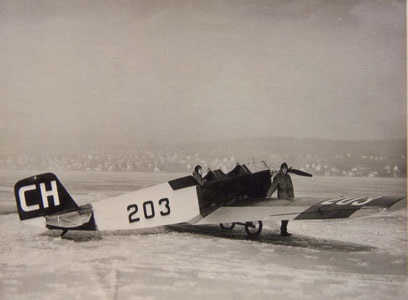
Wilhelm Olrik in the cockpit of the Klemm low-wing aircraft: The photo was taken in 1929 after landing on the frozen Lake Zurich; pilot Max Fiedler is standing on the wing.
The whole story of Wilhelm Olrik would have remained a family legend for me had I not unexpectedly come across a few yellowed envelopes while clearing out the attic. Along with other photos from the early days of aviation, they contained two pictures with brief notes on the backs. One shows the aforementioned Wilhelm Olrik in front of his homemade hang glider; year: 1913, note: “Before the crash in the vineyard.”
The other photograph shows Olrik in the cockpit of the Klemm low-wing aircraft, or simply
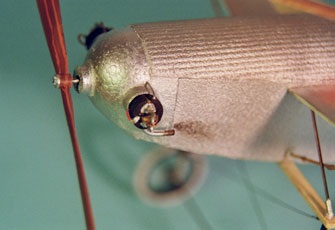
Corrugated metal effect created by grooved Depron.
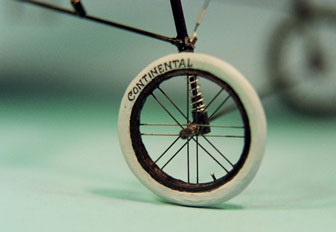
Spoked wheel with pneumatic tires, weighing 0.3 grams.
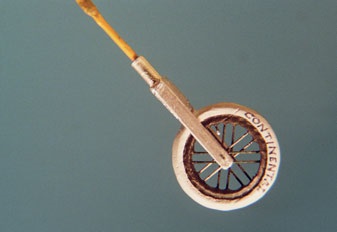
A tiny spur gear on the elegant bamboo boom.
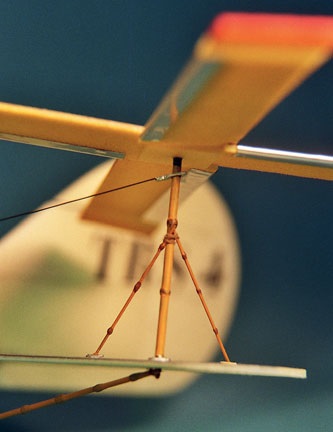
A rotor pylon constructed from "bamboo" on the stump area.
After landing on the frozen Lake Zurich in 1929; pilot Max Fiedler standing next to the aircraft.
The most valuable item to me—and, in a sense, the spark that ignited my next model-building project—was a somewhat crumpled hand-drawn sketch that my grandfather is said to have dedicated to his “kindred spirit” shortly before the latter’s debacle in the spring of 1937. “Gyrocopter over the Alps” is noted—somewhat grandiosely—on the back.
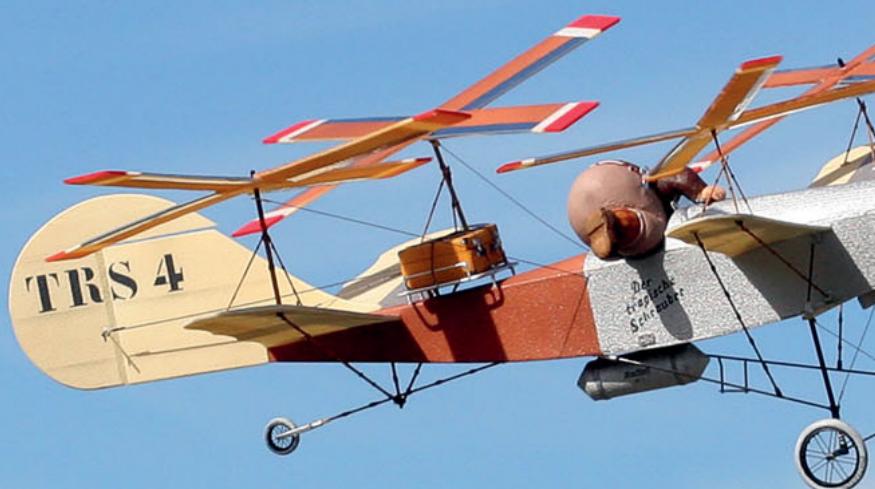
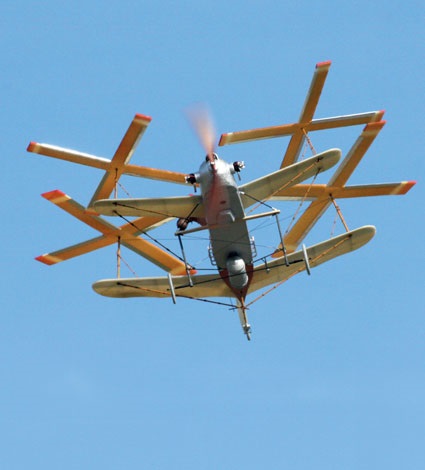
Using this sketch, I set out to create a “scale replica” of this monster, which is actually a “duck” configuration in its design: small rotors in front, main rotors in the rear. Rotor sizes, fuselage length—in fact, all dimensions—were estimated and scaled down to an approximate 1:24 ratio relative to the pilot’s size.
The result was a small-scale model built using the well-established combination of Depron, balsa, and carbon fiber composite, which kept the weight very low. By using thinly sanded Depron (0.8–2 mm) and installing the lightest possible components, a takeoff weight of 38.7 grams was ultimately achieved. The fuselage construction is simple: the fuselage top and side panels are made from a single piece (initially developed as a cardboard template), three support frames inside the fuselage act as “shape formers,” and “grooved” Depron is used for the front cover to mimic corrugated sheet metal. The model was built in 2010; the RC components meet the micro-standard of that time. A small bell-armature motor (7 mm diameter) serves as the power source, with a 150 mAh LiPo cell in the tank. An AR6400 Spektrum unit fits inside a small travel case, which is secured to a luggage rack on the top of the fuselage. I mounted this piece of luggage on the
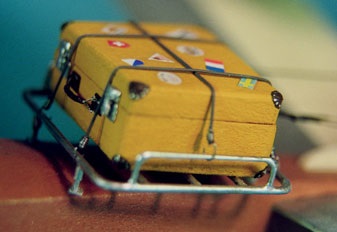
The Mysterious Little Suitcase.

A spare wrench in my pants pocket.
Houses electronics and linear servos.
Autogyros, also known as rotary-wing aircraft or gyroplanes, do not have powered rotors. Instead, the rotation of the rotor blades—which ultimately generates lift—is produced by the “airflow.” The aircraft’s forward motion is generated, as in “normal” powered aircraft, by a pull or push propeller, for example. For this reason, unlike a helicopter, an autogyro cannot hover in place. Famous gyroplanes from the 1920s included those designed by the Spaniard Juan de la Cierva. When properly designed, autogyros fly extremely stably, which was absolutely confirmed by the model presented here: The “tragic screwdriver” is as gentle as a lamb and very pleasant to fly.
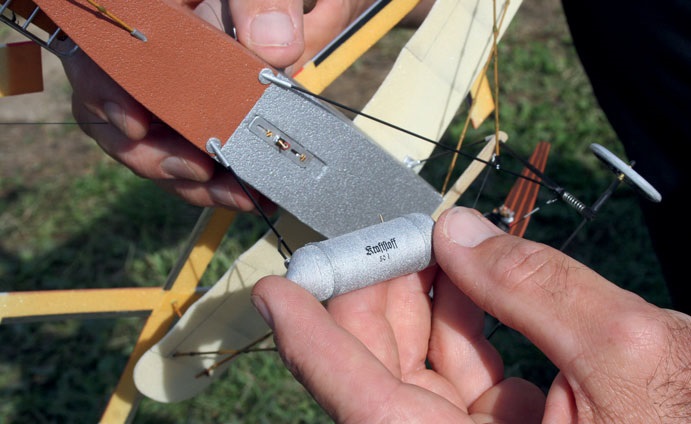
A 150 mAh LiPo cell in the tank.
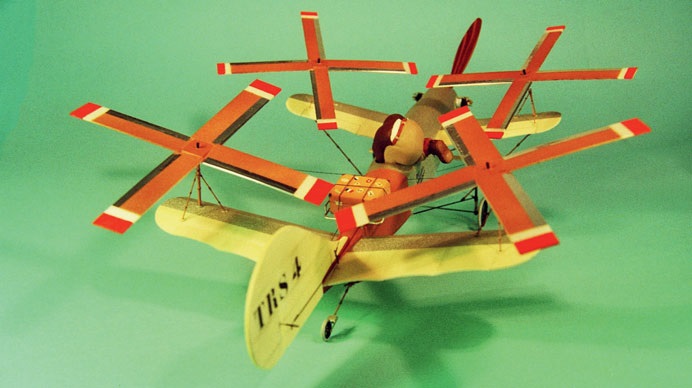
Definitely a hoax.
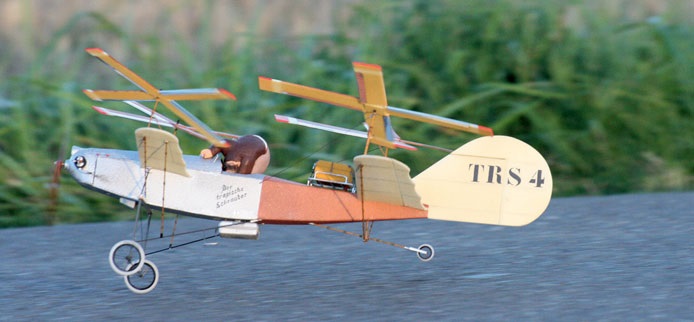
Successful ground launch.
| Name / Designation: | TRS 4 |
| Type / configuration: | 4-rotor gyrocopter, canard configuration |
| Scale: | 1:24 |
| Rear rotors: | 20 cm diameter |
| Front rotors: | 17 cm diameter |
| Overall length: | 42 cm |
| Takeoff weight: | 38.7 grams |
| RC / RC: | AR6400 Spektrum |
| Battery: | 1 Lipo 150 mAh |
| Year of manufacture: | 2010 |
The pilot figure, “carved from a solid block” of Styrodur and hollowed out down to the ankles, was, of course, meant to represent the tragic hero. His facial features cannot be made out in the few historical photos; thus, the tragic hero was to be immortalized at least in the position in which he remained in the memory of the last eyewitnesses: upside down!
And so he continues to fly forever in the lower cockpit area—with the sole consolation that, in the model version presented here, he is always allowed to return to the launch site.


News from HEBU

TEAM MANAGER "THIS" BOSSHARD
 Rodito Nussbaumer

YOU KNOW WHAT I MEAN? 125 YEARS OF THE SWISS AERO CLUB
 Emil Giezendanner

F3A EUROPEAN CHAMPIONSHIPS IN ST-MACAIRE, FRANCE
 Matthias Bosshard

HORIZON HOBBY/LEMACO NEWS: MICRO OV-10 BRONCO 645 MM BY E-FLITE

PRIDE AND GOOD IDEAS
 Markus Nussbaumer

34th HAHNENMOOS ALPINE MODEL AIRPLANE CAMP
Res Dauwalder
TRY-OUT DAY AT MFV WETTINGEN
Urs Keller
52. 2026 ALPS CUP
Emil Giezendanner
EURO CONTEST GLIDER ACRO TOUR AUSTRIA 2026

ATOM, THE NEW DOUBLE-DECKER FROM CPLR
Matthias Bosshard
CORSAIR F4U – A WARBIRD WITH A MEMORABLE LOOK
Jürgen Rosenberger, Jürgen Prinz
SUMMER FUN 2026 AT MG USTER
Martin Wunderli
What's New at Leomotion.com

THE PC-21 STORY
Emil Giezendanner
COUPE DES ALPES – OBSERVE AND LEARN
Rodito Nussbaumer
TWIN TOWN PARTNERSHIP
Wolfgang Voeller
BY YOUTH, FOR YOUTH
Lorena Betschen
SMALL, MODEL-LIKE SAILBOATS
Res Dauwalder
WELCOME, NEW MEMBER!
Andrea Bolliger
FREE FLIGHT IN THE MIDDLE OF SUMMER
Urs Muntwyler
INSIGHTS INTO THE HISTORY OF SEAPLANES

NEWS FROM HEBU
 Julia Bucher

FROM 0 TO 100
Markus Nussbaumer
MEMORIES
Wolfgang Völler
NOS REGION – A HUB FOR ELECTRIC AVIATION
Emil Giezendanner
DO YOU KNOW WHAT I MEAN IN THE LAND OF SMILES?
Emil Giezendanner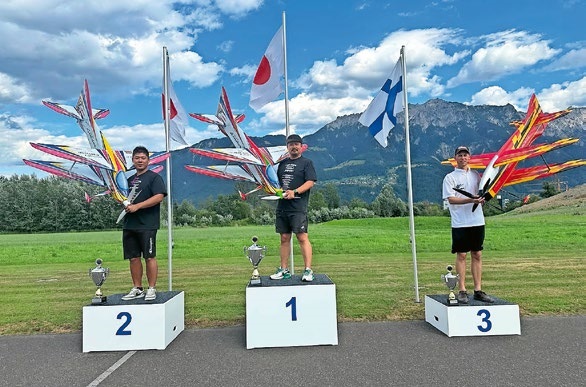
A SPECTACULAR F3A WORLD CUP IN THE PRINCIPALITY OF LIECHTENSTEIN
Emil Giezendanner