
An Electric Plane for Everyone
Why an electric airplane? I usually fly a slope glider and gave up powered flight a long time ago. But our club, CLAM, has a superb airfield, and I needed an aircraft to participate in our group’s activities as well as in internal competitions. The challenge, therefore, was to develop a small electric airplane capable of taking off from a grass runway and flying in all conditions using an economical 600-scale motor with 6 to 7 cells.
Since this type of model is fairly rare on the market, I decided—to save time—to convert a 3-axis trainer designed for a 2.5 cm³ engine.
I settled on a very affordable ARF kit: the Caprise 15 from Topmodel.
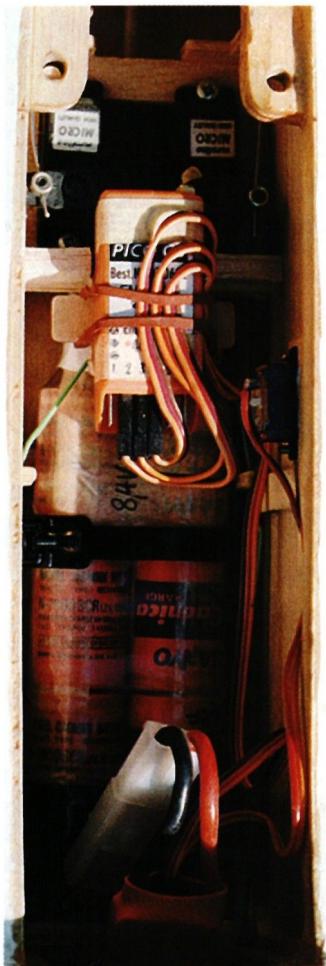
First, I removed the covering from the plane (which was just adhesive plastic). The build quality turned out to be very poor. So I had to replace all the questionable parts and systematically re-glue everything using white glue or epoxy resin. Many parts were remade using a lighter, less fibrous balsa wood. I then had to make the following modifications: securing the wing with screws, reinforcing the battery compartment, moving the servos toward the rear, cutting out the air intakes and ventilation openings, and modifying the nose by installing the leading edge strut. Note that this step must be done last, once the aircraft is fully equipped, with the motor and propeller taped in place to ensure proper balance. The nose is then cut to the correct length and rebuilt.
Extensive sanding followed to refine the shapes of the fuselage, tail surfaces, and wing profile. The aircraft was finally re-covered with heat-shrink film. All this work actually took very little time and could be completed on a simple desk.
The first test flights were conducted without landing gear, in the style of a slope flight, but the power proved to be more than sufficient.
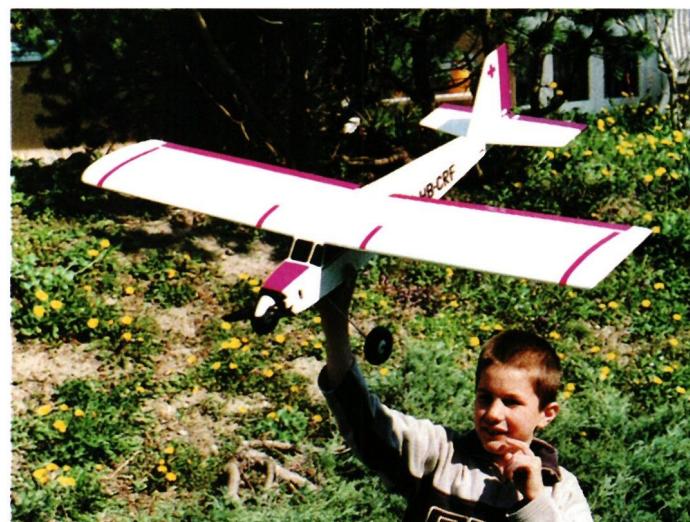
With a bicycle-style landing gear and 70-mm wheels, taking off from a well-mowed runway is no problem.
Numerous tests were subsequently conducted (motors, propellers, ESCs, batteries), and here are the main results:
- Using 6 cells should be avoided because the BEC system shuts off prematurely before the battery is fully discharged.
- In direct drive, powerful, high-RPM motors produce disappointing results and cause excessive overheating (Speed 600 BB 7.2 V).
- Folding propellers offer numerous advantages: less noise and vibration, better efficiency, and protection of the motor shaft during landing.
- The selected batteries are Sanyo SCRs with capacities ranging from 1,000 to 1,250 mAh (weight: 300 g) or 2,000 to 2,400 mAh (weight: 450 g). The extra weight is noticeable during takeoff, but it isn’t a problem and can even be an advantage in windy conditions or during aerobatics.
- Electric motors generate significant over-torque, which must be taken into account during go-arounds and can be utilized for certain maneuvers (spins, left-hand stalls).
- Any 30-amp ESC or higher will do the job; however, be sure to check ESC/receiver compatibility and test for interference on the ground. In general, take care with the radio installation and use lightweight equipment (micro servos).
Two setups have proven very effective and have been in use for two years:
This very economical combination allows for a smooth flight and long flight time, but requires precise piloting. There is no significant heat buildup, even when operating at full throttle for an extended period. Flight time ranges from 6 to 8 minutes (SCR 1000 mAh) up to 18 minutes (SCR 2400 mAh).
This combination offers an advantage in terms of power and flight speed. It allows for basic aerobatics, such as inverted flight, stalls, rolls, and inverted half-loops. Flight paths and speed are better with larger batteries. Heat generation remains moderate, and the plane holds a level flight at medium throttle. You can fly for up to 13–15 minutes by conserving battery power.
A downscaled Speed Gear 500 1:2.8 motor could also have been used (same weight as a 600), but the 10×8" propeller requires building a new, taller—and rather inelegant—landing gear.
This experiment has proven to all skeptics that electric aircraft are functional, especially at this scale. For my part, I plan to continue in two directions:
- Using two 600 ECO motors, as described above, to build a good-sized yet lightweight twin-engine aircraft where this type of motor should really shine.
- Building a lighter and slightly larger airframe for the second motor configuration described (retro-style aircraft).
I hope you enjoy your next electric aircraft as much as I have.
François Croset
| Wingspan | 117 cm |
| Length | 84 cm |
| Wing area | 25 dm² |
| Airfoil | NACA 2412 |
| Weight | 1,200–1,350 g |
François Croset
Vuichardaz 4
, 1030 Bussigny
, Tel./Fax 021 701 30 49

EURO CONTEST GLIDER ACRO TOUR AUSTRIA 2026

THE PC-21 STORY
 Emil Giezendanner

TWIN TOWN PARTNERSHIP
 Wolfgang Voeller

SUMMER FUN 2026 AT MG USTER
Martin Wunderli
CORSAIR F4U – A WARBIRD WITH A MEMORABLE LOOK
Jürgen Rosenberger, Jürgen Prinz
52. 2026 ALPS CUP
Emil Giezendanner
YOU KNOW WHAT I MEAN? 125 YEARS OF THE SWISS AERO CLUB
Emil Giezendanner
News from HEBU

TEAM MANAGER "THIS" BOSSHARD
Rodito Nussbaumer
ATOM, THE NEW DOUBLE-DECKER FROM CPLR
 Matthias Bosshard

F3A EUROPEAN CHAMPIONSHIPS IN ST-MACAIRE, FRANCE
Matthias Bosshard
INSIGHTS INTO THE HISTORY OF SEAPLANES

WELCOME, NEW MEMBER!
Andrea Bolliger
What's New at Leomotion.com

PRIDE AND GOOD IDEAS
 Markus Nussbaumer

SMALL, MODEL-LIKE SAILBOATS
Res Dauwalder
FREE FLIGHT IN THE MIDDLE OF SUMMER
Urs Muntwyler
BY YOUTH, FOR YOUTH
Lorena Betschen
HORIZON HOBBY/LEMACO NEWS: MICRO OV-10 BRONCO 645 MM BY E-FLITE

34th HAHNENMOOS ALPINE MODEL AIRPLANE CAMP
Res Dauwalder
COUPE DES ALPES – OBSERVE AND LEARN
Rodito Nussbaumer
TRY-OUT DAY AT MFV WETTINGEN
 Urs Keller

NEWS FROM HEBU
 Julia Bucher

NOS REGION – A HUB FOR ELECTRIC AVIATION
Emil Giezendanner
MEMORIES
 Wolfgang Völler

70 YEARS OF THE NIDWALDEN MODEL AIRPLANE CLUB
Martin Barmettler
A SPECTACULAR F3A WORLD CUP IN THE PRINCIPALITY OF LIECHTENSTEIN
Emil Giezendanner
FROM 0 TO 100
Markus Nussbaumer