
Operational Reliability and Transmission Reliability in Model Aviation
Who hasn't wondered at some point whether their model airplane is—or was—controllable in every situation? The switch to the new frequency bands and modern transmission protocols was touted as a step toward the future with guaranteed immunity to interference. What was just wishful thinking, and what was reality?
Answers:
There are some fundamental principles that cannot be disputed, but which we are unaware of or which advertisers refuse to acknowledge.
- Interference in radio-based data transmission can never be completely ruled out. Even with redundant systems and different frequency bands, the risk of interference can be reduced but never eliminated.
- Both transmitters and receivers can experience technical problems, no matter how carefully we maintain the components. Receivers and servos are subjected to significant mechanical stress: G-forces during flight, impacts upon landing, and vibrations from the motors.
- Today’s systems are all software-based. Here, too, an error can never be ruled out with absolute certainty; it depends on the quality of the development.
- Standards are introduced, modified, and improved—but improved for whom?
The industry that enables us to establish radio contact with the models we control is doing its best to protect us from surprises—that is, crashes.
The technologies used in model aviation originate from the industry, where they have long been used in other applications and have proven their worth. The electronic components are also used in millions of other applications—they are not custom-made solely for model aviation.
This includes the European Telecommunications Standards Institute, which, with the EN 300-328 standard introduced 5½ years ago, has brought about an improvement in communication security. This standard requires that any transmitter intending to send a data packet in the 2.4-GHz band must first scan the corresponding channel before actually transmitting. This significantly reduces collisions.
The introduction of the standard required the industry to make corresponding adjustments to the transmitters, some of which did not function satisfactorily right away. Third-party receivers also did not handle the changed protocols 100% correctly. Is this all old news, or are you still skeptical and hesitant?
- Check the software version of your transmitter and update it to the latest version. Even if you feel that the listed changes and improvements don’t apply to you: Manufacturers don’t publish all the details of their modifications, but these can still be significant for general use (improved software filters, modified software processes, and more).
- Make sure to check if there are software updates available for your receivers as well; if so, update them too!
- How old is your receiver? Does it meet the latest requirements, or are there any restrictions or reported incompatibilities from the manufacturer? Shouldn’t it be replaced every now and then?
Various transmitters have the ability to store return channel data (even if you don’t use return channels, the receiver voltage and signal strength at the receiver are reported). After the flight, check the log data for inconsistencies, time gaps, missing data, or failsave events. If any of these occur, you should inspect your system. However, if the data is complete and consistent, you can assume that data transmission was flawless. If you still experience flight problems or even crashes, you’ll need to look for the problem elsewhere: receiver voltage, stall due to low airspeed or turbulence in the airspace, or mechanical issues with the servos or the model.
A range test conducted according to the manufacturer’s specifications can also help you determine whether the radio system portion of your setup is still functioning properly. How did I program my failsafe settings? Is the motor being throttled back?
If, despite your best efforts, you’re still having trouble getting your system and model to work properly, analyze the issue with colleagues or experts. Sometimes it takes a lot of finesse and persistence.
I wish you lots of fun and success with your “hassle-free” model flying. ■
Paul Rudolf is a technical advisor in the SMV’s Infrastructure Department


News from HEBU

TEAM MANAGER "THIS" BOSSHARD
 Rodito Nussbaumer

YOU KNOW WHAT I MEAN? 125 YEARS OF THE SWISS AERO CLUB
 Emil Giezendanner

HORIZON HOBBY/LEMACO NEWS: MICRO OV-10 BRONCO 645 MM BY E-FLITE

PRIDE AND GOOD IDEAS
 Markus Nussbaumer

34th HAHNENMOOS ALPINE MODEL AIRPLANE CAMP
Res Dauwalder
TRY-OUT DAY AT MFV WETTINGEN
Urs Keller
F3A EUROPEAN CHAMPIONSHIPS IN ST-MACAIRE, FRANCE
 Matthias Bosshard

52. 2026 ALPS CUP
Emil Giezendanner
ATOM, THE NEW DOUBLE-DECKER FROM CPLR
Matthias Bosshard
SUMMER FUN 2026 AT MG USTER
Martin Wunderli
What's New at Leomotion.com

THE PC-21 STORY
Emil Giezendanner
COUPE DES ALPES – OBSERVE AND LEARN
Rodito Nussbaumer
TWIN TOWN PARTNERSHIP
Wolfgang Voeller
EURO CONTEST GLIDER ACRO TOUR AUSTRIA 2026

BY YOUTH, FOR YOUTH
Lorena Betschen
CORSAIR F4U – A WARBIRD WITH A MEMORABLE LOOK
Jürgen Rosenberger, Jürgen Prinz
SMALL, MODEL-LIKE SAILBOATS
Res Dauwalder
WELCOME, NEW MEMBER!
Andrea Bolliger
FREE FLIGHT IN THE MIDDLE OF SUMMER
Urs Muntwyler
INSIGHTS INTO THE HISTORY OF SEAPLANES

NEWS FROM HEBU
 Julia Bucher

FROM 0 TO 100
Markus Nussbaumer
MEMORIES
Wolfgang Völler
NOS REGION – A HUB FOR ELECTRIC AVIATION
Emil Giezendanner
DO YOU KNOW WHAT I MEAN IN THE LAND OF SMILES?
Emil Giezendanner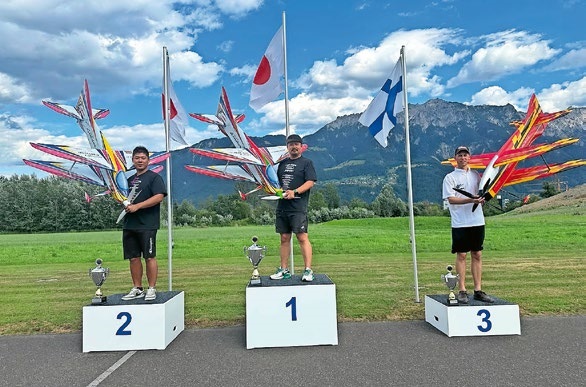
A SPECTACULAR F3A WORLD CUP IN THE PRINCIPALITY OF LIECHTENSTEIN
Emil Giezendanner