
Wintertime – Construction Season – Ski Flying Season

When the first snow blankets our meadows and hills in the lowlands and the sun occasionally peeks through the wisps of fog, it’s high time to pull my dusty skis out of their summer hiding spot for my plane.
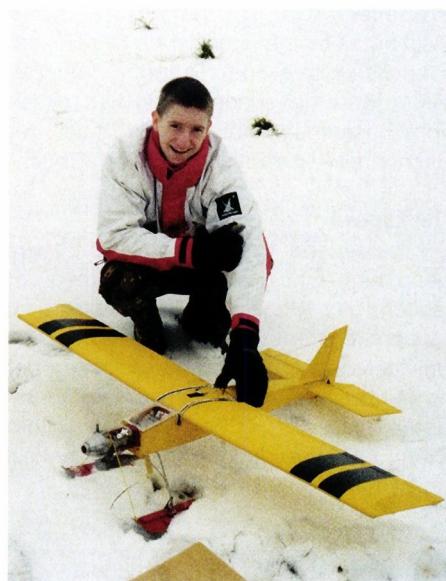
A small three-axis trainer I know well—with a two-leg landing gear and a steerable tail wheel—is then fitted with its winter gear. Off come the wheels; skis and a tail skid are attached, and in half an hour, the model is ready as a ski plane on the workbench. Check the controls, ensure proper trim, and most importantly: How are the batteries holding up? Don’t forget: Discharge and recharge the batteries occasionally even in winter—that way, they’ll be ready for use at any time.
Tips and Considerations for Building or Converting Ski Planes
Two- or three-axis-controlled model airplanes with good low-speed flight characteristics are suitable.
Smaller models have the advantage that they can be assembled at home in a "warm" place and thus fit in the trunk of a car.
The engine power must not be too low. An airplane stuck in the snow needs power to start gliding again.
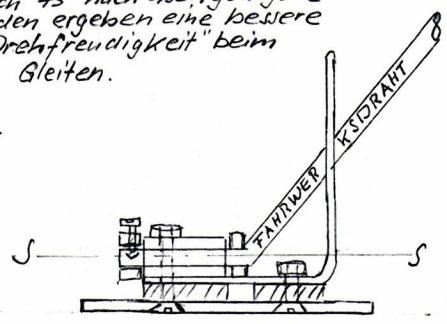
Skis designed for a model with a wingspan of 1.35 meters.
Use plywood blocks and brackets to screw the skis together using four M3 countersunk screws and nuts.
Hole for attaching string and elastic cord.
Aluminum ski tubes ~ 98–10 mm
Height: 30 mm
Reinforcement: $\phi 20 \times 5$
1 mm sheet metal or aluminum
Mounting brackets for chassis made of spring steel wire.
Ski tips bent upward at a 45° angle on the sides provide better “maneuverability” while gliding.
~ 40 mm
10 mm
Width 75 mm
110 mm 110 mm
Length ~ 240 mm
Plywood or Tammen strip $20 \times 5$ mm to reinforce the landing gear mount—glue it in place with epoxy.
The most important thing is that the propeller isn't too close to the snow. Propellers that already have green tips from mowing the lawn in the summer will be too close to the ground after the skis are mounted.
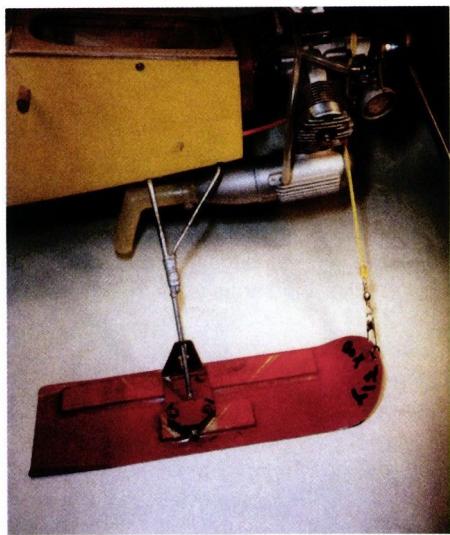
It is important to ensure that the propeller tips are at a sufficient distance from the snow. Propellers that already have green tips from mowing the lawn in the summer are clearly too close to the ground after the skis have been mounted.
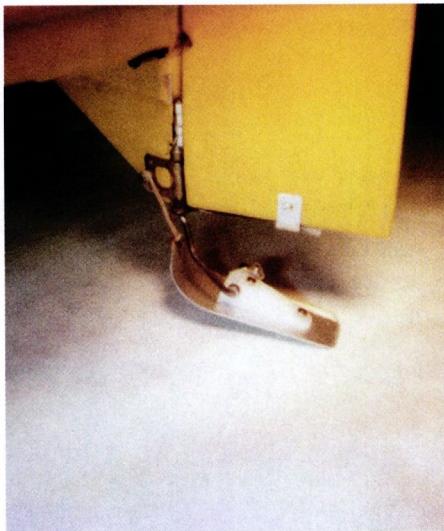
A steerable tail skid is not absolutely necessary. However, a steerable skid allows for precise control of the model on the ground. The deep footprints left by the Yetis in the snowfield—from retrieving the models that got stranded on frozen molehills—are dangerous pitfalls for future takeoffs or landings!
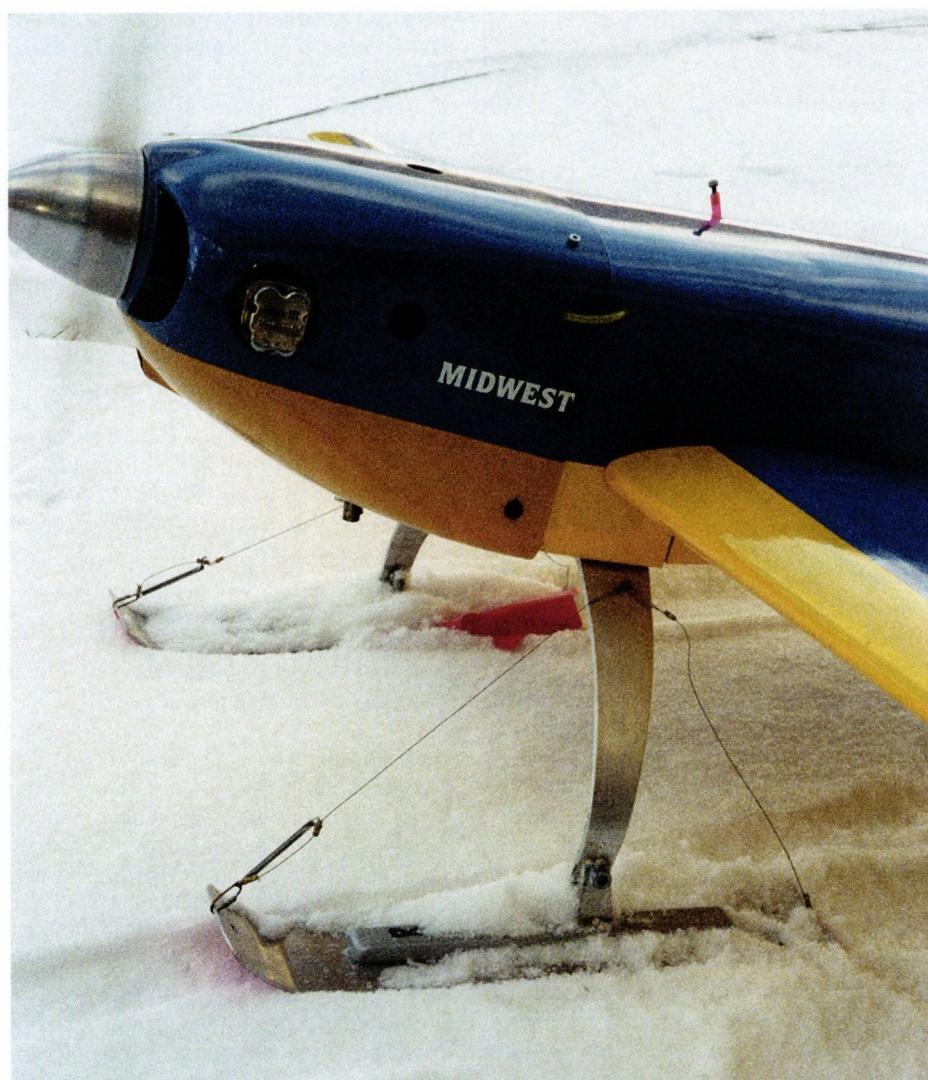
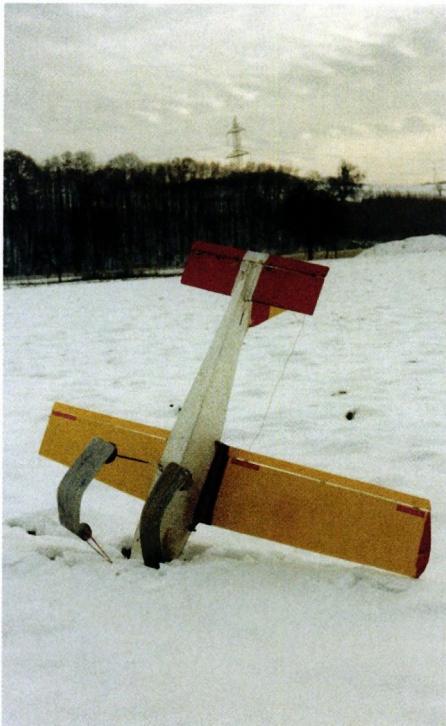
As can be clearly seen in “Figure 13,” very long and excessively wide skis—which have been adapted for a model with a tricycle landing gear—are less suitable. Such skis have a negative effect on flight behavior at all bank angles during flight. The normal control forces are then not always sufficient to recover the model from a critical flight attitude in a timely and safe manner. This means that long skis should be built as narrow as possible. Waxing the skis with universal ski wax prevents snow from freezing to the base.
With tricycle landing gear, the wing may have a slight angle of attack when the model is resting on its skis; this helps the model take off more easily.
This type of ski is not very easy to control on the ground, so the model must be manually moved into the takeoff position.
Even a relatively small amount of powder snow makes takeoff impossible. Landings after a hand launch look surprisingly old-fashioned! The best conditions are on a frozen snowpack covered with a light dusting of powder snow.
When launching, accelerate the model to a sufficient speed before pulling up to take off.
The greater air resistance of skis compared to wheels causes some models to behave differently in flight. Critical flight conditions, such as spinning, can have serious consequences.
Based on my experience, I avoid the three-point landing. I approach the runway at a slightly higher landing speed and touch down; only then do I reduce the throttle completely.

EURO CONTEST GLIDER ACRO TOUR AUSTRIA 2026

THE PC-21 STORY
 Emil Giezendanner

TWIN TOWN PARTNERSHIP
 Wolfgang Voeller

SUMMER FUN 2026 AT MG USTER
Martin Wunderli
CORSAIR F4U – A WARBIRD WITH A MEMORABLE LOOK
Jürgen Rosenberger, Jürgen Prinz
52. 2026 ALPS CUP
Emil Giezendanner
YOU KNOW WHAT I MEAN? 125 YEARS OF THE SWISS AERO CLUB
Emil Giezendanner
News from HEBU

TEAM MANAGER "THIS" BOSSHARD
Rodito Nussbaumer
ATOM, THE NEW DOUBLE-DECKER FROM CPLR
 Matthias Bosshard

F3A EUROPEAN CHAMPIONSHIPS IN ST-MACAIRE, FRANCE
Matthias Bosshard
INSIGHTS INTO THE HISTORY OF SEAPLANES

WELCOME, NEW MEMBER!
Andrea Bolliger
What's New at Leomotion.com

PRIDE AND GOOD IDEAS
 Markus Nussbaumer

SMALL, MODEL-LIKE SAILBOATS
Res Dauwalder
FREE FLIGHT IN THE MIDDLE OF SUMMER
Urs Muntwyler
BY YOUTH, FOR YOUTH
Lorena Betschen
HORIZON HOBBY/LEMACO NEWS: MICRO OV-10 BRONCO 645 MM BY E-FLITE

34th HAHNENMOOS ALPINE MODEL AIRPLANE CAMP
Res Dauwalder
COUPE DES ALPES – OBSERVE AND LEARN
Rodito Nussbaumer
TRY-OUT DAY AT MFV WETTINGEN
 Urs Keller

NEWS FROM HEBU
 Julia Bucher

NOS REGION – A HUB FOR ELECTRIC AVIATION
Emil Giezendanner
MEMORIES
 Wolfgang Völler

70 YEARS OF THE NIDWALDEN MODEL AIRPLANE CLUB
Martin Barmettler
A SPECTACULAR F3A WORLD CUP IN THE PRINCIPALITY OF LIECHTENSTEIN
Emil Giezendanner
FROM 0 TO 100
Markus Nussbaumer