
Lentus ELAPOR plus Rigid Foam Electric Glider with a 3-meter Wingspan
This Time, It Has to Be “Plastic”
It’s well known that Multiplex is the inventor of “foam-waffle airplanes.” Naturally, this technology—which was new at the time—divided the model-airplane community. Some believed you had to learn how to build first before you could fly, while others argued that these planes had nothing to do with model aviation.
One thing, however, quickly became clear: a new type of model airplane had been born. With its models, Multiplex made it possible for those interested in model flying to get airborne as quickly and successfully as possible. Having little or no building experience was no longer an obstacle. These models all flew “out of the box” without any problems, and their ruggedness made it easier to get started in the sport of model flying.
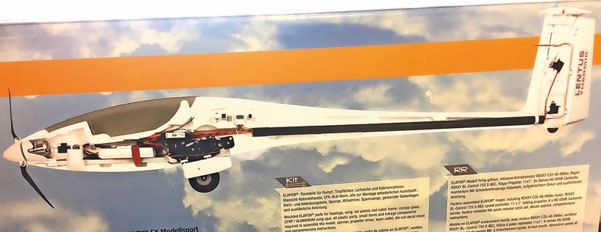
The latest product—and likely the culmination of “foam plane” development—is the Lentus. The Lentus is, one might say, a semiscale glider model, based on the well-known Ventus. This “foam model” with a three-meter wingspan not only impresses with its good looks but is also a well-engineered design “made in Germany.” Both the fuselage surface and those of the wings and tail are worth seeing. Countless reinforcements made of fiberglass, carbon fiber, and metal ensure the model’s stability. For example, the rear section of the fuselage is reinforced by a GRP tube with a diameter of 20 mm and a length of 750 mm. The wings are constructed with double CFRP-aluminum composite spars. All control surfaces are reinforced with stainless steel tubes and are therefore torsion-free. The four wing servos are connected to the receiver in the fuselage via a pre-assembled forced connection (fuselage/wing) using M6 high-current connectors. The rudder is removable via grooved hinges. A CFRP retractable landing gear is also available as an option for the Lentus, which offers particular advantages when using the Lentus for glider towing.
Multiplex offers the Lentus in two versions:
- The KIT version: This includes all the necessary Depron parts and accessories. All other components—such as servos, ESCs, motors, etc.—are your choice, whether from other manufacturers or from your own collection. You’ll need to glue all the model parts together yourself.
- The RR version: With this version, you receive a fully assembled model with all power and RC components (excluding the receiver and LiPo battery), ready to fly! Assembly is limited to connecting the receiver, adjusting the control surfaces, and balancing the center of gravity.
All of these tasks are supported by the very comprehensive assembly manual included with the kit.
Once the specified center of gravity has been set by repositioning the LiPo (3S/4S) and the aileron deflections have been programmed according to the instructions, nothing stands in the way of the maiden flight. My maiden flight with the Lentus took place at our field under nearly ideal wind conditions with a hand launch. At “full throttle,” the Lentus climbs rapidly into the sky at an angle of more than 45°. After the motor has been running for about 5–7 seconds, the permitted altitudes are already reached, and the Lentus transitions into a brisk but very shallow glide angle. The specified control surface deflections and the indicated center of gravity are spot on, and the Lentus responds very willingly to the pilot’s commands. The Lentus signals an impending stall with a clearly noticeable loss of speed. Loops and rolls are performed well with a slight excess of speed achieved by pushing the controls or with engine assistance. Mixing the flaps with the ailerons is advantageous and significantly improves maneuverability around the longitudinal axis. The Lentus indicates the effects of the “speed” and “thermal” flight phases through increased speed or visibly improved climb rate. The Lentus has a very good glide angle. This is particularly evident during the landing approach. If you do not use the butterfly position, you must be prepared for a very long landing approach. When towed by a glider, the Lentus shows no eccentricities at moderate tow speeds and behaves “meekly” and willingly.
On the slope, the Lentus is “right at home.” If you engage the flaps in conjunction with the elevator, you can fly turns almost like in F3F. The Lentus thus demonstrates that, as of now, a “foam model ban” on the hillside is no longer valid. Of course, the Lentus can’t keep up with purebred F3F speedsters made of CFRP, but those also cost many times more for the same flight performance.
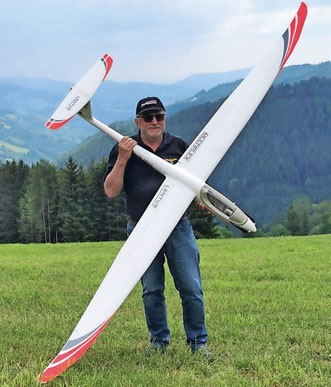
With the Lentus, Multiplex is now also entering the 3-meter class of electric gliders. The two versions offered—a kit or a ready-to-fly model—appeal to a wide range of model pilots. Personally, I recommend the ready-to-fly version. It’s a great offering from Multiplex, both in terms of build quality and value for the money (everything included, fully equipped). In the air, the Lentus impresses with both excellent flight characteristics and a stunning flight profile.

| Span: | 3,000 mm |
| Overall length: | 1,410 mm |
| Flight weight: | approx. 2,300–2,600 g |
| Wing area: | approx. 52.6 dm² |
| Wing loading: | approx. 44–49 g/dm² |
| 9 RC functions: | Elevator, rudder, ailerons, flaps, motor, optional retractable landing gear, tow hook |
| Motor: | Roxy C35-48 990 kV |
| ESC: | Roxy 755 S BEC |
| Servos (6): | HS-65HB Carbonite |
| Propellers: | 11x7 inches |


News from HEBU

TEAM MANAGER "THIS" BOSSHARD
 Rodito Nussbaumer

YOU KNOW WHAT I MEAN? 125 YEARS OF THE SWISS AERO CLUB
 Emil Giezendanner

SUMMER FUN 2026 AT MG USTER
Martin Wunderli
F3A EUROPEAN CHAMPIONSHIPS IN ST-MACAIRE, FRANCE
 Matthias Bosshard

52. 2026 ALPS CUP
Emil Giezendanner
PRIDE AND GOOD IDEAS
 Markus Nussbaumer

ATOM, THE NEW DOUBLE-DECKER FROM CPLR
Matthias Bosshard
CORSAIR F4U – A WARBIRD WITH A MEMORABLE LOOK
Jürgen Rosenberger, Jürgen Prinz
TRY-OUT DAY AT MFV WETTINGEN
Urs Keller
TWIN TOWN PARTNERSHIP
Wolfgang Voeller
BY YOUTH, FOR YOUTH
Lorena Betschen
INSIGHTS INTO THE HISTORY OF SEAPLANES

SMALL, MODEL-LIKE SAILBOATS
Res Dauwalder
What's New at Leomotion.com

HORIZON HOBBY/LEMACO NEWS: MICRO OV-10 BRONCO 645 MM BY E-FLITE

COUPE DES ALPES – OBSERVE AND LEARN
Rodito Nussbaumer
EURO CONTEST GLIDER ACRO TOUR AUSTRIA 2026

34th HAHNENMOOS ALPINE MODEL AIRPLANE CAMP
Res Dauwalder
WELCOME, NEW MEMBER!
Andrea Bolliger
FREE FLIGHT IN THE MIDDLE OF SUMMER
Urs Muntwyler
THE PC-21 STORY
Emil Giezendanner
NEWS FROM HEBU
 Julia Bucher

FROM 0 TO 100
Markus Nussbaumer
MEMORIES
Wolfgang Völler
NOS REGION – A HUB FOR ELECTRIC AVIATION
Emil Giezendanner
Have you almost forgotten about aircraft that take off and land vertically?
Emil Giezendanner
DO YOU KNOW WHAT I MEAN IN THE LAND OF SMILES?
Emil Giezendanner