
Distinguished Swiss Gliding Athletes
The Free Flight World Championships were held in Monocontour, France. This was the most successful event yet for the Swiss delegation: two individual medals and other strong results.
Pilots: F1A: Lauri Malila, Michael Bleuer, Christian Andrist; F1B: Alfred Andrist, Christian Andrist, Dominik Andrist; F1C: Peter Maurer. A World Championship of superlatives for Switzerland has come to an end. It was organized flawlessly by the French organizers. There aren’t many venues left where such a championship can be held.
In the F1A class, 41 launch spots were needed. With a 10-meter spacing between each launch spot, this meant a launch line 410 meters long. This demanded a great deal of attention from the pilots. Cable crossings were a frequent occurrence. So we always had a second pilot with the one taking off to keep an eye on the competition. This allowed the pilot taking off to focus on the model and the air. Our team had approached the competition with some optimism. Unfortunately, in the fifth round, Christian’s elevator servo failed, causing the model to go into a tailspin that couldn’t be stopped with the radio brake. Lauri and Michael flew the full flight time in every round. As a result, they were among 46 other pilots in the fly-off. This posed an additional challenge for the organizer. According to the rules, three timekeepers must be provided for each fly-off participant. The fly-offs were rescheduled for the early evening. As a result, only very weak thermals were available. Fifteen pilots, including Lauri, achieved the required six minutes in the first fly-off. Michael had a poor launch and thus was unable to achieve this time. Lauri invests a great deal of time in optimizing his launch. Time and again during practice, he launched his models to fine-tune the launch sequence even further. His launches in the fly-offs were very good. The setup was timed so that the model immediately transitioned into glide flight without the need for additional thrust. With the altitude he achieved, he was able to maximize his glide time and deservedly became the new world champion in the F1A class.
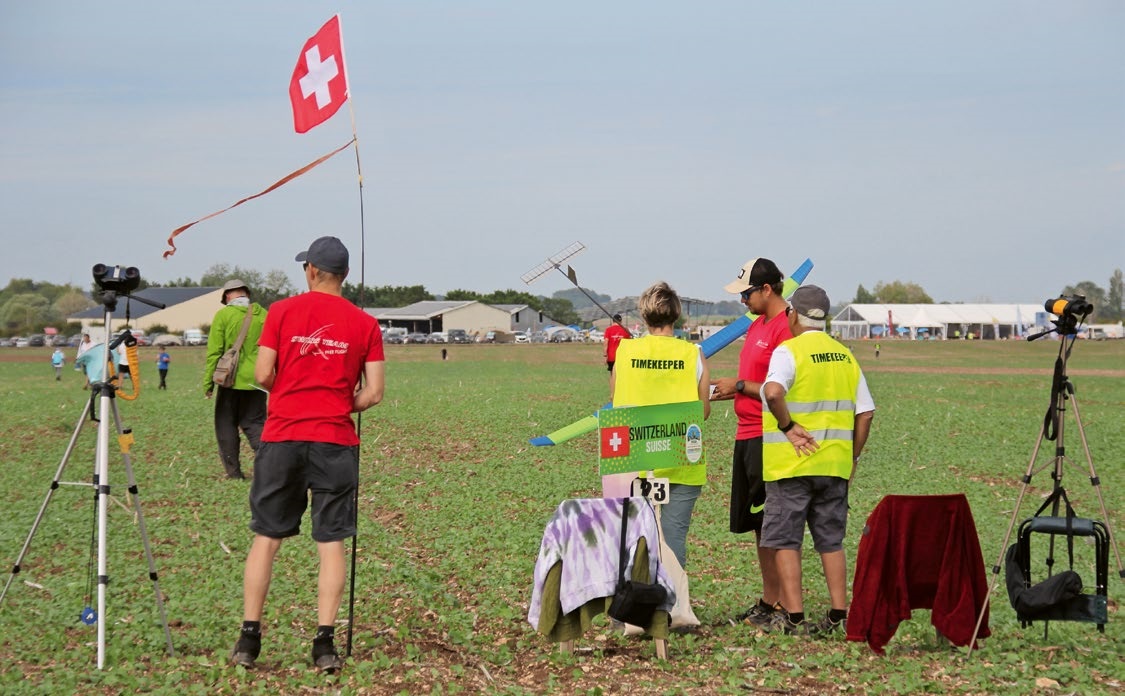
A full team also competed in the F1B class (rubber-powered models). Here, Alfred missed the required time by 20 seconds in the second round. In this class, the rubber band is a crucial component. It must weigh no more than 30 grams. It is wound using a winding machine. Top pilots can achieve up to 480 revolutions. But even more important than the number of revolutions is the rotational speed. This determines the force the rubber band delivers. A higher rotational speed means more power, and the initial altitude is considerably more favorable. Dominik and Christian advanced to the fly-off along with 46 other competitors. The fly-off was scheduled for 8:30 a.m., so it was safe to assume that the thermals would be weak by then. The flight time was 8 minutes. In the fly-offs, things get tight for pilots in this class with a 7-minute preparation time. During this time, the rubber must be wound and the model launched. Dominik wound the rubber quickly and was the first to launch his model. Christian had a hard time. Two rubber breaks cost him a lot of time. He handed in his model as one of the last. Dominik’s recorded flight time of 7 minutes and 7 seconds was good. When it became clear that this was enough for third place, the Swiss team was overjoyed. In the F1C class, we had only one pilot at the starting line: Peter. It wasn’t his day. His launches were very mediocre, and he lacked the necessary initial altitude. This World Championship demonstrated that today’s models have reached a level that is now very difficult to improve upon. F1A models reach an initial altitude of over 100 meters with a line length of 50 meters. The initial altitudes are also enormous in the other two classes. Anyone who fails to achieve the required flight time in the regular rounds finds themselves in the lower half of the rankings. With such large fly-off fields, the challenge extends not only to the pilots but also to the organizers and timekeepers. Without additional aids (such as flashing lights), it is nearly impossible to track the models at dusk.
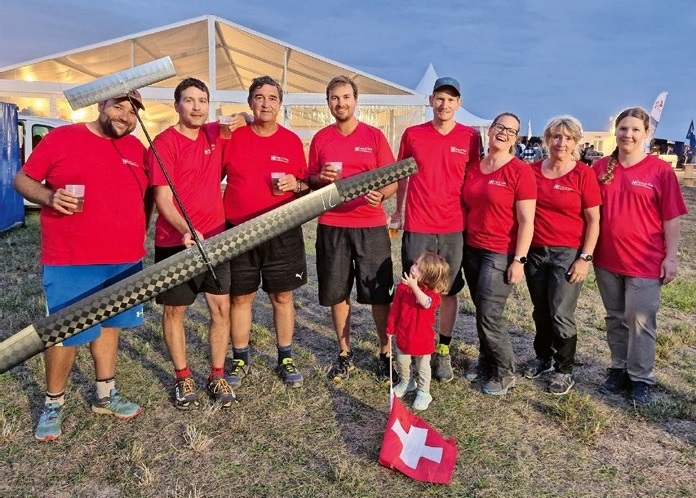
There is intense debate among free-flight pilots about how to prevent these large fly-off fields in the future. It remains to be seen which direction those in charge will take. Swiss free-flight pilots have nothing to be ashamed of. The performances achieved at this World Championship are extraordinary.


News from HEBU

HORIZON HOBBY/LEMACO NEWS: MICRO OV-10 BRONCO 645 MM BY E-FLITE

PRIDE AND GOOD IDEAS
 Markus Nussbaumer

TEAM MANAGER "THIS" BOSSHARD
 Rodito Nussbaumer

YOU KNOW WHAT I MEAN? 125 YEARS OF THE SWISS AERO CLUB
 Emil Giezendanner

F3A EUROPEAN CHAMPIONSHIPS IN ST-MACAIRE, FRANCE
 Matthias Bosshard

ATOM, THE NEW DOUBLE-DECKER FROM CPLR
Matthias Bosshard
SUMMER FUN 2026 AT MG USTER
Martin Wunderli
TRY-OUT DAY AT MFV WETTINGEN
Urs Keller
What's New at Leomotion.com

52. 2026 ALPS CUP
Emil Giezendanner
TWIN TOWN PARTNERSHIP
Wolfgang Voeller
34th HAHNENMOOS ALPINE MODEL AIRPLANE CAMP
Res Dauwalder
CORSAIR F4U – A WARBIRD WITH A MEMORABLE LOOK
Jürgen Rosenberger, Jürgen Prinz
SMALL, MODEL-LIKE SAILBOATS
Res Dauwalder
WELCOME, NEW MEMBER!
Andrea Bolliger
FREE FLIGHT IN THE MIDDLE OF SUMMER
Urs Muntwyler
COUPE DES ALPES – OBSERVE AND LEARN
Rodito Nussbaumer
EURO CONTEST GLIDER ACRO TOUR AUSTRIA 2026

BY YOUTH, FOR YOUTH
Lorena Betschen
INSIGHTS INTO THE HISTORY OF SEAPLANES

THE PC-21 STORY
Emil Giezendanner
NEWS FROM HEBU
 Julia Bucher

FROM 0 TO 100
Markus Nussbaumer
MEMORIES
Wolfgang Völler
NOS REGION – A HUB FOR ELECTRIC AVIATION
Emil Giezendanner
DO YOU KNOW WHAT I MEAN IN THE LAND OF SMILES?
Emil Giezendanner
Have you almost forgotten about aircraft that take off and land vertically?
Emil Giezendanner