
Model Aircraft in the French-speaking Swiss Press
db / The Swiss Aero Club, in collaboration with the Bern Model Aircraft Club, organized a major press conference on July 2 on the topic “Model Aircraft Flying in Switzerland.” Two
major daily newspapers from French-speaking Switzerland were in Bern that day: “24 heures” and “Tribune – le matin.” Here we share their impressions and comments:
Monday, July 4, 1983
24 heures
24
The active presence on Saturday at the Bern-Belpmoos airfield of the director of the Federal Office of Civil Aviation, Rolf Künzi, on Saturday at the Bern-Belpmoos airfield, demonstrated—if any proof were needed—the importance that federal authorities attach to aviation sports in general and model aircraft flying in particular, a discipline that some consider merely a game for teenagers or a hobby for DIY enthusiasts.
PIERRE HENCHOZ
The annual press day, organized by the Aero-Club of Switzerland, focused specifically on this discipline, which is an integral part of the activities for which our national club is responsible. Model aircraft flying, a sport little known except to those who practice it, is often viewed with suspicion by some residents living near the small areas required for flying these models.
But complaints about noise are set to diminish significantly. Two-stroke engines, with their high-pitched vibrations, are increasingly being replaced by quieter four-stroke engines or electric motors, which are completely silent. Saturday’s demonstrations convinced us completely.
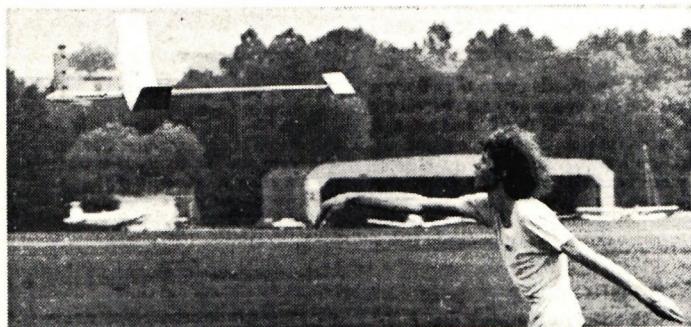
Due to the need for national and international competitions, model aircraft enthusiasts have been grouped into distinct classes. So-called free-flight models, with or without engines, fly with the help of air currents and can
land anywhere. That’s where beginners are found. In the circular flight category, the aircraft is held by strings that allow it to be steered, like a horse being led on a lunge line around a circle. The third category includes all remote-controlled models—airplanes, gliders, helicopters, or original experimental craft. Here, pilots maneuver their machines with astonishing precision and skill. The most complex acrobatic routines
are commonplace. That leaves the final class, known as “scales,” which features models that are exact replicas of both historic and modern aircraft. Modelers who take on this challenging specialty deserve special recognition. The old Biériot or Fokker aircraft from World War I, the Messerschmitts and Mustangs from World War II, or even the Bucker Jungmeister in flight, evoke a unique sensation. Were it not for the distinctive sound of the engine, the illusion would be complete.
Model aircraft building requires a wide range of skills: manual dexterity, technical knowledge, patience, and perseverance—a great deal of perseverance.
P. Hz
The Revival of a Hobby
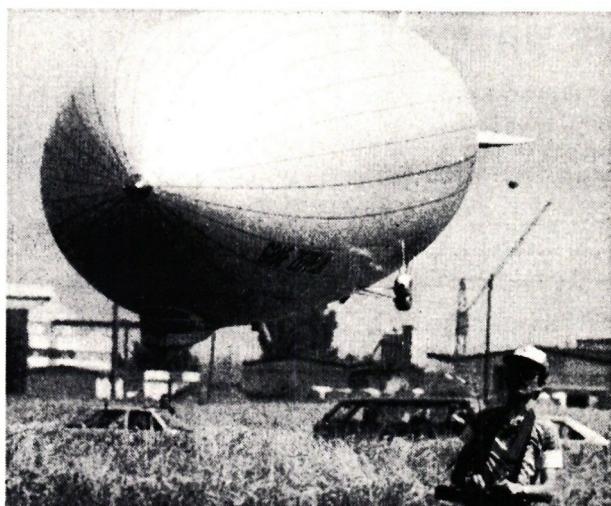
“A model airplane enthusiast’s ‘drug’ is neither LSD nor heroin, but flight.” This is how Werner Kölliker, vice president of the Swiss Aero Club (AéCS), Werner Kölliker, during the AéCS’s annual press conference held Saturday at the Bern/Belpmoos Airport. The various speakers sought to restore the reputation of this hobby, which suffers from a bad reputation among the general public (noise, pollution, etc.). The AéCS also took advantage of this event to showcase various types of aircraft, including a scale model airship.
Currently, 25,000 model aircraft enthusiasts build and fly model aircraft in Switzerland. There are 7,500 model aircraft enthusiasts who are members of the Aero-Club. However, they are generally viewed rather negatively by the public in the areas where they practice. They have been
deemed undesirable, and some cases were only resolved in court.
However, as both Werner Kölliker and Marc Schnyder, head of model aviation for the AéCS, have stated, efforts have been made, and
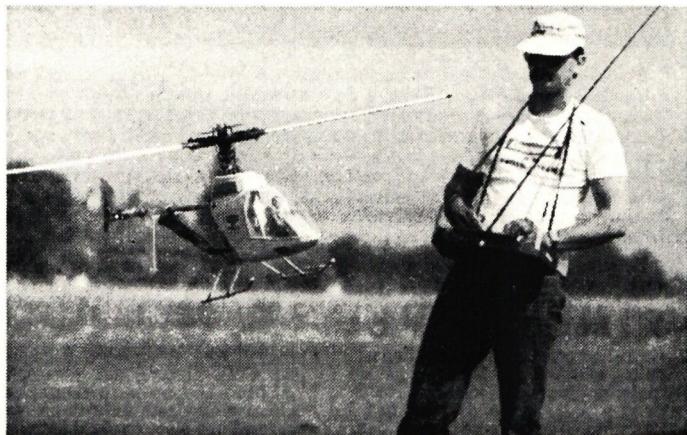
All technical resources have been mobilized to reduce noise pollution. It was also noted that the majority of model aircraft builders are enthusiasts of gliding and electric flight, which are completely silent disciplines.
Furthermore, older two-stroke engines are gradually being replaced by four-stroke engines, which are much quieter. To support these claims, noise measurements were taken: the results showed 80 decibels for a
four-stroke engine and 82 decibels for a two-stroke engine equipped with a muffler. For his part, Rolf Künzi, director of the Federal Office of Civil Aviation (FOCA), noted that the regulations in effect for model aircraft are exactly the same as those for any other flying object. He noted that the FOCA was working on revising the regulations governing model aircraft to bring them in line with the current situation. — (ats)


News from HEBU

TEAM MANAGER "THIS" BOSSHARD
 Rodito Nussbaumer

YOU KNOW WHAT I MEAN? 125 YEARS OF THE SWISS AERO CLUB
 Emil Giezendanner

HORIZON HOBBY/LEMACO NEWS: MICRO OV-10 BRONCO 645 MM BY E-FLITE

PRIDE AND GOOD IDEAS
 Markus Nussbaumer

34th HAHNENMOOS ALPINE MODEL AIRPLANE CAMP
Res Dauwalder
TRY-OUT DAY AT MFV WETTINGEN
Urs Keller
F3A EUROPEAN CHAMPIONSHIPS IN ST-MACAIRE, FRANCE
 Matthias Bosshard

52. 2026 ALPS CUP
Emil Giezendanner
ATOM, THE NEW DOUBLE-DECKER FROM CPLR
Matthias Bosshard
CORSAIR F4U – A WARBIRD WITH A MEMORABLE LOOK
Jürgen Rosenberger, Jürgen Prinz
SUMMER FUN 2026 AT MG USTER
Martin Wunderli
What's New at Leomotion.com

THE PC-21 STORY
Emil Giezendanner
COUPE DES ALPES – OBSERVE AND LEARN
Rodito Nussbaumer
TWIN TOWN PARTNERSHIP
Wolfgang Voeller
EURO CONTEST GLIDER ACRO TOUR AUSTRIA 2026

BY YOUTH, FOR YOUTH
Lorena Betschen
SMALL, MODEL-LIKE SAILBOATS
Res Dauwalder
WELCOME, NEW MEMBER!
Andrea Bolliger
FREE FLIGHT IN THE MIDDLE OF SUMMER
Urs Muntwyler
INSIGHTS INTO THE HISTORY OF SEAPLANES

NEWS FROM HEBU
 Julia Bucher

FROM 0 TO 100
Markus Nussbaumer
MEMORIES
Wolfgang Völler
NOS REGION – A HUB FOR ELECTRIC AVIATION
Emil Giezendanner
DO YOU KNOW WHAT I MEAN IN THE LAND OF SMILES?
Emil Giezendanner
A SPECTACULAR F3A WORLD CUP IN THE PRINCIPALITY OF LIECHTENSTEIN
Emil Giezendanner