
The Unique SB 14: An All-FRP Sailboat
It must have been about ten years ago when my longtime flying buddy Richi Oberholzer surprised me with the suggestion that we build the SB 14 on a 1:3.5 scale. Until then, I hadn't heard anything about this glider, which was still under construction at the time.
Like all earlier SB models, including the legendary, long-winged, and high-aspect-ratio SB 10, the SB 14 was also developed by Akaflieg Braunschweig. The flaps-equipped glider was designed to have as small a fuselage surface area as possible, be easy to fly, glide optimally at higher speeds, and still exhibit good-natured flight characteristics. The tail unit was adopted from the ASH 26. The original, one of the first designs in the then-emerging 18-meter class, took off on its maiden flight on January 17, 2003.
At first glance, the three-view drawing didn’t immediately impress me. The distinctive, pronounced taper of the fuselage beneath the wing took some getting used to. On the other hand, the wing shape—which closely resembled an ellipse—promised a generous wing area and thus a low wing loading. The long tailplane lever arm guaranteed stability and a straight-line flight as if on rails. The longer I worked on the project, the more this glider captivated me. We soon agreed that the SB 14 would be our second joint project. Richi and I had previously built the Diana 1 together on a 1:3.5 scale and gained valuable experience in the process. Richi got started right away and created a flawless fuselage template. My task was the wing construction. Once again, we chose the HN-474 airfoil with 2.1% camber, which had already proven itself on the Diana 1. We made a small “modification” to the wing planform by slightly extending the outermost trapezoid at the expense of the central wing section. On the one hand, this resulted in a sufficiently large aileron, which ensures adequate control of the aircraft’s attitude during thermal flight without having to engage the center wing flap. On the other hand, the outermost wing trapezoid was designed to be optionally detachable, making the inner wing section easier to transport—that is, no longer than the fuselage. The decision to forgo dive brakes was made from the very beginning, and we have never regretted it. Thanks to the long, highly effective inner flaps, the SB 14 in butterfly configuration can be “braked down” almost vertically without noticeably gaining speed. We each built a prototype. Richi equipped his aircraft with winglets, true to the original design. I fitted my SB 14 with crescent-shaped wingtips, which were apparently intended for the original design in the early planning stages.
We built the wings using the positive-mold construction method described several times before (see my article on this in MFS 2/2010). In a nutshell, here’s how it works:
The wing is built upside down, with the top side facing down. First, the foam core and the upper Abachi skin are glued together in the negative mold, with the Carbon-D-Box fabric and all other fabric reinforcements inserted between the foam and the wood. In the next step, the cutouts for the main spar, flap struts, etc., are made, the Rohacell spar core is fitted, and the cables are routed. This is followed by the “major bonding” process, namely the installation of the spars, struts, and lower planking, all wet-on-wet. Afterward, it’s time for sanding and finishing.
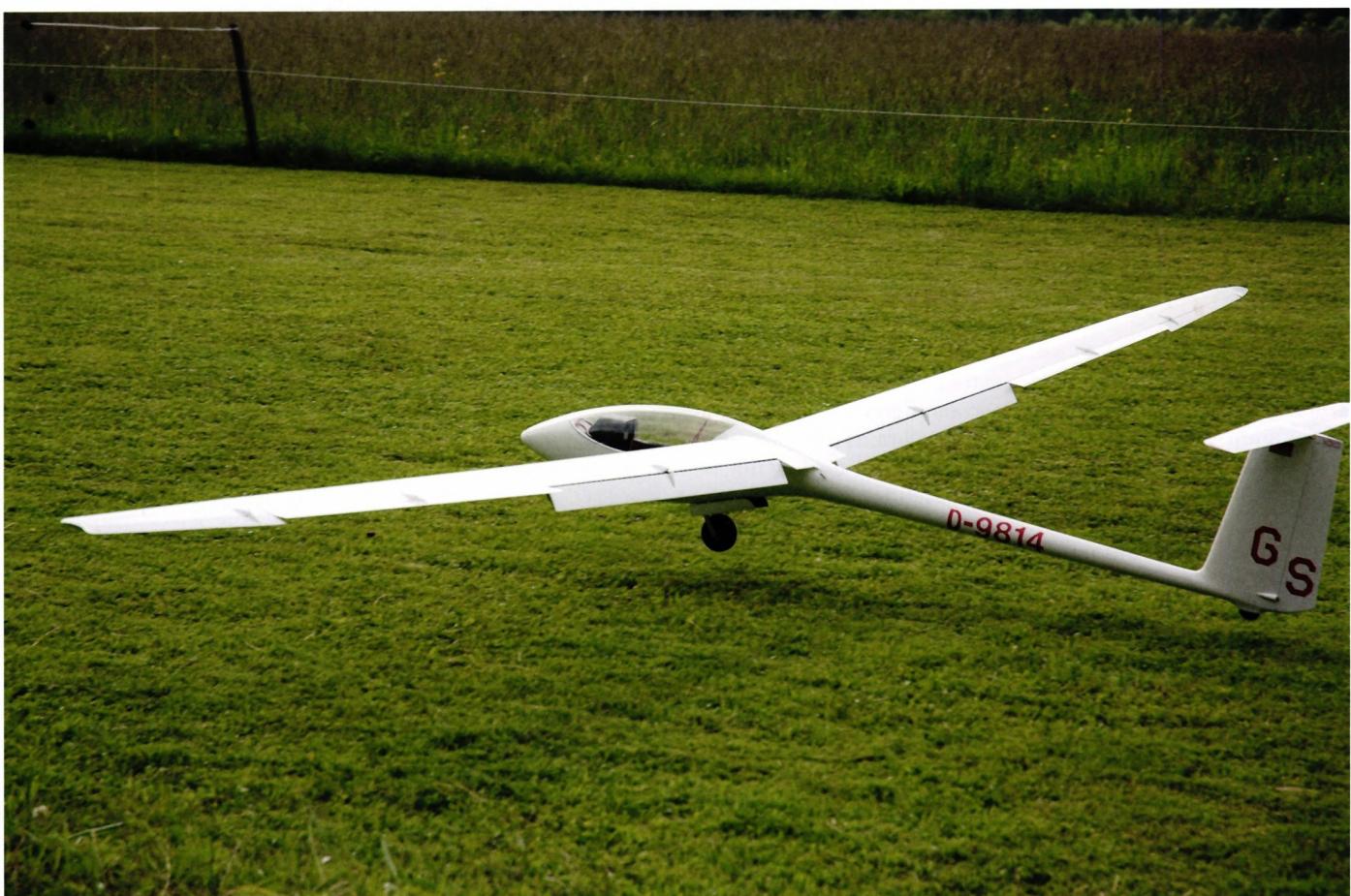
The SB 14 impressed us right from the start. It stands out for its balanced and versatile flight characteristics and is very easy to fly. Every flight is pure pleasure. Amazing dynamics, a very wide speed range, and excellent low-speed flight characteristics are combined with practically “fully automatic” circling behavior in thermals, which is likely due to its multiple V-shapes. When all six flaps are in the thermal position, the SB 14 seems to literally float in the air like a cork on water. Even the weakest thermal can be exploited this way. When all the flaps are set to the speed position, the glider accelerates rapidly and impresses with its strong pull.
Soon, other club members began building their own SB 14s. This was followed by electric-powered versions, either with the motor in the nose of the fuselage or mounted on a clip-on pylon. The latter version allows for takeoff with the landing gear extended from any grass runway. The front-engine SB 14 is catapulted a few meters into the air on flat ground using a strong rubber band, at which point the motor takes over.
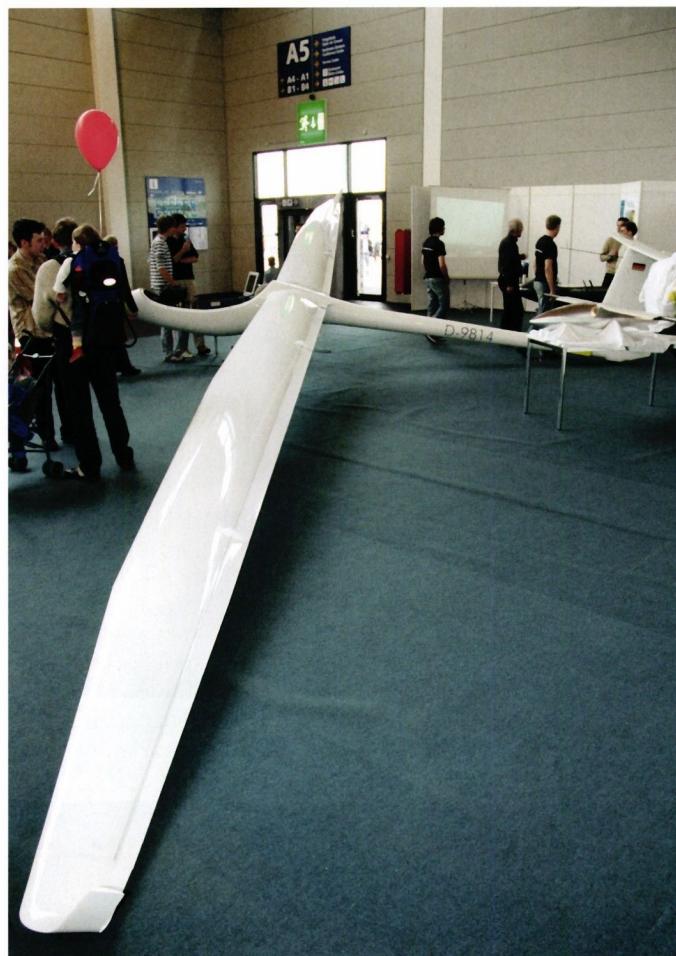
Driven by the constant quest for even better glide performance and dynamics, I set out to refine the design after a few years. I built another SB 14 with a wing profile featuring a camber of just 1.7%. This profile was developed by a helpful fellow pilot—who wishes to remain anonymous—based on the HN-474, using time-consuming computer calculations. Flight testing of this prototype yielded impressive results: significantly higher glide speed with flaps retracted, even greater dynamic performance, no noticeable loss of climb rate in thermals, and continued excellent low-speed flight characteristics. Test flights with about one kilogram of ballast showed that this airfoil would also easily handle the additional weight of an electric motor. When the same airfoil design then delivered equally good results in one of our next projects, the Diana 2 slope glider (scale 1:3.5), we were certain we were on the right track.
By then, more and more pilots had seen the SB 14 in flight and were asking the usual question: where could they buy this aircraft? So, over time, we became more and more willing to let other pilots share in our success and to approve the SB 14—equipped with the new airfoil—for production using CFRP/GFRP construction. Daniel Aeberli took on this project. After an extensive search, he found the right manufacturer in 2k models. Its owner, Karel Koudelka, has made a name for himself with F3J models and is a master of lightweight GRP construction. I modified the connecting ribs on the fuselage positive, after which the fuselage was shipped to the Czech Republic in the fall of 2010 to be cast. Karel Koudelka built the wing molds using a 3D milling machine built specifically for this project. When the pre-production batch was delivered in the summer of 2011, we could hardly get enough of the perfect craftsmanship. In no time at all, these three models—which differed slightly in the dimensions of their spars and D-boxes—were made ready for flight. This was followed by extensive test flights that exceeded all expectations. It soon became clear that the well-known, excellent flight characteristics of the first SB 14 had been passed on to the “second generation.” Despite a slightly lower weight, the dynamics have, as expected, improved even further. The center and outer wing flaps were newly equipped with RDS actuators. The SB 14 is unique in the market for all-fiberglass models. We are not aware of any mass-produced large-scale glider with a 514 cm wingspan that is both this light and this dynamic. With a spring-loaded retractable landing gear and a six-position wing “flap system,” the SB 14 weighs only about 5.3 kg as a pure glider and about 1 kg more with an electric motor, though additional ballast can be added. Smooth, wide-ranging aerobatics are easily achievable. However, the model is not designed for a 1,000-meter dive followed by full pull-up. After all, we’re not Stuka pilots, but glider pilots who know how to enjoy flying an elegant, highly dynamic large glider. ■
*Text: Georg Staub,
Photos: Hans Rudolf Lüdi,
Georg Staub, and
René Willemsen*
[www.chocofly.com](http://www.chocofly.com)
[www.2kmodels.eu](http://www.2kmodels.eu)


News from HEBU

TEAM MANAGER "THIS" BOSSHARD
 Rodito Nussbaumer

YOU KNOW WHAT I MEAN? 125 YEARS OF THE SWISS AERO CLUB
 Emil Giezendanner

HORIZON HOBBY/LEMACO NEWS: MICRO OV-10 BRONCO 645 MM BY E-FLITE

PRIDE AND GOOD IDEAS
 Markus Nussbaumer

TRY-OUT DAY AT MFV WETTINGEN
Urs Keller
F3A EUROPEAN CHAMPIONSHIPS IN ST-MACAIRE, FRANCE
 Matthias Bosshard

52. 2026 ALPS CUP
Emil Giezendanner
ATOM, THE NEW DOUBLE-DECKER FROM CPLR
Matthias Bosshard
SUMMER FUN 2026 AT MG USTER
Martin Wunderli
What's New at Leomotion.com

COUPE DES ALPES – OBSERVE AND LEARN
Rodito Nussbaumer
TWIN TOWN PARTNERSHIP
Wolfgang Voeller
34th HAHNENMOOS ALPINE MODEL AIRPLANE CAMP
Res Dauwalder
CORSAIR F4U – A WARBIRD WITH A MEMORABLE LOOK
Jürgen Rosenberger, Jürgen Prinz
SMALL, MODEL-LIKE SAILBOATS
Res Dauwalder
WELCOME, NEW MEMBER!
Andrea Bolliger
FREE FLIGHT IN THE MIDDLE OF SUMMER
Urs Muntwyler
EURO CONTEST GLIDER ACRO TOUR AUSTRIA 2026

BY YOUTH, FOR YOUTH
Lorena Betschen
INSIGHTS INTO THE HISTORY OF SEAPLANES

THE PC-21 STORY
Emil Giezendanner
NEWS FROM HEBU
 Julia Bucher

FROM 0 TO 100
Markus Nussbaumer
MEMORIES
Wolfgang Völler
NOS REGION – A HUB FOR ELECTRIC AVIATION
Emil Giezendanner
DO YOU KNOW WHAT I MEAN IN THE LAND OF SMILES?
Emil Giezendanner
A SPECTACULAR F3A WORLD CUP IN THE PRINCIPALITY OF LIECHTENSTEIN
Emil Giezendanner