
A NEW LEASE ON LIFE FOR THE POLITICALLY FAILED P-16
A NEW LEASE ON LIFE FOR THE POLITICALLY FAILED P-16
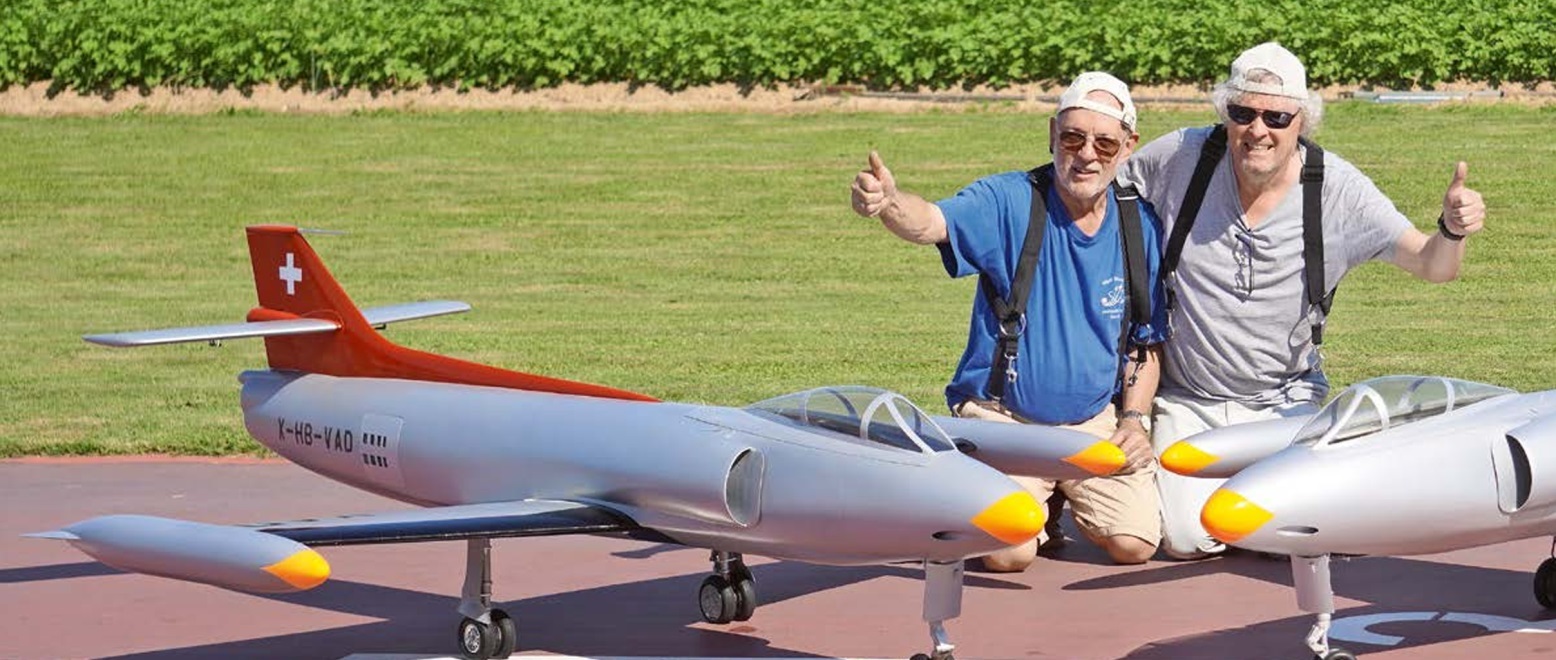
Anyone who has never attended the Warbird Meeting in Schänis is missing out on something in life. I didn’t miss the takeoffs and landings, nor the impressive demonstration of a P-16—a beautiful, imposing aircraft built over five years by Herbert Jost and Walter Blumer. Since the FFA P-16 is a Swiss fighter jet, it was immediately clear to me that this model belongs in our Swiss specialty magazine “Modell Flugsport.”
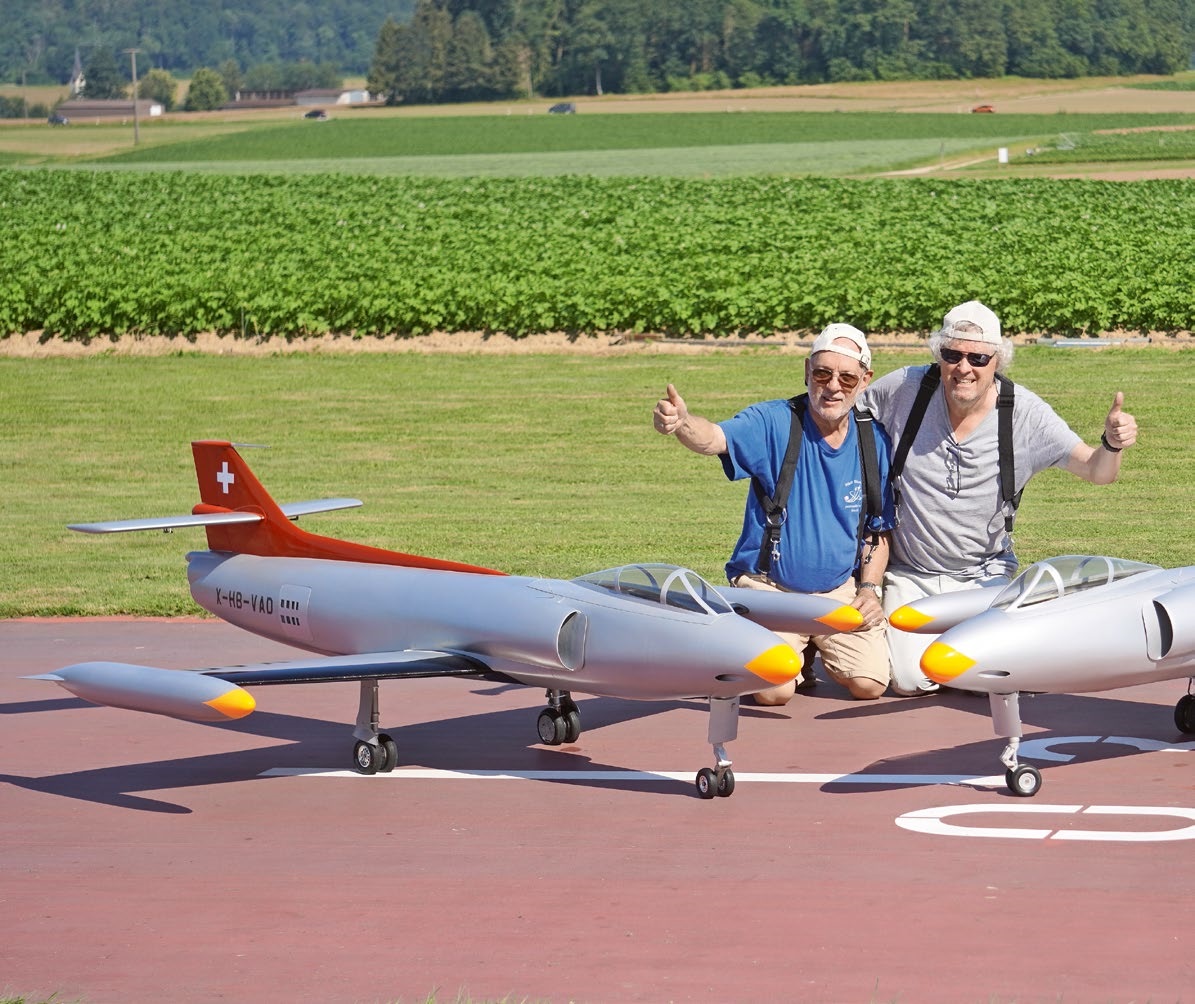
Anyone who ventures to build a replica of the FFA P-16 must accept that they will have access to a very limited amount of documentation: A somewhat better three-view drawing with fuselage cross-sections is said to come from the former drafting training program at FFA. The situation is better when it comes to photos. However, these aren’t always helpful for the detail-oriented scale modeler, and many of them are nearly 70 years old.
Herbert and Walter were interested to learn that ETH student Marc Immer had used the Leica T-Scan (see box) to capture the original P-16 at the Dübendorf Aviation Museum over the course of two workdays, generating a total of 40 million data points (20,000 points per second). Herbert scaled the 3D data generated by this project to a scale of 1:5.5 for the planned model.
It was clear that 3D printing would fundamentally change model building. In just a few years, it has taken the model aviation hobbyists’ workshops by storm.
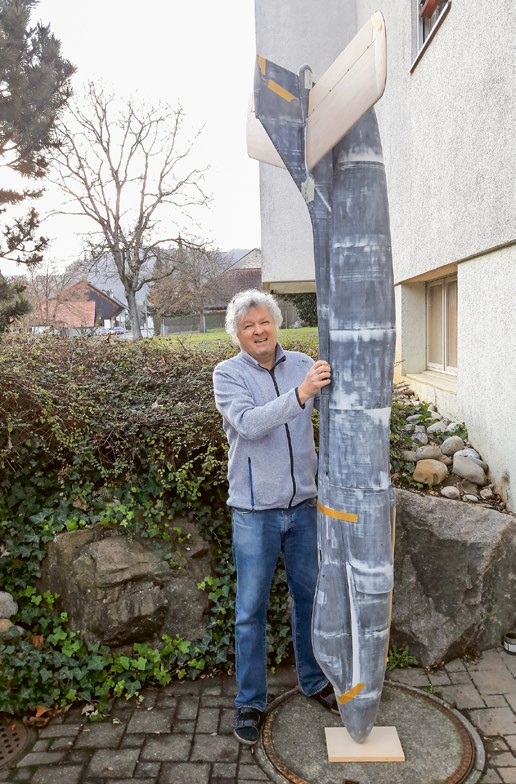
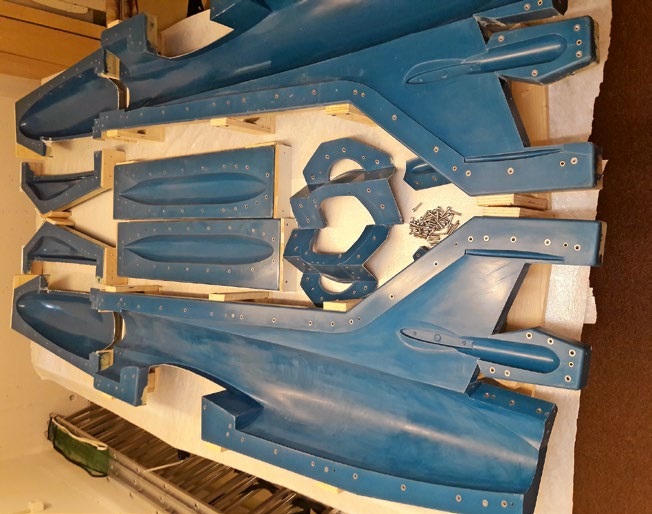
At first, it was all about smaller parts, such as cockpit equipment or practical components for technical systems—like battery mounts, servo frames, and much more. This was followed by fuselages up to three meters or more in length, assembled from individual segments. But before printing could begin, Herbert had to tackle the CAD design for the fuselage mold-making, the CNC-milled parts, and the masking films. The fuselage was divided into 18 3D-printed parts: rudder, external fuel tanks, canopy, underside of the fuselage, etc. That took 1,500 hours of pure print time and about 14 kg of PLA filament!
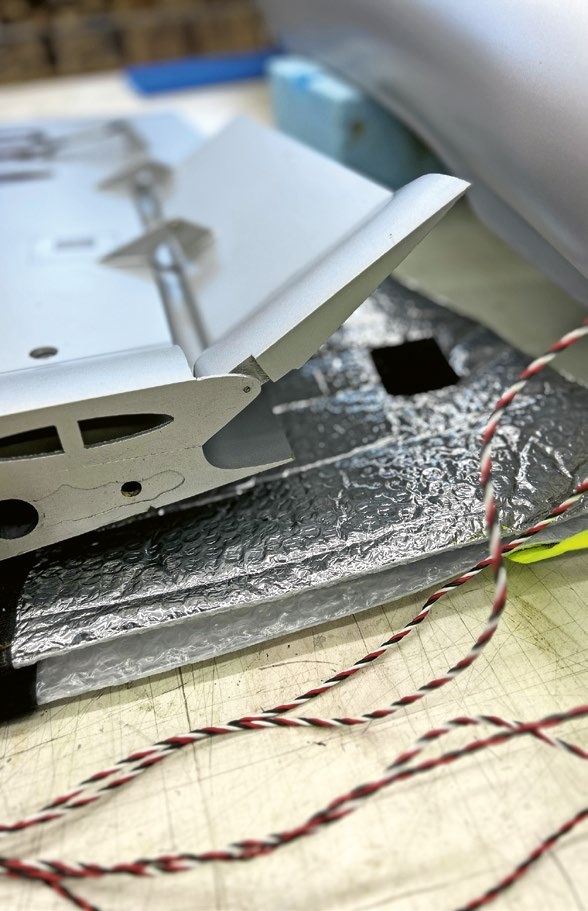
The 3D-printed fuselage master model, consisting of 18 parts, required extensive post-processing: This involved filling, sanding, priming, fine sanding, and polishing. Only then could the molding process proceed using the various parting lines. After the white Celcoat was sprayed into the mold, the lamination was done by hand—without a vacuum—using multiple layers of fiberglass cloth reinforced with carbon fiber tape. The two-piece fuselage structure features an integrally molded GRP vertical stabilizer and numerous CNC-milled frames, which facilitate the installation of the turbine and the custom-built tanks made of Kevlar and GRP. The electrical installation is clearly laid out and logically organized. A particularly noteworthy feature is the two-stage dive brakes, which are driven by a rack-and-pinion mechanism and can be extended and retracted. The cockpit interior, faithful to the original, was added during a second phase of construction. We would like to take this opportunity to once again highlight the elegance of this jet.
MSTB 1: | 5.5 |
Wingspan: | 202 cm |
Fuselage length: | 258 cm |
Empty weight: | 19 kg |
Fuel tank: | 4.5 liters |
Turbine: | Jetcat 180N |
Another important source of information was our unrestricted access to the original P-16 at the Dübendorf Aviation Museum. Urs Ritter, who is in charge of the P-16, was very supportive and granted us access to take measurements, photographs, and more. We would like to express our sincere thanks to him.
Herbert Jost and Walter Blumer
The wing was cut out using a hot wire (RG-15 profile), and the entire core was vacuum-pressed at a 45-degree angle with carbon fiber fabric and 1.5-mm balsa planking. The spar consists of a continuous carbon tube as well as a second section extending to the landing gear. The spar joint consists of a milled aluminum part. Here, too, 3D printing and CNC milling played a key role in ensuring perfect results: Milling various GRP and carbon-coated ribs, printed landing flaps in the round fuselage section. The wheel wells recessed into the Styrofoam were created on the printer and provide a sleek finish. Now for the details of the landing gear:
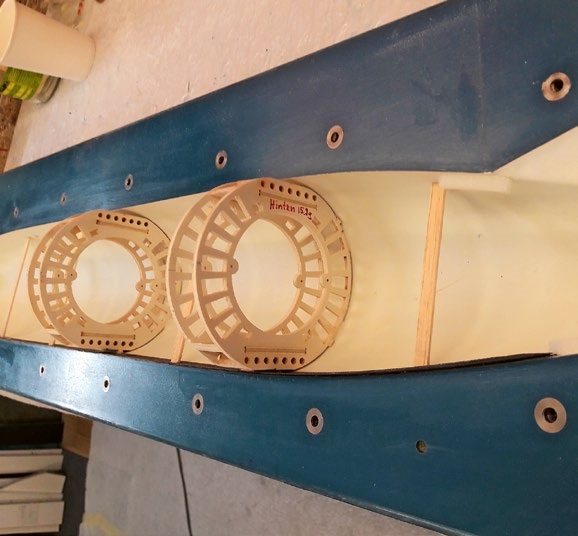
It’s very common to see the landing gear on beautiful scale models fail, which can even result in unsightly damage to the model itself. Second landing: landing gear torn from the wing or nose gear buckled! These are frustrating incidents that aren’t always easy to fix. Walter Blumer, a highly experienced landing gear designer and manufacturer, played a key role in the success of the entire project. He designed and built the retractable landing gear as well as the two-stage dive brakes. The system is driven by a gearmotor via a 5-mm trapezoidal lead screw. The outer twin wheels are braked. The main landing gear is equipped with springs, and the nose wheel has a gas shock absorber. Installing the landing gear into the wing is often a rather clumsy process. In this wing, however, the entire assembly was carried out very professionally using CFRP-coated ribs made of aircraft-grade plywood—a wing design that is truly impressive.
The Leica T-Scan works in conjunction with the laser tracker via a digital camera system (Leica T-Cam) that operates using visible light and infrared (IR) radiation. The non-contact, high-speed scanner offers a measurement sampling rate of 20,000 points per second. When in use, the operator’s movements resemble holding a paintbrush and applying paint to the surfaces of the aircraft’s wings or fuselage. Over the course of two workdays, a total of 40 million points were captured during the scanning of the P-16. At 20,000 points per second, the dense point cloud on the computer screen actually looks like a photograph of the aircraft. The scanner’s four sides provide multiple viewing angles of the object’s surface, allowing even the smallest details to be captured with precision. Based on laser-tracking technology, the operator can establish a local coordinate system and then access a larger coordinate system. Source: hexgon.com
While the original FFA-P-16 completed over 500 flights, the Jost/Blumer replica managed 30. The original was designed as a short takeoff and landing (STOL) fighter aircraft. These characteristics were first achieved using full-span Krüger flaps. More than 70 years later, the model met these expectations during its test flights—thanks in part to its extremely lightweight construction. The builders describe their model’s flight characteristics as docile, smooth, and stable—“as if on rails”—and note that it can be controlled with precision. The flaps were set down 10 to 15 degrees during takeoff. The jet is also docile during landing. With the flaps fully extended and the dive brakes set halfway, the model became somewhat unstable around the vertical axis. They are trying to address this issue using a gyroscope. With this wonderfully successful project, our two model-building colleagues honor the pioneering work of the engineers and pilots of that era.


News from HEBU

HORIZON HOBBY/LEMACO NEWS: MICRO OV-10 BRONCO 645 MM BY E-FLITE

PRIDE AND GOOD IDEAS
 Markus Nussbaumer

TEAM MANAGER "THIS" BOSSHARD
 Rodito Nussbaumer

YOU KNOW WHAT I MEAN? 125 YEARS OF THE SWISS AERO CLUB
 Emil Giezendanner

F3A EUROPEAN CHAMPIONSHIPS IN ST-MACAIRE, FRANCE
 Matthias Bosshard

ATOM, THE NEW DOUBLE-DECKER FROM CPLR
Matthias Bosshard
SUMMER FUN 2026 AT MG USTER
Martin Wunderli
What's New at Leomotion.com

52. 2026 ALPS CUP
Emil Giezendanner
TWIN TOWN PARTNERSHIP
Wolfgang Voeller
34th HAHNENMOOS ALPINE MODEL AIRPLANE CAMP
Res Dauwalder
CORSAIR F4U – A WARBIRD WITH A MEMORABLE LOOK
Jürgen Rosenberger, Jürgen Prinz
SMALL, MODEL-LIKE SAILBOATS
Res Dauwalder
TRY-OUT DAY AT MFV WETTINGEN
Urs Keller
WELCOME, NEW MEMBER!
Andrea Bolliger
FREE FLIGHT IN THE MIDDLE OF SUMMER
Urs Muntwyler
COUPE DES ALPES – OBSERVE AND LEARN
Rodito Nussbaumer
EURO CONTEST GLIDER ACRO TOUR AUSTRIA 2026

BY YOUTH, FOR YOUTH
Lorena Betschen
INSIGHTS INTO THE HISTORY OF SEAPLANES

THE PC-21 STORY
Emil Giezendanner
NEWS FROM HEBU
 Julia Bucher

FROM 0 TO 100
Markus Nussbaumer
MEMORIES
Wolfgang Völler
NOS REGION – A HUB FOR ELECTRIC AVIATION
Emil Giezendanner
DO YOU KNOW WHAT I MEAN IN THE LAND OF SMILES?
Emil Giezendanner
Have you almost forgotten about aircraft that take off and land vertically?
Emil Giezendanner