
A Passion for Wooden Building Kits
Pilatus Flugzeugwerke AG in Stans has always produced airplanes that have enjoyed great popularity among model airplane enthusiasts. This remains true to this day. While the P-2 and P-3 were the models of choice in the early years, the PC-6 Porter and the Turboporter later became among the most popular models among model aviators. The Pilatus B4 glider, which was originally built entirely of metal, was—and still is—a must-have at any model airfield, and virtually every Swiss model builder has had or currently has a B4 in their collection. With the PC-7 and PC-9 models, Pilatus once again created extremely attractive designs for interesting and well-flying models.
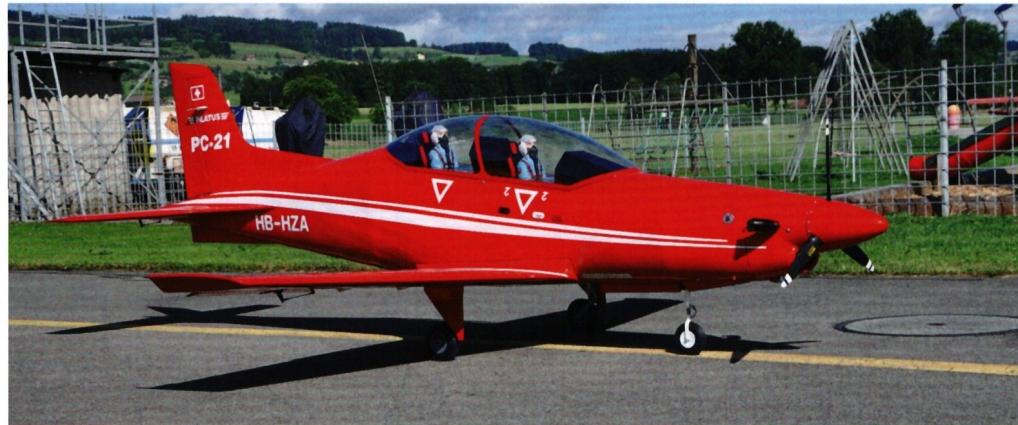
The latest offering from the Central Swiss aircraft manufacturer is the Pilatus PC-21: a training aircraft in a class of its own. This elegant bird from Central Switzerland, too, quickly caused a stir in model aviation circles. So it’s no surprise that, soon after the first three-view drawings were released, finished models could be seen in the sky. The two model builders, Kurt Odermatt from Ettiswil and his colleague Ruedi Suter from Frenkendorf, had a slightly different goal. Their goal was to get the world’s largest PC-21—built entirely of wood—into the air. Ruedi Suter—a trained auto mechanic—has continued his education
He became a computer specialist and is now the owner of Aerobel, a company that specializes in bringing models to market that aren’t available just anywhere. Suter says: “I love classic wooden model kits. I’m not alone in this—quite the opposite. The demand for such kits encouraged me to start my own company.” His success proves him right. After a Super Constellation with a 233 cm wingspan, a PC-21 with a wingspan of about 150 cm, a PC-12 with a 185 cm wingspan, and a PC-6 Porter with a 200 cm wingspan—all of which can be found on his website www.aerobel.ch, he teamed up with Kurt Odermatt to develop the large PC-21.
"Buy today—fly tomorrow," as model-building brochures often say—is something you can forget about with a model like this. Just programming the laser cutting system, selecting the types of wood to be used, measuring and redrawing the three-view diagram supplied by Pilatus, calculating the required profile dimensions, set angle differences, and building the first prototype—all forced Suter to work intensively for over half a year. Kurt Odermatt also invested a good 1,000 hours. The model builder, employed at Hope-Modellbau in Schöftland, was responsible for installing the electronics, mounting the control system, selecting the correct components, and assembling a
Pilatus Flugzeugwerke AG in Stans was founded in 1939. In the 1940s and 1950s, the company laid the foundation for its reputation as one of the most renowned manufacturers of training aircraft with the Pilatus P-2 and P-3 models. Starting in 1959, the legendary PC-6—also known as the Pilatus Porter—established the company’s second pillar in the multipurpose aircraft market. Beginning in the late 1970s, the turboprop-powered Pilatus PC-7 replaced the P-3. Over 450 units were sold over the next few decades. In the mid-1980s, the more powerful Pilatus PC-9 expanded Pilatus’s lineup in the training aircraft market. With the PC-12, Pilatus created a new class of efficient single-engine, turboprop-powered multipurpose aircraft starting in 1994. It offers similar or better flight performance than many of its multi-engine competitors at significantly lower operating costs and has become Pilatus’s best-selling model. The latest training aircraft from Stans is the PC-21, which was granted a type certificate by the Federal Office of Civil Aviation at the end of 2004.
Tiz/wiki

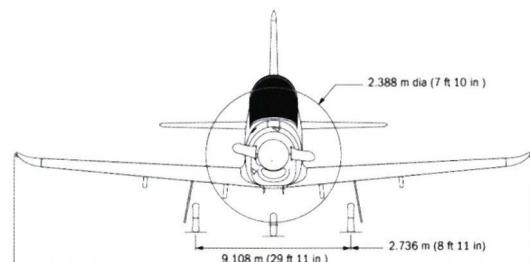
landing gear appropriate for the flight weight. It goes without saying that a model with a fuselage length of 325 cm, a wingspan of 260 cm, and a takeoff weight of 25 kg should be powered accordingly. An American DA 85-cm³ engine with about 10 PS provides adequate propulsion. The airframe, coated with natural silk and tension varnish, was finally given a flawless two-component paint finish.
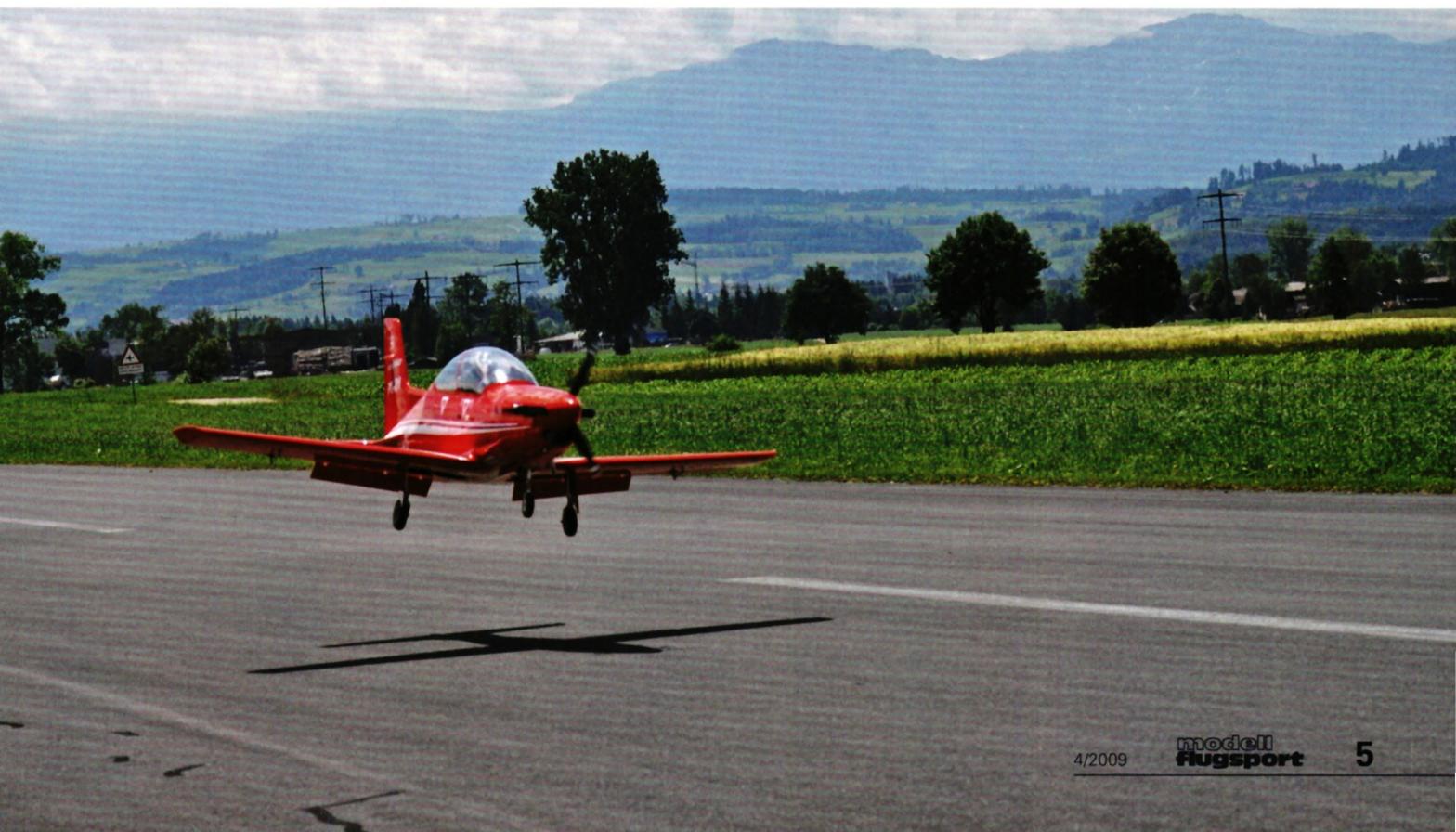
Wednesday, June 10, 2009. A small group of model airplane enthusiasts, along with the three key figures—the model, pilot Kurt Odermatt, and designer and builder Ruedi Suter—met at the airfield in Triengen. This was where the PC-21 was set to take to the skies for the first time. After assembly, refueling, and a final check of all control surfaces, the Giezendanner landing gear, and the performance of the DA engine, the PC-21 taxied onto the runway at the Flying Ranch. With Kurt
His heart rate must have gone up a bit as he aligned the aircraft and pushed the throttle lever on his controls to full throttle. The PC-21 accelerated rapidly, lifted off the ground completely uneventfully after a short roll, and demonstrated that it
flew beautifully. After about 8 minutes of flight and a smooth as silk landing, accompanied by warm and appreciative applause from fellow model aviators, the champagne corks popped—and deservedly so.
The pilot’s conclusion: “It simply flies wonderfully, without any quirks or problems; it’s easy to fly for such a large model and is a ton of fun.” Our design considerations, the set parameters, the airfoil used, and the overall design are 100% spot on—as evidenced by the trim levers, which are still in the center position
. The manufacturer’s equally beaming face also revealed his satisfaction. According to Ruedi Suter, the PC-21 will be available in about two to three weeks at Hope-Modellbau in Schöftland (www.hopemodell.ch) and online (www.aerobel.ch), among other places.
This report deliberately does not go into the minutest technical details of the various manufacturing areas. With its 85-cm³ engine, the PC-21 is certainly not overpowered, but it flies perfectly. Of course, the kit also allows for the use of a turboprop engine or, for speed enthusiasts, can be powered electrically when equipped with enough LiPo batteries. Anyone wishing to learn more about technical specifications, prices, installed equipment, etc., can contact Ruedi Suter’s company, Aerobel, in Frenkendorf for information regarding design and construction (www.aerobel.ch). Kurt Odermatt from Hope-Modellbau in Schöftland is well-versed in the details of the control systems and electronics to be installed, as well as questions regarding the landing gear and engine (www.hopemodell.ch).

EURO CONTEST GLIDER ACRO TOUR AUSTRIA 2026

THE PC-21 STORY
 Emil Giezendanner

TWIN TOWN PARTNERSHIP
 Wolfgang Voeller

SUMMER FUN 2026 AT MG USTER
Martin Wunderli
CORSAIR F4U – A WARBIRD WITH A MEMORABLE LOOK
Jürgen Rosenberger, Jürgen Prinz
52. 2026 ALPS CUP
Emil Giezendanner
YOU KNOW WHAT I MEAN? 125 YEARS OF THE SWISS AERO CLUB
Emil Giezendanner
News from HEBU

TEAM MANAGER "THIS" BOSSHARD
Rodito Nussbaumer
ATOM, THE NEW DOUBLE-DECKER FROM CPLR
 Matthias Bosshard

F3A EUROPEAN CHAMPIONSHIPS IN ST-MACAIRE, FRANCE
Matthias Bosshard
INSIGHTS INTO THE HISTORY OF SEAPLANES

WELCOME, NEW MEMBER!
Andrea Bolliger
What's New at Leomotion.com

PRIDE AND GOOD IDEAS
 Markus Nussbaumer

SMALL, MODEL-LIKE SAILBOATS
Res Dauwalder
FREE FLIGHT IN THE MIDDLE OF SUMMER
Urs Muntwyler
BY YOUTH, FOR YOUTH
Lorena Betschen
HORIZON HOBBY/LEMACO NEWS: MICRO OV-10 BRONCO 645 MM BY E-FLITE

34th HAHNENMOOS ALPINE MODEL AIRPLANE CAMP
Res Dauwalder
COUPE DES ALPES – OBSERVE AND LEARN
Rodito Nussbaumer
TRY-OUT DAY AT MFV WETTINGEN
 Urs Keller

NEWS FROM HEBU
 Julia Bucher

NOS REGION – A HUB FOR ELECTRIC AVIATION
Emil Giezendanner
MEMORIES
 Wolfgang Völler

70 YEARS OF THE NIDWALDEN MODEL AIRPLANE CLUB
Martin Barmettler
A SPECTACULAR F3A WORLD CUP IN THE PRINCIPALITY OF LIECHTENSTEIN
Emil Giezendanner
FROM 0 TO 100
Markus Nussbaumer