
Successful First World Championships in Indoor Aerobatics (F3P) in Coburg, Germany
The organizers of the German Aero Club can be proud of the success of the first F3P World Championships, which drew 49 participants. In some areas, the organizers had to contend with new challenges and demonstrate a healthy dose of improvisation. Both the models and the performances of the top pilots were already at a level that will be very difficult to surpass.
Bringing together a diverse group of judges from 11 countries—and doing so in a new aerobatics category—was no easy task. Through two intensive training courses and two dozen practice flights, CIAM F3 Aerobatics Chairman Michael Ramel was able to accomplish this task admirably. He relied on Peter Uhlig’s highly illustrative slides for his instructions. I had the opportunity to participate in both courses and a large number of pre-flights, and in doing so, I gained a very favorable impression of the competence and professionalism of the judges’ work. The organizers deserve congratulations for this.
With only very rudimentary knowledge of F3P model technology leading up to these World Championships, I was surprised by the large number of truly high-tech machines. Their construction requires a high degree of precision work, knowledge of materials, and an understanding of mechanics and electronics. Added to this are the rather complex transmitter settings. There’s also a noticeable trend toward using less and less Depron, moving toward pure carbon-fiber construction. While not (yet) as popular in F3A, counter-rotating propellers were used by the majority of the top ten competitors there. These powerplants are truly tiny marvels. The single- and twin-motor systems with gearboxes are said to weigh around 16 to 20 g, while the single-motor models with counter-rotating, freely spinning propellers are correspondingly lighter.
The leading group consistently demonstrated not only great precision in their maneuvers but also exemplary positioning from the judges’ perspective. There is still room for improvement here for many pilots, as well as in the speeds of the vertical ascending and descending maneuvers—which are well known from F3A flights.
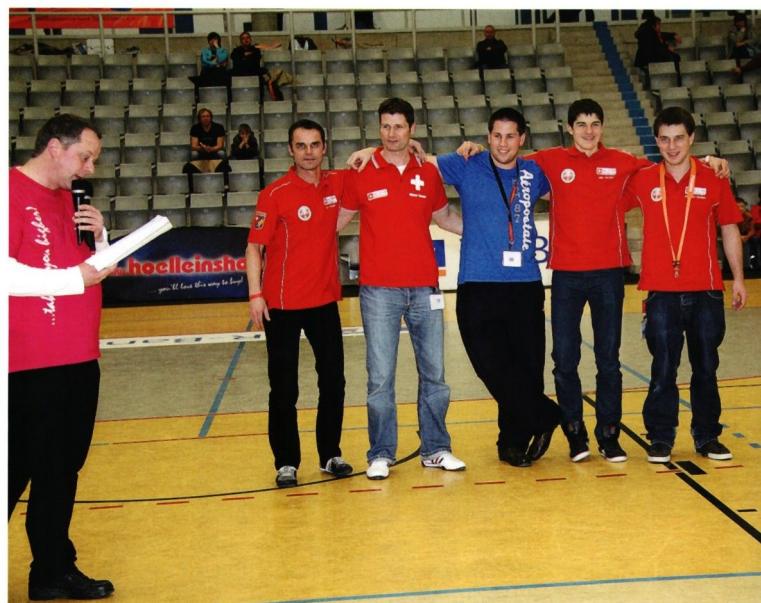
The Swiss team consisted of three “seniors,” one junior, and two assistants. Although their flights were clean, they couldn’t quite keep up with the leaders and finished in the middle of the pack in the individual standings and in the bottom third in the team standings. The models were not state-of-the-art. Aside from one instance of touching the ceiling, there were practically no major problems to report. One drawback was that our Swiss team had to compete without a team leader. I noticed that with better communication to the pilots, a few more points could have been earned here and there.
In the freestyle flights—which, as is well known, are not part of the World Championships—the pilots were able to showcase their versatile skills. This annex competition—which, unfortunately, is often mistakenly called “AeroMusicals” in Switzerland—produced a ranking similar to that of the World Championships. It also confirmed the fundamental concept behind the F6 classes: a huge difference in spectator numbers! Our team finished at the bottom of the rankings. Here, too, with better information for the pilots about freestyle flying, we could have moved up a few spots. In particular, Christian Oppliger was unfortunately unable to fully realize his flying potential or take full advantage of his model’s technical capabilities. The flights by the top group must be viewed as true artistic performances of the highest caliber: the versatility and creativity of the routines, as well as the selection of music, were of the highest standard. Time and again, the spectators burst into spontaneous applause and clapped along rhythmically.
*E. Giezendanner
Photos: G. Wöbbeking*
| The Rankings | |
|---|---|
| Seniors (49 competitors) | |
| 1. Gernot Bruckmann | AUT |
| 2. Donatas Pauzuolis | LIT |
| 3. Tetsuo Onda | JAP |
| Also | |
| 25. Nico Strebel | SUI |
| 29. Christian Oppliger | SUI |
| 35. Daniel Ziegenhagen | SUI |
| 37. Michel Hauser | SUI |
| Teams (15 teams) | |
| 1. France | |
| 2. Austria | |
| 3. Germany | |
| Also | |
| 10. Switzerland | |
| Juniors (12 competitors) | |
| 1. Theo Catros | FRA |
| 2. Takuya Takahashi | JAP |
| 3. Karl-Ernst Overdick | GER |
| Also | |
| 6. Nico Strebel | SUI |
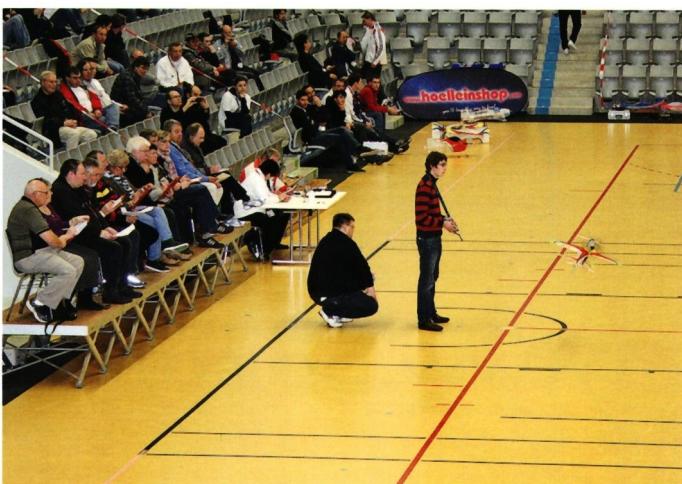
We don’t have to fire the coach every time we lose, as is customary in soccer. Nevertheless, I’m convinced that the team manager—or TM, as he’s also called—plays an important role at model aircraft world championships. Yes, in certain situations, his competent intervention can even be decisive. The demands placed on pilots, helpers, and TMs have been steadily increasing for many years. While 20 years ago it was still somewhat acceptable for one person to take on multiple roles—even then, it was suboptimal in some classes—this is no longer possible today without certain areas being neglected. For this reason, I have repeatedly proposed to the SMV that TM training be improved—or that such training be provided at all. The Sports Department now intends to address this issue.


News from HEBU

TEAM MANAGER "THIS" BOSSHARD
 Rodito Nussbaumer

YOU KNOW WHAT I MEAN? 125 YEARS OF THE SWISS AERO CLUB
 Emil Giezendanner

HORIZON HOBBY/LEMACO NEWS: MICRO OV-10 BRONCO 645 MM BY E-FLITE

PRIDE AND GOOD IDEAS
 Markus Nussbaumer

34th HAHNENMOOS ALPINE MODEL AIRPLANE CAMP
Res Dauwalder
TRY-OUT DAY AT MFV WETTINGEN
Urs Keller
F3A EUROPEAN CHAMPIONSHIPS IN ST-MACAIRE, FRANCE
 Matthias Bosshard

52. 2026 ALPS CUP
Emil Giezendanner
ATOM, THE NEW DOUBLE-DECKER FROM CPLR
Matthias Bosshard
SUMMER FUN 2026 AT MG USTER
Martin Wunderli
What's New at Leomotion.com

THE PC-21 STORY
Emil Giezendanner
COUPE DES ALPES – OBSERVE AND LEARN
Rodito Nussbaumer
TWIN TOWN PARTNERSHIP
Wolfgang Voeller
EURO CONTEST GLIDER ACRO TOUR AUSTRIA 2026

BY YOUTH, FOR YOUTH
Lorena Betschen
CORSAIR F4U – A WARBIRD WITH A MEMORABLE LOOK
Jürgen Rosenberger, Jürgen Prinz
SMALL, MODEL-LIKE SAILBOATS
Res Dauwalder
WELCOME, NEW MEMBER!
Andrea Bolliger
FREE FLIGHT IN THE MIDDLE OF SUMMER
Urs Muntwyler
INSIGHTS INTO THE HISTORY OF SEAPLANES

NEWS FROM HEBU
 Julia Bucher

FROM 0 TO 100
Markus Nussbaumer
MEMORIES
Wolfgang Völler
NOS REGION – A HUB FOR ELECTRIC AVIATION
Emil Giezendanner
DO YOU KNOW WHAT I MEAN IN THE LAND OF SMILES?
Emil Giezendanner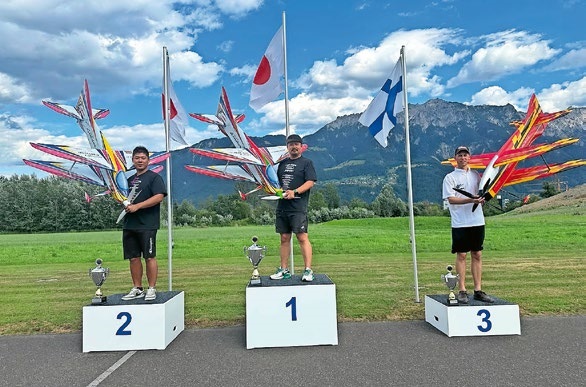
A SPECTACULAR F3A WORLD CUP IN THE PRINCIPALITY OF LIECHTENSTEIN
Emil Giezendanner