
World Championships in Slope-Launched Free-Flight Models (F1E)
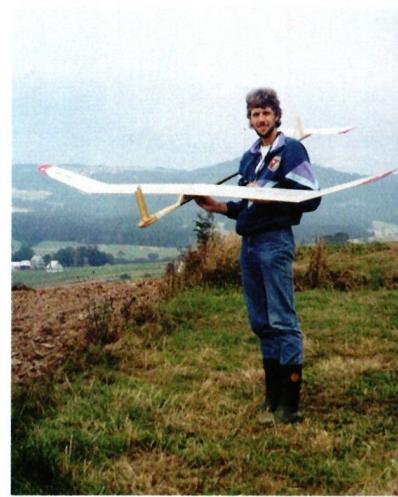
Two participants were lucky enough to have competed in the first World Championships on the same slope 12 years ago. That was in 1989, a few weeks before the fall of the Berlin Wall... This time, we load our bus from Feldkirch to Vienna onto the train and arrive in Novy Targ on Friday afternoon. Afterward, we practice at the 1989 World Championship site. The next morning, we’re able to train there until the organizers send us to the official practice area, where the other teams are testing their models on a small slope. Fortunately, we’d already been able to fine-tune the models somewhat on the better slope.
We return to the 1989 World Cup venue. It’s overcast, and there’s a light crosswind. The first flight, limited to 180 seconds, poses no difficulty for us. Only 8 of the 28 adult participants (seniors) fail to reach the maximum required flight time. The juniors have more trouble; only 7 fly for 3 minutes. The second flight is set for a 4-minute flight time. 17 senior participants achieve the maximum (12 reach 200%). Not a single Swiss pilot is among them—it’s enough to drive you to despair! In the third round, Andreas Tschanz and Heinz Bleuer achieve the maximum, while 11 competitors still hope to win. It starts raining heavily. Fortunately, there’s a tent where we can have lunch during the break. The ground gets muddy—it reminds us of Waterloo.
The fourth flight is limited to 5 minutes. Retrieving the models from the flooded and muddy valley is anything but pleasant. Only 6 full flights are completed; only Schmidt, Mang, and the American “beginner” Davis still hope for a tiebreaker flight. Tschanz is steadily moving up the leaderboard.
The final launch; 5 minutes are required. It’s almost a relief to see the end of the competition. I’d memorized some poor landmarks and spent two hours searching for my model in the impassable swamp. Finally, I give up—it’s getting dark soon. When I arrive back at the launch site, Madeleine (the team manager) tells me that Andreas Tschanz has become world champion and that one of the participants had found my model. We head back to the hotel to dry the models and our clothes.
The teams from Romania, Poland, Germany, and the Czech Republic fielded full teams and placed in that order. Slovakia had two participants, while Switzerland and Hungary each had one junior competitor. The winner, Lukasz Morgala of Poland, achieved a longer flight time than our senior competitor, Andreas.
The next day, a new launch site is selected, south of Novy Targ. The first launch takes place from a hill, toward a nearby opposite slope. Result: 12 maximum altitudes out of 30 pilots (240 s). Fortunately, the wind shifts, and we move the launch site to an open area with a large, flat slope and a light headwind: 28 maximum flight times (240 s). Then the conditions become more challenging due to rain, fog, and gusts of wind. The best performers are the timekeepers, who never lose sight of the models, while the pilots have faulty binoculars. This time, our junior pilot finishes 14th as the top Swiss competitor. In the end, there’s a tiebreaker between four competitors; the launch point is moved 300 m downhill. The Czech pilot Zima wins because he chooses the best course. It is worth noting that the Polish pilot Kubit, whose model is equipped with a variable angle of attack, performs a skid launch. It’s quite conceivable that this launch method has a future, especially on flat terrain and during tie-breaker flights. A gain of 10 m in altitude corresponds to about 40 additional seconds for a large, lightweight model.
In 1975, I had tried to promote the F1E category in French-speaking Switzerland and France by publishing several articles in *Modèle Réduit d'Avion* (M.R.A.). At that time, there was no response from those regions.
In Novy Targ, I learned that my information had first borne fruit in Romania through G. Popa and his colleagues. Later, the Romanians distributed copies of my articles to Pierre Chaussebourg, who built several models. Pierre, in turn, found a follower in Jon Davis, the first American—and non-European—to compete in a World Championship. Jon is an architect and lives in Albuquerque, New Mexico. I hope that teams from the U.S. and France will participate in the 2003 World Championship in Romania.
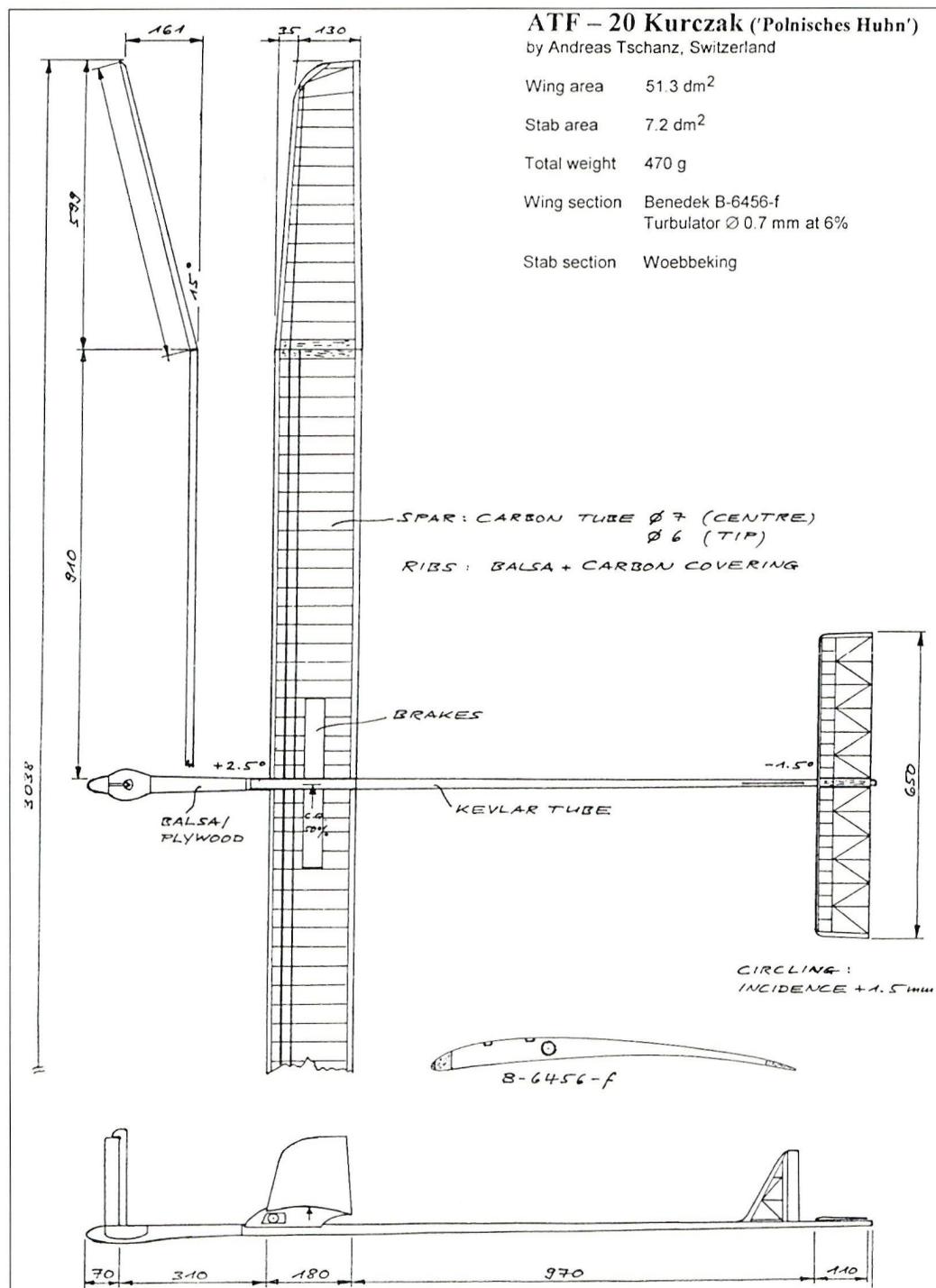
Next time we’ll do better. For events like this, it’s absolutely essential to have at least one large, lightweight model (wing loading 6–8 g/dm²) to stay in the slope lift for a long time. On the other hand, you also need to be able to use at least two fast wind models. We’ve noticed that some Romanians and Hungarians have a horizontal stabilizer that’s deeper than the wings (about 200 mm and 180 mm, respectively) and has an aspect ratio of 2.5. Most of the lightweight models used are equipped with or reinforced by carbon fiber parts. Caution is advised if there are high-voltage power lines in the flying area!
All competitors except the author use a front-mounted control system.
Romania, Poland, and the Czech Republic fielded full junior teams; Slovakia fielded two junior players, while Hungary and Switzerland fielded only one each.
Currently, several nations are making a serious effort to develop young talent.
For example, there are competitions where adults are only allowed to participate if the club sends at least one junior. You can’t forbid a junior from building his own model, but at least you try to prevent the father from taking over the model. This has led to self-reliant young people in some teams who have strong team spirit, especially among the Romanians. The results speak for themselves. At the World Championships, the top junior scored more points than our world champion, Andreas. In the World Cup, juniors hold positions 4 (tiebreaker) through 8. Michi Bleuer is the top Swiss competitor!
In the future, we must capitalize on the junior category and give our juniors the opportunity to participate in real competitions. Participating in international championships motivates young people and helps them gain the experience they need to become competitive.
The Free Flight category, which is flown by only a few, has the advantage that there is a high probability of being selected for the national team. Since only a few juniors participate, success is within reach. Hopefully not for much longer...
To ensure the continuity of these categories, the young pilots must be motivated and financially supported. Some nations are already hesitant to travel to certain Eastern European countries because the entry fees are high. We are counting on a gesture of solidarity from the AeCS, the model flying clubs, and our sponsors!
Maurice Bodmer
(Translated from French by Madeleine Bodmer)

EURO CONTEST GLIDER ACRO TOUR AUSTRIA 2026

THE PC-21 STORY
 Emil Giezendanner

TWIN TOWN PARTNERSHIP
 Wolfgang Voeller

SUMMER FUN 2026 AT MG USTER
Martin Wunderli
CORSAIR F4U – A WARBIRD WITH A MEMORABLE LOOK
Jürgen Rosenberger, Jürgen Prinz
52. 2026 ALPS CUP
Emil Giezendanner
YOU KNOW WHAT I MEAN? 125 YEARS OF THE SWISS AERO CLUB
Emil Giezendanner
News from HEBU

TEAM MANAGER "THIS" BOSSHARD
Rodito Nussbaumer
ATOM, THE NEW DOUBLE-DECKER FROM CPLR
 Matthias Bosshard

F3A EUROPEAN CHAMPIONSHIPS IN ST-MACAIRE, FRANCE
Matthias Bosshard
INSIGHTS INTO THE HISTORY OF SEAPLANES

WELCOME, NEW MEMBER!
Andrea Bolliger
What's New at Leomotion.com

PRIDE AND GOOD IDEAS
 Markus Nussbaumer

SMALL, MODEL-LIKE SAILBOATS
Res Dauwalder
FREE FLIGHT IN THE MIDDLE OF SUMMER
Urs Muntwyler
BY YOUTH, FOR YOUTH
Lorena Betschen
HORIZON HOBBY/LEMACO NEWS: MICRO OV-10 BRONCO 645 MM BY E-FLITE

34th HAHNENMOOS ALPINE MODEL AIRPLANE CAMP
Res Dauwalder
COUPE DES ALPES – OBSERVE AND LEARN
Rodito Nussbaumer
TRY-OUT DAY AT MFV WETTINGEN
 Urs Keller

NEWS FROM HEBU
 Julia Bucher

NOS REGION – A HUB FOR ELECTRIC AVIATION
Emil Giezendanner
MEMORIES
 Wolfgang Völler

70 YEARS OF THE NIDWALDEN MODEL AIRPLANE CLUB
Martin Barmettler
A SPECTACULAR F3A WORLD CUP IN THE PRINCIPALITY OF LIECHTENSTEIN
Emil Giezendanner
FROM 0 TO 100
Markus Nussbaumer