
Is it all just junk from China?
It may be regrettable, but it is undeniable: the vast majority of our model accessories are manufactured in Southeast Asia. For years, we in Europe have benefited from this in the form of a wide range of products, low prices, and—this, too, is hard to deny—ready-to-fly models that have now reached a level of quality that the average model airplane enthusiast could not match even in his own workshop. The production center is located in the Guangdong region of southern China, bordering Hong Kong to the north. I traveled through the region in March 2010 and, thanks to some good friends, was given access behind the scenes where Mao’s heirs manufacture model engines, electronic accessories, and even models themselves. It was an interesting and enlightening journey through a part of our model-making world that has been little known in Europe until now.
Shenzhen, the rapidly growing industrial city of 12 million people located north of Hong Kong on the Pearl River, has long been regarded as China’s technology hub. In recent years, a thriving model-making industry has also taken root here. Other destinations included the “million-person towns” of Dongguan and Guangzhou further to the northwest.
The journey of discovery began at the electronics company ZTW in one of Shenzhen’s vast industrial zones. Even the drive there is an adventure in itself, as the driving style of Chinese motorists is extremely “creative.” Marked lanes and traffic rules are, at best, merely recommendations. Whoever honks the loudest gets to go first. The taxi driver finds the right block but has to ask around for quite a while before dropping us off at the company building, which looks just like all the others. →
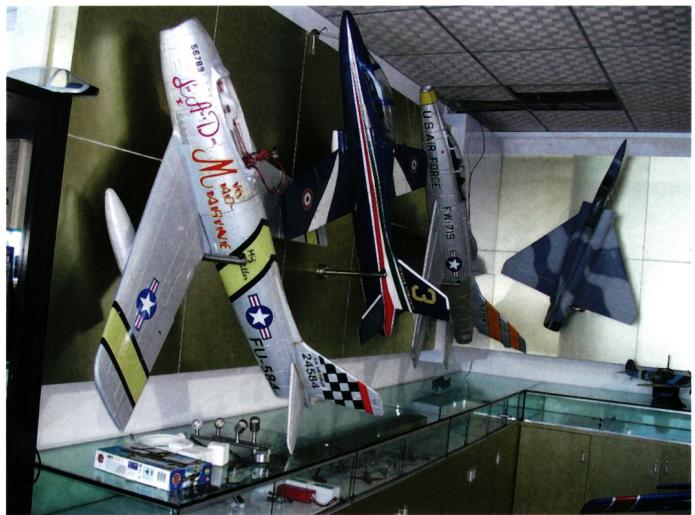
ZTW manufactures speed controllers for brushless model motors. It doesn’t take much of a detective’s instinct to spot the controllers from well-known brands hidden under the black heat-shrink tubing (which they readily confirm). They present the entire product range to us on a red kitchen tray. Fancy a quick tour of the production facilities? They’re happy to guide us through the company and also show us the room where the machine-assembled circuit boards undergo final assembly and are fitted with connection cables. Soldering is done with lead-free tin. As is well known, however, this type of
soldering produces fumes that seem unpleasant and aren’t exactly good for your health. In this country, industrial facilities are therefore required to have exhaust systems that extract and filter the fumes. In China, such problems are solved differently. Each workstation has a fan that directs the fumes to the center of the room, so that ultimately everyone benefits; a “disposal principle” that we would encounter again in various forms. In addition to several room fans, the functional test—which every
motor controller produced undergoes at the end of the process in the same room: It must make a large motor with a big propeller roar for a few seconds; for safety’s sake, the propeller is located behind a wire mesh screen.
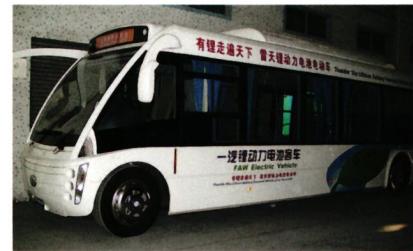
I would have loved to see how LiPo batteries are folded and bagged, but that wasn’t possible. So our journey took us to Thunder Sky, which, according to its own website (http://www.thunder-sky.com/home_en.asp), is the world’s largest manufacturer (world’s largest) of lithium batteries (up to 7,000 Ah). It became clear right from the moment we were picked up in the luxuriously appointed, fully electric company bus just who their clientele is: They manufacture power sources for electric vehicles, among other things. On the streets of Shenzhen, electric mopeds and e-scooters are already more the rule than the exception. But while in Germany—a country known for its automotive industry—people are still debating the environmental benefits and range of an electric Smart car, in China, stretch
limousines and buses with purely electric drives are already cruising the streets. It’s quite possible that safety considerations are also handled rather loosely in this sector; yet
the Far East’s lead in this future technology seems almost tangible. The fact that they are well aware of this explains a great deal. No other Chinese company was quite so tight-lipped. Only exhibits behind glass were allowed to be photographed. The actual production site for the batteries wasn’t even mentioned, and my overly detailed questions were met with the counter-question, “Do you produce batteries?” Well, then—it seems the situation regarding intellectual property protection in China isn’t quite as bad as one might think, provided the balance tilts in the right direction.
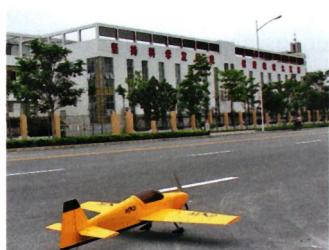
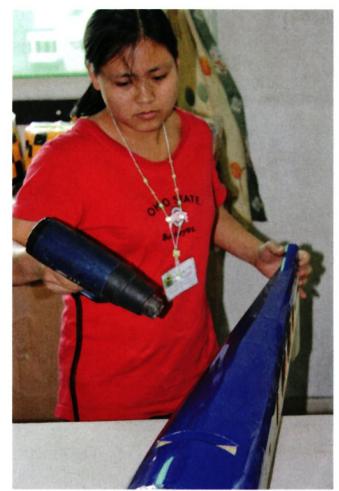
In recent years, Fly Fly Hobby has become known here for its foam jets, which look truly full-scale and fly well. They are sold more or less ready-to-fly by local importers. We were given a tour of the entire production facility—with nothing held back—and they spoke openly about challenges and future projects. We were able to see nearly the entire spectrum of model production, from the assembly of ribbed wings to the demolding and finishing of fiberglass fuselages (it smelled like polyester). It’s striking that a large number of female workers are employed solely to fill and sand surfaces. This is apparently more cost-effective there than replacing worn-out molds. →
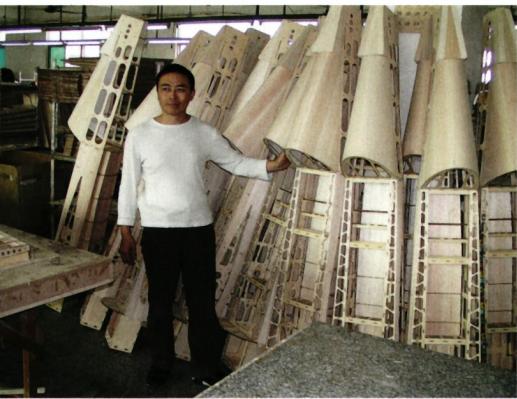
However, the workers—who are paid very low wages by European standards—by no means seem like serfs to their employer. There are signs of a growing awareness of workplace safety. Anyone who produces sanding dust or handles adhesive wears a green cloth mask over their mouth and nose. Let’s hope it also helps the rank-and-file worker at the paint station. After all,
his personal health is served by a large fan that immediately vents the paint fumes into the fresh (?) air. A little more stifling air doesn’t matter much in southern China anyway. If you could see the sun, it would surely be a little hotter. The Fly Fly Hobby company building also houses a well-staffed development department. It’s possible that the young men sitting at their flat-screen monitors have absorbed quite a few Western designs and incorporated them into their CAD program, but they work with a high degree of creativity. Clearly, there’s still a long way to go before the accessories developed there give the expensive Western quality manufacturers a run for their money. For now, they’re still catering more to the consumer-oriented segment of the Western hobbyist market. But even the Japanese audio industry hadn’t yet penetrated the true audiophile market in the 1960s.
Almost exactly ten years ago, a German trade journal published the building instructions for a new type of model engine. Today, tens of thousands of LRK external-rotor motors are manufactured in China. You can buy them today at prices that back then wouldn’t even have covered the cost of materials. I was determined to
figure out how this works. Xingyaohua Industrial Co. Ltd. in Shenzhen manufactures model motors of all sizes and shapes. They don’t follow any particular philosophy; instead, they build what the market demands: in-runners, out-runners, large, small, cylindrical, or shaped like a bicycle bell—anything is possible! Every major customer can choose the anodized color they want from the catalog of available options. The “spoke design” of the rotor bell is just as customizable as the type and number of vent holes in the front mounting plate. The motors are manufactured on the company’s own lathes and milling machines, which look as though they might have served European companies in a previous life. The same seems to apply to the injection molding machines used to produce the plastic parts.
The motors are wound almost exclusively by the diligent hands of Chinese women. Whether the correct number of turns is determined by concentrating on counting them precisely is not up for debate. Rather, the length of the wire bundles is determined in advance and then simply wound until they reach the stop. An optimal fill factor cannot be the top priority here. Certain variations between individual units are understandable. Otherwise, however, the work is carried out with seasoned professionalism. The parts are—
We couldn’t leave out the manufacturer that has distinguished itself in recent years with models of the very highest quality—and for whom companies such as Silvestri, Hyperion, and Hepf, among others, have their models manufactured. In the past, complete designs were usually sent to Haikong Mfg. Co. (http://www.dghaikong.com/) in the unadorned industrial area for production.
in the city of Dongguan, located further north. Today, the company’s in-house talent pool there is so well-developed that simply specifying the aircraft type and scale is enough to have a particular model built.
Precision seems to be primarily a management responsibility even in China. The company’s CEO, who goes by the name Mr. Bear to make it easier for Western ears, founded the company in 2004 with ten employees after he was no longer satisfied with the quality standards of his former company (name known to the author). He now employs more than 200 workers, aged 18 to 40, most of whom live on the factory grounds in a multi-story residential wing and are also provided with meals there. Accommodations are typically in 6-bed rooms, separated by gender on each floor. An unskilled worker usually earns the equivalent of 150 € per month, with free room and board. In case of illness, a doctor is available at the company’s expense. A design engineer (engineer) earns about twice that amount. Without being asked, Mr. Bear immediately adds that all of his company’s key experts are relatives. The accountant and executive secretary are his wife. This is how the experienced Chinese entrepreneur protects himself against intellectual property theft.
At first glance, the working hours seem less attractive by European standards: 7:30 a.m. to 11:30 a.m., followed by a lunch break, then 1:30 p.m. to 5:30 p.m. Dinner. Then back to work from 6:30 p.m. to 9:30 p.m. Six days a week. Sundays are off. They only go home—usually deep in rural China—for the Chinese New Year.
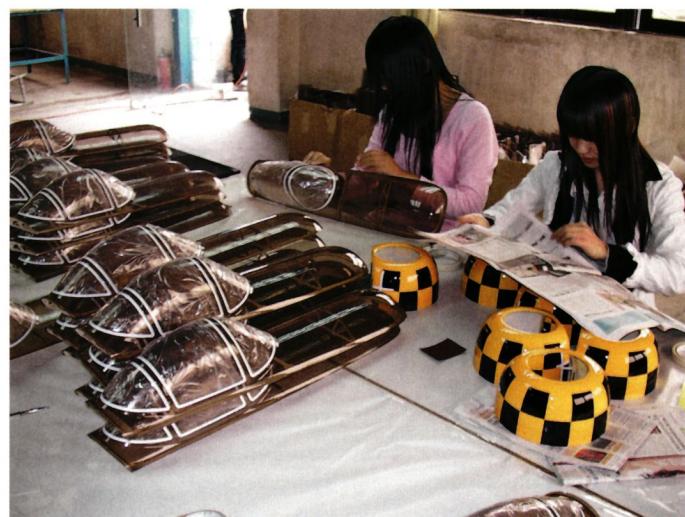
The work atmosphere in such a Chinese model factory, however, seems neither hectic nor frantic, but rather highly focused. Workers do not let themselves be distracted from their work by the long-nosed visitors or their annoying camera flashes. The young Chinese workers have long since shed their Mao-era standard blue work uniforms. They show up at work strikingly well-dressed. They’re happy to be among those who have jobs and can go shopping on Sundays in the sprawling and unimaginably crowded shopping malls. The money they have left is always enough for a new T-shirt and, eventually, a fancy Nokia cell phone—even if the printed brand names don’t always seem entirely authentic. It is undoubtedly our Western lifestyle that China’s youth has chosen as its model. Any practicing model airplane enthusiast who steps into the production facilities initially feels as if they’ve entered a land of milk and honey. Shelves full of
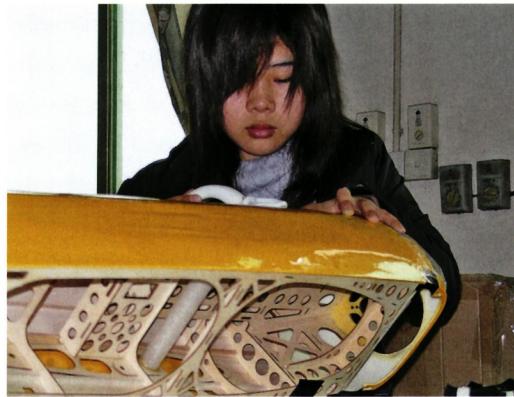
Fuselage shells, wings, and tail sections—as they make their way through the factory, they gradually undergo the reverse of what we call a “striptease” in this country. But this isn’t just a matter of tinkering on a grand scale; this is production. Balsa boards are cut to size, sanded, and—believe it or not—weighed. It must not happen that one wing half weighs significantly more than its counterpart. Load-bearing parts—generally made of plywood—are cut with a laser beam, including all lightening holes. The hot beam cuts the boards with minimal waste; whatever remains is put to good use as fuel in the kitchen while cooking rice.
The molded parts, such as tail surfaces, wings, and fuselages, are created
on simple wooden molds. And although they may seem primitive, they are precise to the millimeter and structurally sound. Nothing goes wrong, and every fuselage fits every wing. After the glue is applied, the fabric is secured with plenty of rubber rings. The parts are glued together with superglue and, at times, a (slightly excessive) amount of white glue.
It’s a downright voyeuristic experience to be allowed to watch the models being ironed. Not only because this demanding precision work is done almost exclusively by young women, but also because you feel you might finally be able to uncover the secret to wrinkle-free foil ironing. I would have loved to ask one of the ironers how she manages to iron foil onto foil without those ugly air bubbles always sneaking in between. But the language barrier proves to be nearly insurmountable. No one speaks even a single word of a language other than Chinese. And even the otherwise so helpful “sign language” proves, in the Middle Kingdom, to be a very shaky bridge between cultures at times—even though our shared hobby has already brought us significantly closer together.
*Ludwig Retzbach*


News from HEBU

TEAM MANAGER "THIS" BOSSHARD
 Rodito Nussbaumer

YOU KNOW WHAT I MEAN? 125 YEARS OF THE SWISS AERO CLUB
 Emil Giezendanner

HORIZON HOBBY/LEMACO NEWS: MICRO OV-10 BRONCO 645 MM BY E-FLITE

PRIDE AND GOOD IDEAS
 Markus Nussbaumer

34th HAHNENMOOS ALPINE MODEL AIRPLANE CAMP
Res Dauwalder
TRY-OUT DAY AT MFV WETTINGEN
Urs Keller
F3A EUROPEAN CHAMPIONSHIPS IN ST-MACAIRE, FRANCE
 Matthias Bosshard

52. 2026 ALPS CUP
Emil Giezendanner
ATOM, THE NEW DOUBLE-DECKER FROM CPLR
Matthias Bosshard
SUMMER FUN 2026 AT MG USTER
Martin Wunderli
What's New at Leomotion.com

THE PC-21 STORY
Emil Giezendanner
COUPE DES ALPES – OBSERVE AND LEARN
Rodito Nussbaumer
TWIN TOWN PARTNERSHIP
Wolfgang Voeller
EURO CONTEST GLIDER ACRO TOUR AUSTRIA 2026

BY YOUTH, FOR YOUTH
Lorena Betschen
CORSAIR F4U – A WARBIRD WITH A MEMORABLE LOOK
Jürgen Rosenberger, Jürgen Prinz
SMALL, MODEL-LIKE SAILBOATS
Res Dauwalder
WELCOME, NEW MEMBER!
Andrea Bolliger
FREE FLIGHT IN THE MIDDLE OF SUMMER
Urs Muntwyler
INSIGHTS INTO THE HISTORY OF SEAPLANES

NEWS FROM HEBU
 Julia Bucher

FROM 0 TO 100
Markus Nussbaumer
MEMORIES
Wolfgang Völler
NOS REGION – A HUB FOR ELECTRIC AVIATION
Emil Giezendanner
DO YOU KNOW WHAT I MEAN IN THE LAND OF SMILES?
Emil Giezendanner
A SPECTACULAR F3A WORLD CUP IN THE PRINCIPALITY OF LIECHTENSTEIN
Emil Giezendanner