
Ka-8 – A Piece of History as an XXL Model
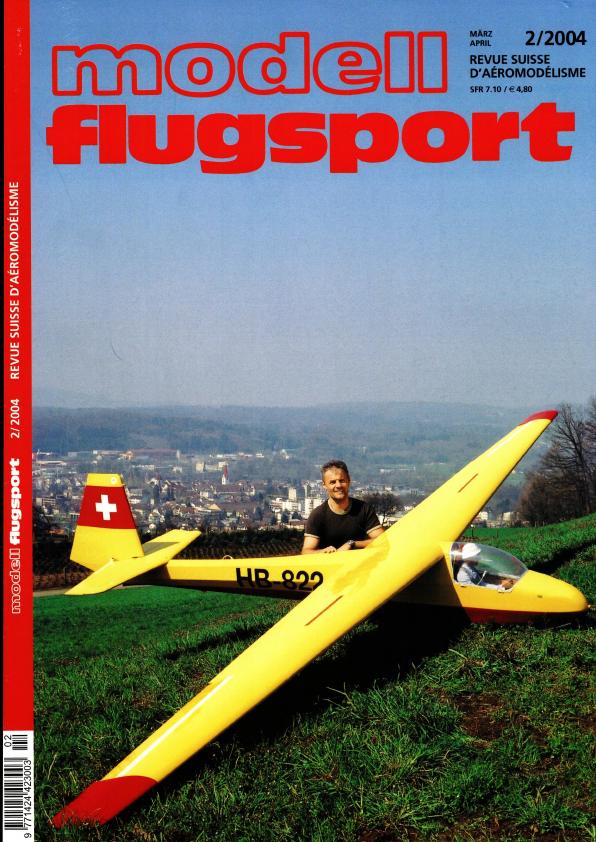
The Ka-8, arguably one of the most widely produced gliders, has virtually disappeared from the skies in its original form. Once one of the most popular group-flying gliders, on which thousands of glider pilots earned their first stripes after obtaining their license, the Ka-8 is now seen primarily at vintage glider gatherings. Patrick Trauffer fulfilled his long-cherished dream of owning such a glider by building it himself—albeit “only” on a 1:2 scale.
It was in the winter of 1995 when Patrick heard that overhaul work on a Ka-8 was underway in the workshop at the Birrfeld airfield. This was the perfect opportunity to photograph and measure the glider’s details, and it marked the start of a sensational project. Patrick had long been certain that it had to be a Ka-8, because to him this glider is the most beautiful vintage model from that era, and it’s very well-suited for model-building since it doesn’t have too many curves. The fact that many original Ka-8s are painted yellow suited Patrick just fine, as he wanted a colored glider—finally something different from the usual white ones. Patrick already had experience building a vintage glider—namely, a Rhönlerche in 1989 with a wingspan of 4.70 m, built from an FMT plan. After his visit to Birrfeld, Patrick had good photographic documentation and numerous measurements, but no plans for the fuselage or the wings. He had drawn the plans for the rudder and elevator himself, since he had been allowed to borrow these parts from the original. Patrick then wrote to the Schleicher company in Germany, the successor to the factory that had produced many copies of the original. Soon afterward, he received copies of the original plans—particularly those of the wings, with all details such as air brakes, power units, etc., at scales ranging from 1:1 to 1:10—but no documentation regarding the fuselage. Patrick had no choice but to draw the fuselage himself based on a three-view drawing. This required a lot of paper, because at a scale of 1:2, the fuselage plan was 3.5 m long and the one for a wing was as long as 3.65 m. Given the size of the model, Patrick decided to use the original wing profile, a Gö 533 with 4.7% camber and a substantial 17% thickness at the root. This was the only way to fit the profile’s strongly curved upper contour into the fuselage contour without having to alter it.
Once the plans were finished, Patrick quickly got to work on the build. His apartment became a woodshop, because this was no longer about model-building in the traditional sense. For example, Patrick had to “step into the living room” whenever he wanted to turn the fuselage or a wing. He worked away at it at a brisk pace until 1998, when the crisis—which was practically inevitable given the amount of work involved in this project—hit. Patrick had the veneer, and there were other reasons as well that led to the already completed parts becoming covered in an ever-thickening layer of dust. Anyone who assumes that Patrick simply sat around doing nothing is mistaken. Rather, he simply turned his attention to other projects; among other things, he “quickly” built the airframe of a Fokker DR 1 on a 1:2 scale! In 2002, however, he turned his attention back to the Ka-8 and began the final push. What Patrick created over a total of about 2,000 hours of work will now be described in more detail below.
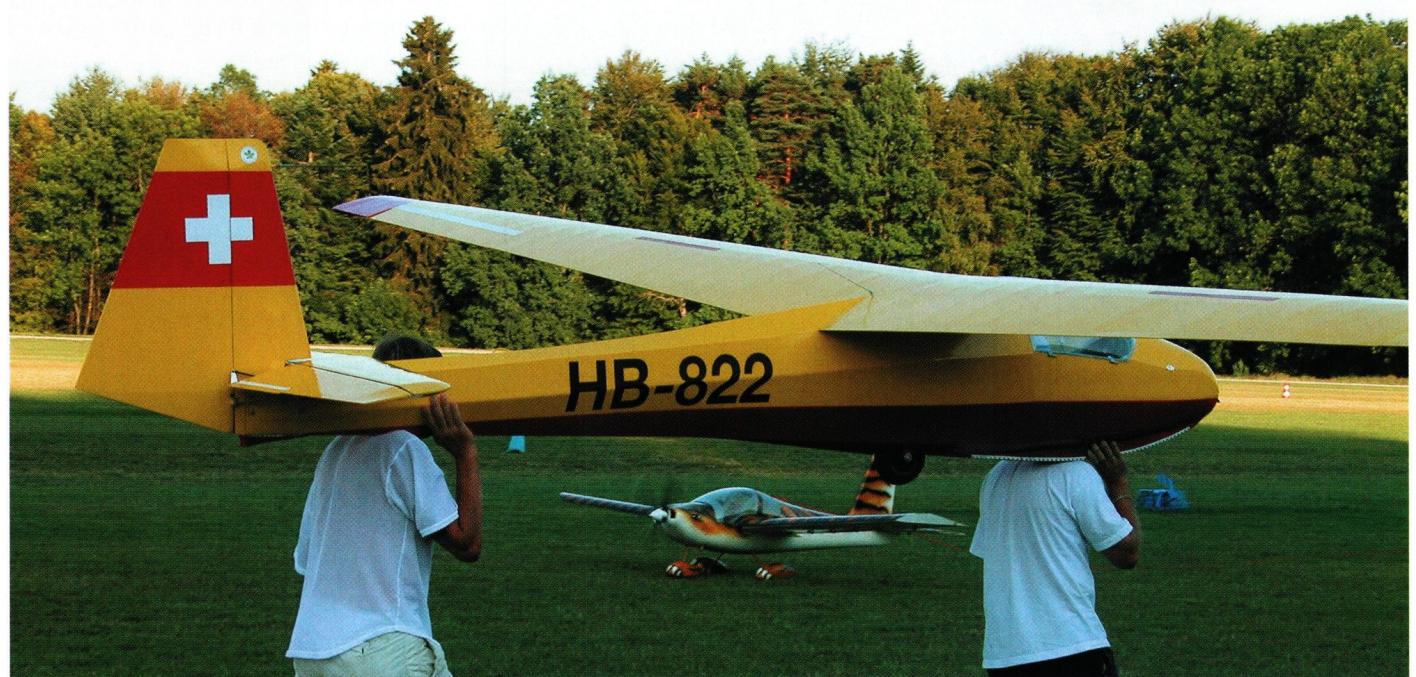
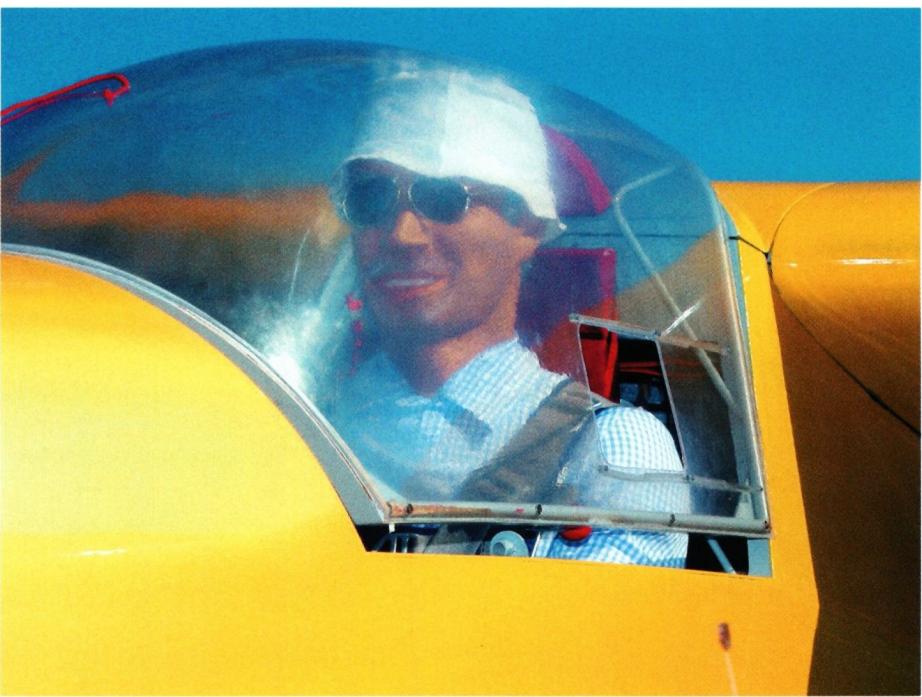
The hull is made almost entirely of wood. Although this construction method is not true to the original—since the original hull was welded together from steel tubes—the wooden replica was much easier to build. For the half-frames, Patrick used 3-mm-thick poplar plywood, dividing the frames horizontally at the level of the fuselage chord. The lower half of the fuselage was built on its back, and then the upper half was assembled on top of it. For the stringers, Patrick used beech and pine strips from the hardware store; for the planking, he used 1.5-mm balsa. At the very end, Patrick attached pine strips in the locations where the steel tubes of the original’s lattice structure were located, onto which he glued round beech wood pieces. Thanks to this clever trick, an uninformed observer would think, after the model is covered, that they are looking at a steel-tube structure. As with the wings and tail surfaces, Toni Clark’s Proficover reinforced fabric was used as the covering material. Unlike the tail, the landing gear is not sprung; however, thanks to its 160-mm diameter, the wheel—equipped with a brake—can handle even rougher bumps. Patrick carved the positive mold for the cowling out of Styrodur, covered it with plenty of fiberglass and carbon fiber, then spray-painted it with three coats of two-component paint and finely sanded it. Due to time constraints, he abandoned his original plan to have the hood manufactured by the Ulmer company in Germany. Online, he came across the company Grütter Kunststoffe in Hombrechtikon, which produced a beautiful hood for him from 3-mm PET, approximately 45 cm long and about 25 cm high. Patrick fitted this with a plywood frame, which he combined with brass tubes—again to imitate steel tubing. The hood opens to the side, true to the original, and is locked with bolts operated through the side window. Under the hood, a pilot from the family of Axel’s scale figures makes himself comfortable.
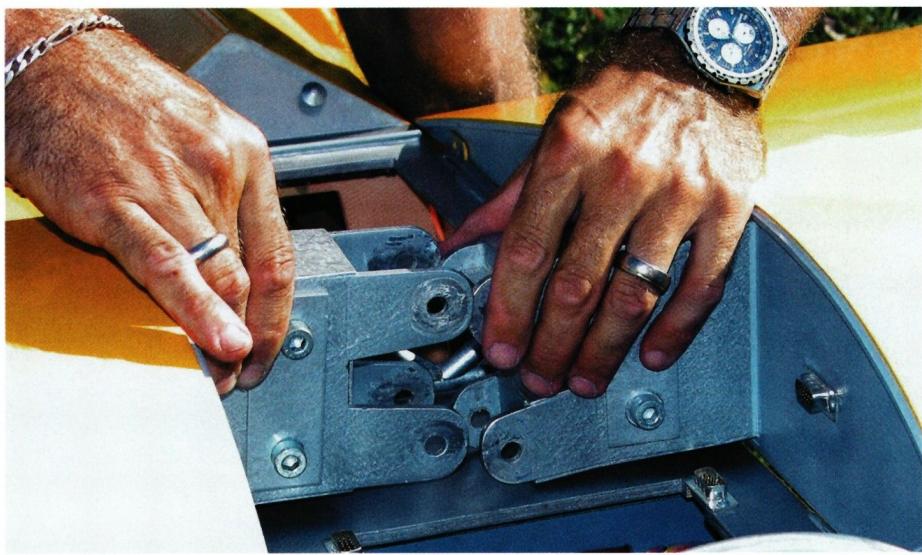
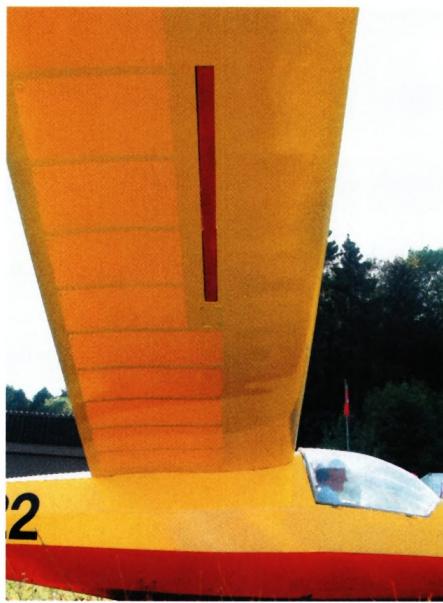
For the wing, Patrick was able to count on the help of his colleague Rolf Fritschi, who used a CNC-controlled milling machine to cut the ribs from 1.5 mm thick plywood. Since the router wasn’t large enough, the ribs had to be split at the main spar, which is not surprising given the root profile depth of 65 cm. Patrick had Max Vogelsang fabricate the spar stringers from multi-laminated Douglas fir. The stringers were boxed on both sides along their entire length with 3-mm-thick aircraft plywood. Half-ribs were installed in front of the spar, true to the original design, to improve airfoil accuracy. The trailing edge consists of two plywood strips, each 1.5 mm thick. Patrick pre-shaped the 0.6 mm thick plywood skin by soaking it in water, after which he was able to wrap it around the wing leading edge. A total of eight skin segments were required per wing, which were joined end-to-end. Patrick chose not to tenon the planking segments as in the original, as the effort involved would have been too great. The ribs were fitted with stringers, and the transition between the ribs and the nose planking was reinforced with triangles made of 0.6-mm plywood. All skin parts were glued with 24-hour epoxy resin, which was slightly thickened using cotton flakes. The air brakes, constructed of wood as in the original and extending both upward and downward, are hinged via a continuous brass lever. During their construction, Patrick had a mishap when, due to carelessness, he built the brakes to the original width of 56 mm. But he knew how to remedy the situation when he noticed the mistake. Without hesitation, he placed the brake flaps under the band saw and cut them lengthwise into two equal halves. The spar fittings are made of 5 mm-thick aluminum and were screwed and glued to the spar stringers on both sides. Two M6 screws serve as bolts and connect the spar fittings when mounting the wings. The fuselage is suspended between the wings on pins that extend into the root ribs. Patrick omitted the wing dihedral, which on the original model is 8.5 mm in the aileron area.
Patrick covered the forward section of the fuselage—which, like the original, is planked with plywood—with fine fiberglass mesh. Then came the process of filling, sanding, filling, and so on. Afterward, a white acrylic-based primer was sprayed over the entire surface of the aircraft to ensure that the next coat of paint—yellow—would have a uniform tone. The same type of paint—acrylic—was used for the Swiss cross and the other decorations. Finally, the entire glider was coated with a satin-finish two-component clear coat. Patrick didn’t hold back and sprayed a total of 11 kg of paint, of which, by his estimate, about a third went into the air. He greatly appreciated the help of Fredi Moser from the Moser Auto Paint Shop in Altstetten, who, according to Patrick, needed nerves of steel.
Since very large control surfaces need to be actuated, very powerful servos had to be selected. Patrick chose the Hitec 805 BB with 25 kg of thrust for the ailerons, elevator, and rudder. One such servo is used for each flap. The two elevator servos, mounted at the front of the fuselage, are connected to the elevator surfaces via carbon pushrods. The rudder servo, also located at the front, drives the rudder via a 1-mm wire cable. Patrick also installed a Hitec 805 BB for the tow hook and the landing gear brake. One Futaba servo each is responsible for the air brakes. The servos receive their signals from a Graupner DS-20 receiver. Two batteries, each with a capacity of 2.4 Ah, and a DPSI battery switch provide the power. For safety reasons, Patrick flies with a Telario so he can constantly monitor the onboard voltage. A Graupner/JR Mx 22 is used as the transmitter.
From the very beginning, Patrick assumed that his Ka-8 would have to undergo official certification due to its weight. The weight he had calculated—about 33 kg—was exceeded by roughly 3.5 kg. Franz Walti was the first to arrive for the aircraft certification. He did not focus on the underlying calculations but instead inspected the plans, spar construction, gluing, and structural integrity. The assembled aircraft was lifted on both sides at the base of the ailerons and supported from below, after which a load of 2 to 3 g was applied to the fuselage at the wing attachment point. Patrick audibly breathed a sigh of relief when no cracking sounds were heard. The expert also carefully inspected the linkages and their play. His only requirement was that stronger servos be installed for the air brakes.
Emil Hinnen from the Graupner service center then inspected the radio control system, paying close attention to the components used and ensuring the servos were installed cleanly and securely. His only criticism was that Patrick had soldered the two battery packs—each consisting of 5 NiCd cells—in parallel, citing a fire hazard in the event of a short circuit. The entire aircraft inspection took about two hours.
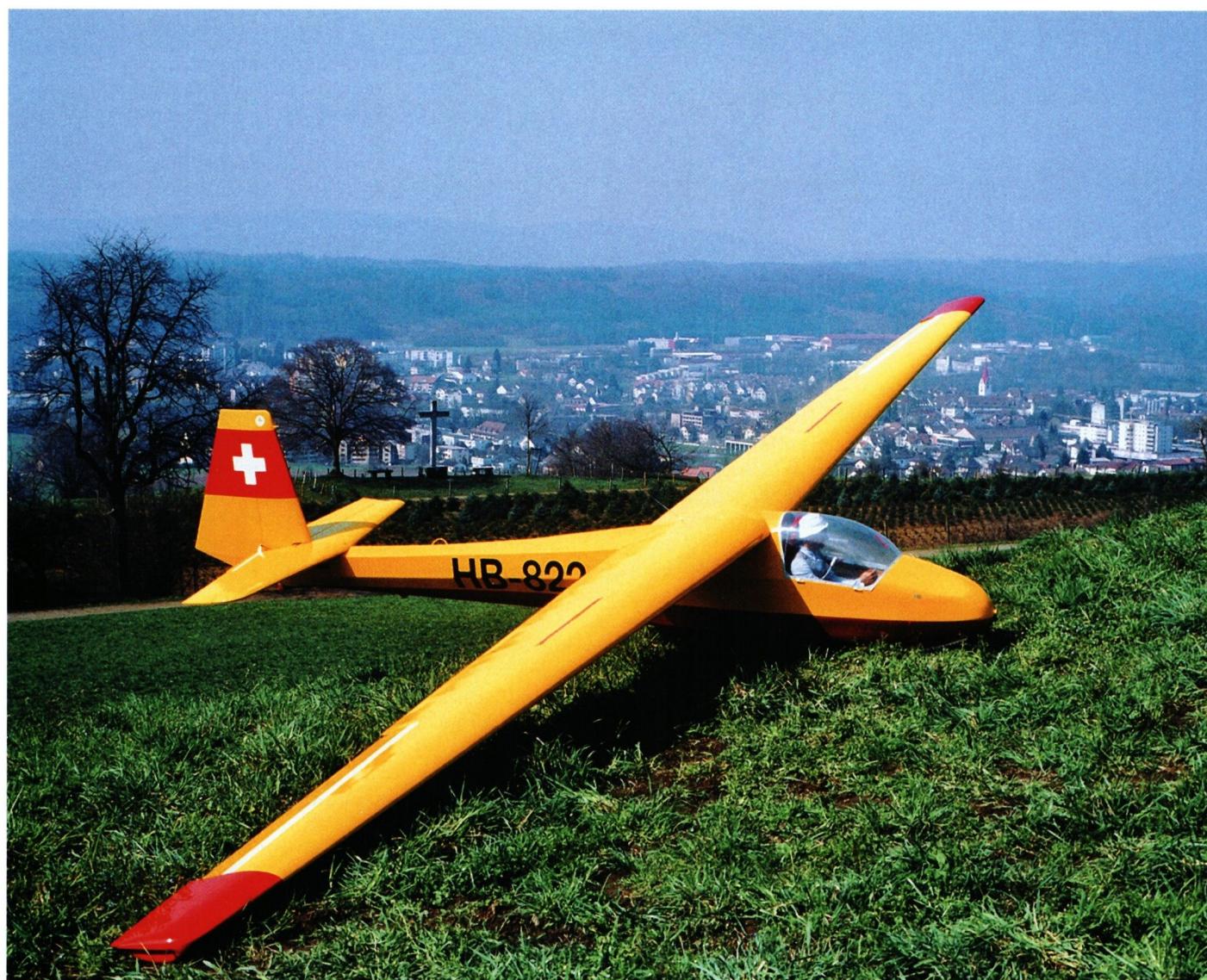
The time had finally come for flight testing. But how did the large glider make its way to the airfield for the first time? Fortunately, Patrick was able to use a trailer onto which the Ka-8 was loaded. During later trips—this time by car—the wings stuck far out the back of the vehicle. On August 21, 2003, the Ka-8 took to the air for the first time at Buttwil Airfield. As the tow plane—a Swiss Trainer with a 150-cm³ engine, piloted by Egon Kraft—uncoiled the 35-meter-long tow rope and accelerated the tow combination, Patrick, who was piloting his Ka-8 himself, looked strikingly pale. However, the immense tension soon gave way to a look of satisfaction after the majestic glider had lifted off after only about ten meters and was following the tow plane as if on rails. After being released at around 350 m, the Ka-8 flew like a charm. The center of gravity was correct; when it stalled, it tipped harmlessly over one wing and continued flying steadily afterward. Over the course of three flights, Patrick became more familiar with the characteristics of his Ka-8. Even in flight, it is practically indistinguishable from the original; in particular, it can be flown at a scale-appropriate slow speed, which is certainly due to the original airfoil profile. Even the smallest thermal can be worked by flying slow, tight circles, though the turns must be precisely controlled with the rudder. This is where the incredibly low wing loading of just 27.4 g/dm² comes into play. Thanks to the model’s size, it can be flown very far. The “too good” glide ratio took some getting used to; even with the flaps fully extended, the landings seemed to go on forever. Patrick also had to get used to the model’s susceptibility to crosswinds. On subsequent flights, the Ka-8 was accompanied in flight by a real Piper Super Cub, from which Urs Pircher filmed and took photographs, while a counter-camera in the Ka-8 also captured footage. The Ka-8 has not yet been used for slope launches. Patrick plans to launch it using a rubber catapult, which is scheduled to happen later this year. Launches from behind a real Piper Super Cub are also planned, using a very long rope measuring 100 to 150 meters.
Some readers may wonder who built this spectacular glider, which can hardly be called a model—it’s much more like an airplane. Patrick Trauffer is 35 years old and the father of two children. After completing an apprenticeship as a architectural draftsman, he did an additional apprenticeship as a mason. For several years now, he has been working in rail maintenance in the city of Zurich—exclusively at night. This leaves him 5 to 6 hours during the day to build his models. One might rightly wonder when this man ever gets any sleep. Well, there are simply people who have more stamina than others. Patrick’s next project also reveals that he’s equipped with a great deal of stamina. It’s a 1:1.5-scale Lo 100. That’s not a typo—the plans and initial parts already exist. This replica of the world-famous aerobatic glider—designed several decades ago—will have a wingspan of 6.66 m, a fuselage length of 4.14 m, and a tailplane span of 1.8 m. Patrick estimates a flight weight of 30 to 50 kg. But that would be a story for another time...
| Class | Club |
| Model Years (from to) | 1957–1976 |
| Number of units | 875 |
| Designer | R. Kaiser |
| Wingspan (m) | 15 |
| Length (m) | 7 |
| Height (m) | 1.58 |
| Wing area (m²) | 14.15 |
| Wing aspect ratio | 15.9 |
| Wing profile (inner/center/outer) | Gö 533 / Gö 532 |
| Assembly weight (kg) | 191 |
| Maximum takeoff weight (kg) | 310 |
| Max. wing loading (kg/m²) | 21.9 |
| Minimum speed (km/h) | 55 |
| Glide ratio | 25 |
| Remarks | + 337 units built under license |

EURO CONTEST GLIDER ACRO TOUR AUSTRIA 2026

THE PC-21 STORY
 Emil Giezendanner

TWIN TOWN PARTNERSHIP
 Wolfgang Voeller

SUMMER FUN 2026 AT MG USTER
Martin Wunderli
CORSAIR F4U – A WARBIRD WITH A MEMORABLE LOOK
Jürgen Rosenberger, Jürgen Prinz
52. 2026 ALPS CUP
Emil Giezendanner
YOU KNOW WHAT I MEAN? 125 YEARS OF THE SWISS AERO CLUB
Emil Giezendanner
News from HEBU

TEAM MANAGER "THIS" BOSSHARD
Rodito Nussbaumer
ATOM, THE NEW DOUBLE-DECKER FROM CPLR
 Matthias Bosshard

F3A EUROPEAN CHAMPIONSHIPS IN ST-MACAIRE, FRANCE
Matthias Bosshard
INSIGHTS INTO THE HISTORY OF SEAPLANES

WELCOME, NEW MEMBER!
Andrea Bolliger
What's New at Leomotion.com

PRIDE AND GOOD IDEAS
 Markus Nussbaumer

SMALL, MODEL-LIKE SAILBOATS
Res Dauwalder
FREE FLIGHT IN THE MIDDLE OF SUMMER
Urs Muntwyler
BY YOUTH, FOR YOUTH
Lorena Betschen
HORIZON HOBBY/LEMACO NEWS: MICRO OV-10 BRONCO 645 MM BY E-FLITE

34th HAHNENMOOS ALPINE MODEL AIRPLANE CAMP
Res Dauwalder
COUPE DES ALPES – OBSERVE AND LEARN
Rodito Nussbaumer
TRY-OUT DAY AT MFV WETTINGEN
 Urs Keller

NEWS FROM HEBU
 Julia Bucher

NOS REGION – A HUB FOR ELECTRIC AVIATION
Emil Giezendanner
MEMORIES
 Wolfgang Völler

70 YEARS OF THE NIDWALDEN MODEL AIRPLANE CLUB
Martin Barmettler
A SPECTACULAR F3A WORLD CUP IN THE PRINCIPALITY OF LIECHTENSTEIN
Emil Giezendanner
FROM 0 TO 100
Markus Nussbaumer