
Interview with Yves Burkhardt, President of the Swiss Model Aviation Association (SMV)
Hi Yves, thanks for taking the time to do this interview.
The reason for this interview is that, in my experience, some model airplane enthusiasts—both men and women—aren’t really familiar with the nature and organization of the SMV. As president, how do you view this issue?
I've noticed that people's understanding of the association has improved significantly, thanks in part to the new website you created. But of course, it will always be the case that elected officials, in particular, have a deeper understanding. The other members of the SMV are primarily interested in pursuing their hobby and spending their free time in the hobby room, at the model airfield, or socializing at the regulars’ table. However, it seems important to me that at least the board members of the model flying clubs are aware of the Swiss Model Flying Association’s governing bodies. I’m thinking in particular of the support that a group can receive from them!
What specific support is actually available, and to what extent is it actually being used?
The SMV has a whole range of centers of expertise that clubs would benefit from working with. I’m thinking primarily of the expert commissions (Fakos) and the working groups (AGs).
From the clubs’ perspective, the most important working group at the moment is probably the Model Airfield Working Group, led by Adrian Eggenberger. It has been demonstrated time and again in recent years that this group can provide both advice and practical support when it comes to preventing pressure on model airfields from arising in the first place—or finding suitable solutions in difficult cases. Thanks to several years of work in this area, a great deal of experience has been gained regarding legal options and the ideal course of action!
The recently established Safety Working Group, led by Edgar Bruhin, will certainly be very important as well; against the backdrop of the trend toward large-scale and jet models, it is addressing the issue of safety in an intensive and concrete manner. The spontaneous willingness of well-known Swiss model pilots from various disciplines to participate in this working group gives us reason to expect great—and, above all, practical—results.
And then there’s your PR and Communications Working Group, which offers concrete support when it comes to presenting model aviation to the public with the necessary weight and in the right light.
Can you share some specific achievements of the Model Airfield Working Group with our readers?
Of course! Numerous model aircraft clubs in various regional associations have received support and advice during the appeal process. Other clubs have contacted the working group in connection with the implementation of the Spatial Planning Act and have sought site-specific information. A master plan for all Swiss model aircraft clubs—covering locations, surrounding areas, and general issues—is also currently being developed. Representatives from the regional model aircraft associations, who have been trained by the Model Airfields Working Group, are working on this plan.
Not to mention, discussions were held with OFCOM to ensure that the first frequencies in the 35-MHz band will finally be available starting around 2003.
Suppose a club president wants to take advantage of one of the offers. What is the best way to proceed?
If these are fundamental questions of a general nature,

So it’s worth taking a look at our website first. There, virtually all relevant documents from the Model Flying Association, the technical committees, and the insurance provider are available for anyone to download as PDF files. The same website also lists virtually all email addresses so you can contact regional board members, technical committees, and working groups with questions even outside of business hours.
It seems important to me that, in the event of major problems, you first seek help through the regional association presidents. They can often provide adequate initial answers on their own.
In general, however, the following applies: In the event of problems with authorities or interest groups, under no circumstances should you make concessions out of fear or time pressure before the assistance offered by our organizations has actually been fully exhausted!
Speaking of organizations: Can you explain to our readers here, in as few words as possible, why membership in the AeCS is—or should be—essential?
In a nutshell... That might be rather difficult, because the AeCS does an incredible amount for its members! And I really don’t want to leave anything out, because the value of its services far exceeds the annual membership fee:
The Aero-Club of Switzerland (AeCS) is the national umbrella organization for aviation sports and light aviation. As such, it represents the disciplines of model aircraft, powered flight, gliding, hot-air ballooning, skydiving, microlight, helicopters, and amateur aircraft construction.
It is also commissioned by the federal government to provide preliminary flight training (FVS), for which it handles management, organization, and promotion. It goes without saying that the selection courses for prospective military and professional pilots are also attended by many young model aircraft enthusiasts.
The AeCS successfully supports approximately 21,000 active members across its various divisions in around 350 local clubs and groups.
"It's a huge general store," one might say critically. Aren't there immense inefficiencies there?
No. On the contrary! Thanks to the extensive expertise available at the AeCS Central Secretariat, all sectors of light aviation can be supported and guided competently, cost-effectively, efficiently, and effectively. In doing so, the Aero-Club of Switzerland also actively coordinates the needs of the individual sectors; for example, it promotes partnership-based cooperation at airfields in collaboration with the regional and sector associations.
And here’s another important cross-sectoral matter: The AeCS is entrusted with the fiduciary management of funds from the Pro Aero Foundation (subsidies for clubs and competitive sports). It applies for these funds based on the budget requests submitted by the sectoral associations. For 2002, the total amount for the AeCS, depending on market interest rates,
market interest rates, amounts to no less than CHF 100,000!
That's quite a bit, but how much of that actually goes toward model aircraft flying?
This, too, depends each year on developments in the capital market and the current interest rate situation in the financial markets, since the foundation’s capital itself may not be touched.
To answer your question specifically: The SMV is expected to raise approximately CHF 27,500 in 2002.
In the case of the Pro Aero Foundation, we must also not forget the JuLa youth camp, which has been held for nearly 20 years and has been attended by over 3,000 young people. The youth camp—which, incidentally, was established on the initiative of Werner Koelliker (now an honorary member of the AeCS and the SMV) and Emil Giezendanner—receives substantial annual support of an additional CHF 90,000 from the “Pro Aero” Foundation!
And what does the Aero-Club do for us model airplane enthusiasts in the political arena?
The Aero-Club in Lucerne works with its divisions and regional chapters to draft policy proposals, submit comments on new draft legislation, provide feedback on regulations, and file objections. A good example in this context is the consultation process and advocacy regarding the protocols of the Alpine Initiative, which also affects us model aircraft enthusiasts. Significant work is also being done in connection with the development of the SIL, the Sectoral Plan for Aviation Infrastructure. Submissions and proposals from model aviation clubs were thus incorporated into the consultation process via the AeCS.
I can't really imagine how the Aviation Infrastructure Plan or the Alpine Initiative might affect me as a model airplane enthusiast. I suspect others feel the same way...
Regarding the Aviation Infrastructure Sector Plan: Many model aircraft clubs fly at military airfields, in some cases even at active Air Force bases with mixed military and civilian use. Model aircraft flying also takes place in Switzerland at decommissioned military airfields that are now used for civilian purposes. I recall the 2000 F4 Scale World Championships in Interlaken. And, of course, model flying also takes place at airfields that have always been used exclusively for civilian purposes. The shared use of airfields with a wide range of classifications by model aircraft pilots was therefore deemed relevant during the SIL consultation process and proposed accordingly. These submissions were also supported in solidarity by our partners in light aviation! – Clear proof of the validity and importance of our membership in the AeCS!
On the topic of the Alpine Initiative: The initiative and its implementation protocol would have significant repercussions for model aviation in the Alpine region as well. Excessive protective measures in mountainous areas could make model flying there practically impossible or even ban it entirely. And surely no one wants that—neither the Alpine model glider pilots who fly their large gliders in slope lifts and thermals, nor those model pilots who fly from airfields in the valleys.
Let's leave Switzerland and the Alps behind for a moment. What roles do the SMV and the AeCS play for us model aircraft enthusiasts in an international context?
The AeCS exercises national sporting authority in Switzerland on behalf of the FAI (Fédération Aéronautique Internationale, headquartered in Lausanne), the international governing body for light aviation.
For us model aviators, technical and competition-related matters pertaining to our sport are submitted through the international model aviation organization CIAM (International Aeromodeling Commission).
The AeCS is responsible for issuing and administering all sports licenses for our national teams and competition pilots.
International working groups on light aviation, in which the AeCS is represented, also address issues related to the increasingly congested airspace in Europe and worldwide as part of their work. If model aviators were to stand on the sidelines and spread their efforts too thinly, this would have disastrous consequences in this case as well. Here, just as in the context of Switzerland, the saying applies: “Only together are we strong.”
“Together we are strong” sounds good. Nevertheless, in the survey regarding the association’s publication, a few respondents expressed negative views about the cross-sector Aero-Revue. Given that the majority of our members are likely not active in manned and unmanned aviation, this criticism is understandable. Wouldn’t it be possible to forgo the subscription and allocate the freed-up funds, for example, to supporting our national teams, promoting youth development, or other initiatives?
Thank you for this excellent question! At the 2001 SOK in Murten, we decided to invest funds in a more targeted and focused manner in our airfields, in the sport, and in the national teams; from this perspective, I believe we are already doing a great deal! As for the actual question: Originally, up until about twenty-five years ago, the only publication was the *Aero-Revue*.
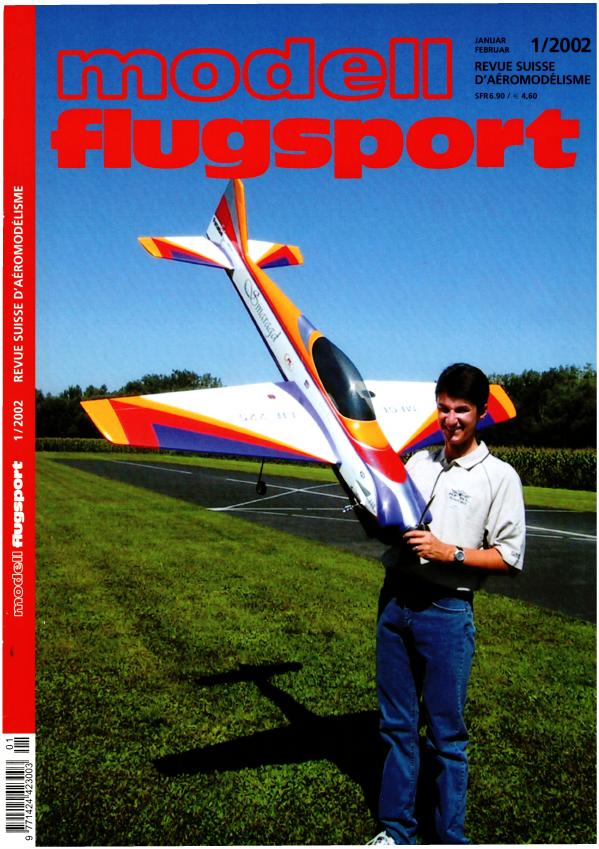
Because articles relevant to model aviation were really being neglected back then, Emil Giezendanner created the magazine “modell flugsport” about 30 years ago as a self-help initiative for model aviators. Over the past few years, “mfs” has evolved into the SMV’s national publication. And given our intention to support the future of “mfs” through formal contracts and as founding members, “mfs” will likely remain our primary official association publication for a long time to come. This is, of course, contingent on the approval of the corresponding motion at the 2002 Swiss Chairpersons’ Conference.
However, this does not explicitly mean that the “Aero-Revue” has no value for us. On the contrary: in order for us to give model aviation the status it deserves within light aviation, it is essential that we are also present and represented in the national
umbrella organization. Only then will our independent and significant sector be recognized as such by the other association members, and only then can we effectively convey our goals, achievements, and messages to those authorities and officials who primarily receive the Aero-Revue as a source of information. Not least for this reason, we are also working to publish more general articles on model aviation in the *Aero Revue* in the future.
Incidentally, other AeCS division associations, such as the Gliding Association, do not maintain a publication with its own logistics and instead integrate their division-specific magazine as a supplement in the Aero-Revue. This would also be a general option for the SMV; however, based on fundamental considerations, the board has given preference to our own magazine with separate logistics—but with more model aviation content and greater substance.
A decision that, for PR reasons, I can only fully support! – In addition to the question of whether *Aero-Revue* is necessary, I’m also occasionally asked whether we couldn’t provide the services of the Central Secretariat ourselves at a much lower cost. What do you think?
The annual membership fee of CHF 55.– (CHF 28.– for youth up to age 18) for the AeCS’s work and services described above, including a subscription to *Aero-Revue*, is, in my opinion, very modest and is put to good use:
The Central Board, together with its administrative office—the AeCS Central Secretariat—serves as a key point of contact for authorities, agencies, associations, insurance companies, and the government. As such, it actively influences Swiss aviation policy (e.g., legislation, airfields, airspace issues, training, insurance, etc.). It is no coincidence that it is also a founding member of the Parliamentary Group on Aviation, a member of the Working Group on Airspace Organization, a member of Swiss Olympic, a member of Aerosuisse (the umbrella organization
of Swiss Aviation), and serves on the Federal Aviation Commission and many other committees. In short: He advocates nationwide for the preservation of aviation infrastructure.
Organizing and managing all competitions and record attempts, as well as the approximately forty different national teams, are just a few of the other demanding tasks handled by the Central Secretariat.
And not to be forgotten: All address management and processing for our association’s printed publication is also handled by the
AeCS in Lucerne. Likewise, membership fee collection for model flying clubs or regional associations can be handled through the Central Secretariat, including the collection of overdue payments!
All of the above tasks are carried out efficiently and cost-effectively by the Central Secretariat and the administrative offices of the AeCS and the SMV in Lucerne.
Efficient and cost-effective: Could you be a little more specific about that?
Yes, I can: The SMV’s “Finance” working group recently conducted an analysis on the topic of the “SMV AeCS flat-rate fee.” The analysis found that, with administrative costs of around CHF 55,000, the value for money is very good. In any case, the SMV could never afford to maintain its own office with the necessary staff for that amount! In addition to pure personnel costs, expenses for office space and technical infrastructure would also have to be taken into account. But even if
it were financially worthwhile, the consistently valuable proximity to aviation partners with similar interests and concerns would be lost.
Thank you, Yves, for your answers. I really hope they helped clarify a few points here and there.
SMV/FSAM PR and Communications Committee Reto Schilliger, NOS, WH 82

EURO CONTEST GLIDER ACRO TOUR AUSTRIA 2026

THE PC-21 STORY
 Emil Giezendanner

TWIN TOWN PARTNERSHIP
 Wolfgang Voeller

SUMMER FUN 2026 AT MG USTER
Martin Wunderli
CORSAIR F4U – A WARBIRD WITH A MEMORABLE LOOK
Jürgen Rosenberger, Jürgen Prinz
52. 2026 ALPS CUP
Emil Giezendanner
YOU KNOW WHAT I MEAN? 125 YEARS OF THE SWISS AERO CLUB
Emil Giezendanner
News from HEBU

TEAM MANAGER "THIS" BOSSHARD
Rodito Nussbaumer
ATOM, THE NEW DOUBLE-DECKER FROM CPLR
 Matthias Bosshard

F3A EUROPEAN CHAMPIONSHIPS IN ST-MACAIRE, FRANCE
Matthias Bosshard
INSIGHTS INTO THE HISTORY OF SEAPLANES

WELCOME, NEW MEMBER!
Andrea Bolliger
What's New at Leomotion.com

PRIDE AND GOOD IDEAS
 Markus Nussbaumer

SMALL, MODEL-LIKE SAILBOATS
Res Dauwalder
FREE FLIGHT IN THE MIDDLE OF SUMMER
Urs Muntwyler
BY YOUTH, FOR YOUTH
Lorena Betschen
HORIZON HOBBY/LEMACO NEWS: MICRO OV-10 BRONCO 645 MM BY E-FLITE

34th HAHNENMOOS ALPINE MODEL AIRPLANE CAMP
Res Dauwalder
COUPE DES ALPES – OBSERVE AND LEARN
Rodito Nussbaumer
TRY-OUT DAY AT MFV WETTINGEN
 Urs Keller

NEWS FROM HEBU
 Julia Bucher

NOS REGION – A HUB FOR ELECTRIC AVIATION
Emil Giezendanner
MEMORIES
 Wolfgang Völler

70 YEARS OF THE NIDWALDEN MODEL AIRPLANE CLUB
Martin Barmettler
A SPECTACULAR F3A WORLD CUP IN THE PRINCIPALITY OF LIECHTENSTEIN
Emil Giezendanner
FROM 0 TO 100
Markus Nussbaumer