
Jets Over Romandy
The first edition of “Jets over Romandie” has come to a close. Not since Payerne 04 have so many military aircraft and helicopters been cheered in the skies over French-speaking Switzerland: Russian, American, and European aircraft gathered in Aigle, in the canton of Vaud, on Saturday, May 7, for a memorable day. The good-natured spirit of a friendly gathering—far from the hassles of judges and regulations—was clearly the goal of a team ready to kick it into high gear on a day when even the threatening weather had better watch out.
While friendship, fun, and passion are the driving forces behind the event, other factors are clearly helping French-speaking Switzerland enter the jet age. For the past two years, the Aigle-Bex Club has operated a 6x90-meter concrete runway in the Aigle industrial zone. The sense of competition sparked by this project was bound to generate enthusiasm, bring a group of friends together, and lead to this first “Jets over Romandie” event. The GAM’s facilities are the envy of many, featuring a spacious shed housing a cutting area/

a building and bar where a friendly atmosphere thrives. They also serve drinks that reflect the proximity to the Valais border. But friendship and passion know no borders. Thus, members of neighboring clubs who practice jet skiing as part of the GAM Aigle-Bex were involved in the organization. The final obvious factor in the category’s success is the advent of the jet ski, which has come into its own thanks to its reliability, safety, and ease of use.
A brief look back shows how the development of a seemingly new technology is a slow process. The first prototypes date back to 1978, featuring turbines powered by internal combustion engines. We cannot fail to mention the journey of a Belgian military pilot, Philip Avonds, who, after years of testing, competed with a twin-turbo F-15 Eagle at the 1986 championships in Oslo. His breakthrough came in
1988 in Gorizia, Italy, followed by Périgueux and Warsaw, Poland, where he won the world and European championships in the F3C scale category. His model fell within the 6-kg limit, and later the 7-kg limit, with two turbines powered by 7.7 cm³ K&B engines. In 1997, his jet was fitted with a genuine JPX T-260 central turbine, with the exhaust flow directed toward the two exhaust nozzles, as is still commonly seen today. As if to remind us of some of the dangers of turbines, a spectacular flame shot out of the model during a flight at a championship in South Africa, followed by a crash. Warning: it’s hot back there!
Today, using a turbine seems almost easy, since starting it is as simple as pressing a button. Furthermore, the general public’s access to commercially available products raised concerns about dangerous misuse that could tarnish the image of model building. Fortunately, that hasn’t happened yet. The turbine remains a sophisticated product reserved for experienced modelers. People tend to keep its price a secret, often responding that when you love something, you don’t count the cost.
Without turning the event into a supermarket, it is worth noting the presence of turbine manufacturers on site: Turbo Jet from the Cagnon workshops in Geneva
DC turbojet manufacturers (
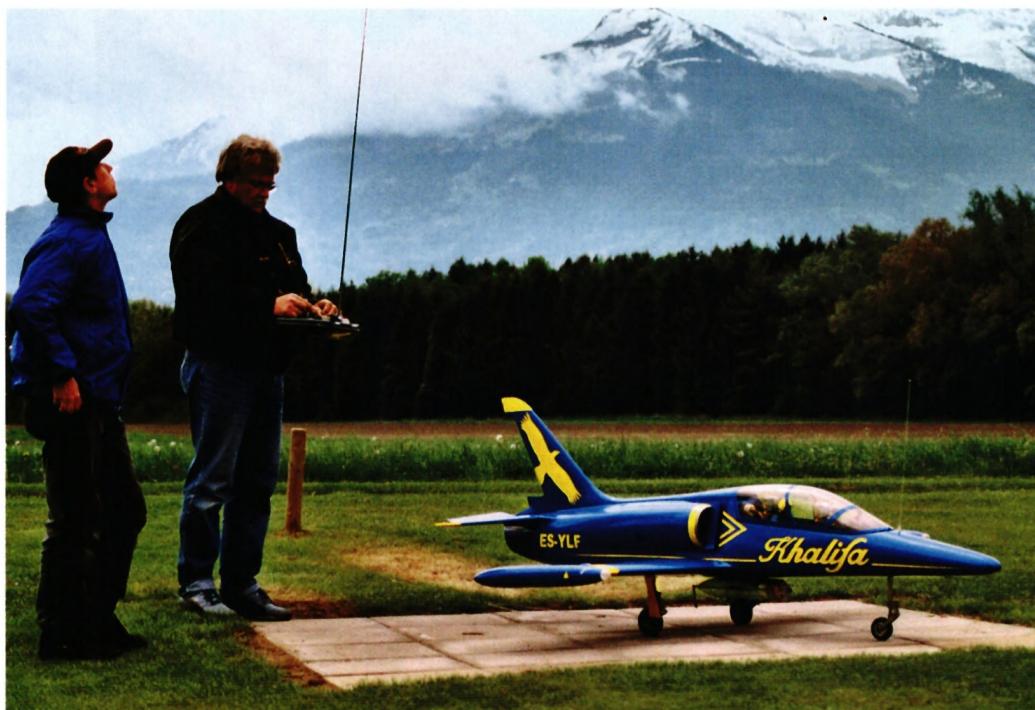
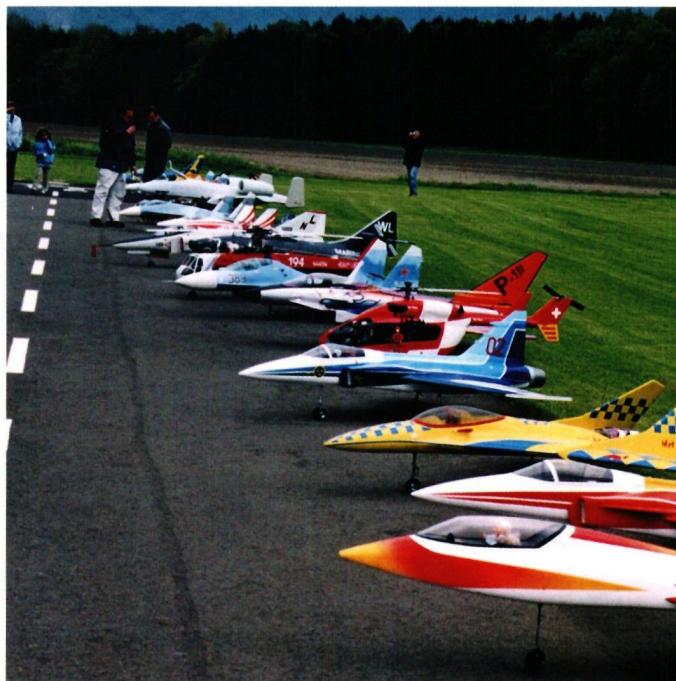
27 registered participants and 18 in attendance, mostly from French-speaking Switzerland. These figures demonstrate the enthusiasm in a region that accounts for less than 10% of model aircraft activity in Switzerland. Some may have stayed away due to concerns about uncertain weather, but the tarmac was nonetheless filled with beautiful models. There were many versions of the single-seat and two-seat SU-27 and Eurofighter
(sport) models cast by Fiberclassics, alongside Saabs, Skyrays, F9F Panthers, L159s, Mirage 2000s, A-10s, and Phantoms. Jet trainers were also represented by Peter Studer’s Flambo and Frank Parodi’s Wild Hornet. Strangely enough, I didn’t spot a single Swiss jet.
Klaus Schillumeit, the event’s delighted organizer, was flying a Czech ALCA L159 B equipped with a camera transmitting footage to the ground. His other model, a replica of the F9F Panther from the Korean War in 1953—which was the Navy’s first carrier-based jet—flew to the tune of *Flipper the Dolphin* to highlight its naval origins.
Speaking of music, the SU-27s took off to the sound of the Soviet national anthem, while others flew to the beat of “Top Gun.” This exhilarating music pushed the pilots to their absolute limits: Andy Meyer, for example, attempted the “cobra” (a dangerous maneuver that causes the turbines to stall, including the Jet-Cats).
One more word about Peter Suder’s Flambo. Peter has been developing his turbines for 12 years. He equips them exclusively with so-called training models. His Flambo, which is very lightweight, is a model with an air intake on top of the
turbine startup, saving about 500 g compared to conventional systems. Its turbine generates 82 N of thrust. Its fuel tank is cleverly compartmentalized to supply the turbine until the very last drop.
Helicopters were definitely in the mix. Guy Hildebrand showcased his 14-kg Hughes 500 E with a Jetcat turbine, a rotor diameter of 190 cm, and a weight of 14 kg. The original, currently in Belgium, has also flown in Switzerland, at Les Eplatures.
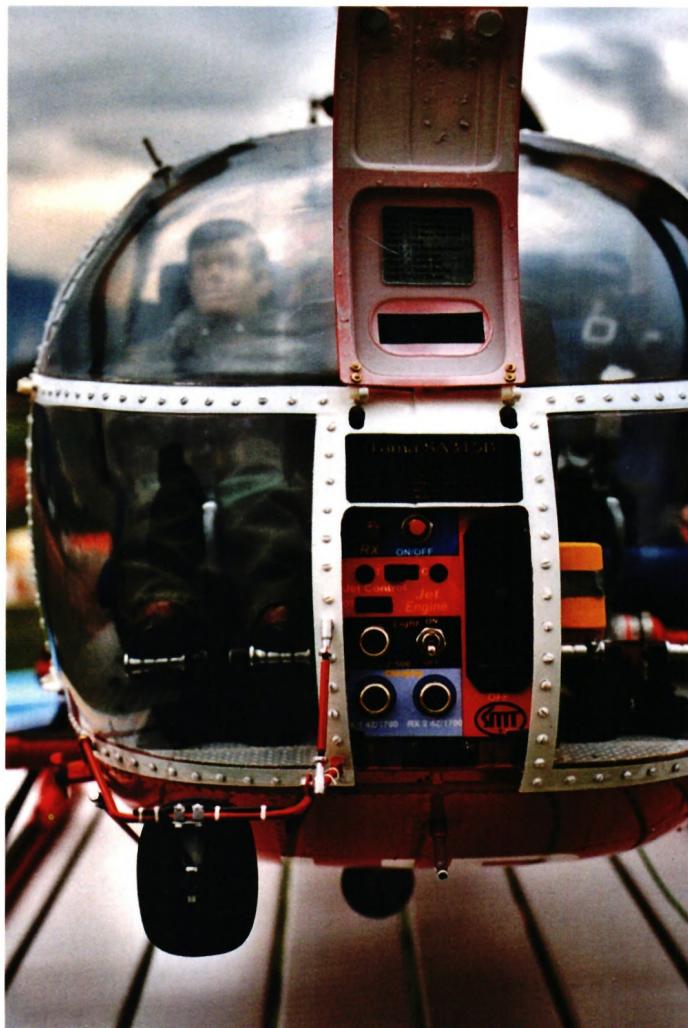
The Valais-based SMT (Schumacher Modell Technick) team presented a Lama powered by an Austrian Jakadofsky (
Roman Kulossek, head of helicopter turbines at JetCat, presented a 16-kg Air Crane powered by a two-stage SPH 5 turbine producing 7 kW. This is the very principle of a turboprop engine: the first turbine blows air onto a second one. There is no mechanical drive between the two turbines. The rotor spins at 950 rpm, with blades 2.16 meters in diameter.
All the ingredients for success came together to make May 7 a memorable day: the weather, the facilities, the atmosphere, the models, and no accidents. A symbolic award was presented to Horst Lenerz for his performance on the field. We must also commend the performance of the kitchen team, who went above and beyond to treat us to “their” ribs (so to speak).
It’s worth noting that despite the notable absence of the invited Swiss Jet Team, French-speaking Switzerland has a sufficient pool of skilled pilots and beautiful aircraft to put on a magnificent show. Judging by the models currently in development, this event will quickly become a classic: see you at the 2006 edition!

EURO CONTEST GLIDER ACRO TOUR AUSTRIA 2026

THE PC-21 STORY
 Emil Giezendanner

TWIN TOWN PARTNERSHIP
 Wolfgang Voeller

SUMMER FUN 2026 AT MG USTER
Martin Wunderli
CORSAIR F4U – A WARBIRD WITH A MEMORABLE LOOK
Jürgen Rosenberger, Jürgen Prinz
52. 2026 ALPS CUP
Emil Giezendanner
YOU KNOW WHAT I MEAN? 125 YEARS OF THE SWISS AERO CLUB
Emil Giezendanner
News from HEBU

TEAM MANAGER "THIS" BOSSHARD
Rodito Nussbaumer
ATOM, THE NEW DOUBLE-DECKER FROM CPLR
 Matthias Bosshard

F3A EUROPEAN CHAMPIONSHIPS IN ST-MACAIRE, FRANCE
Matthias Bosshard
INSIGHTS INTO THE HISTORY OF SEAPLANES

WELCOME, NEW MEMBER!
Andrea Bolliger
What's New at Leomotion.com

PRIDE AND GOOD IDEAS
 Markus Nussbaumer

SMALL, MODEL-LIKE SAILBOATS
Res Dauwalder
FREE FLIGHT IN THE MIDDLE OF SUMMER
Urs Muntwyler
BY YOUTH, FOR YOUTH
Lorena Betschen
HORIZON HOBBY/LEMACO NEWS: MICRO OV-10 BRONCO 645 MM BY E-FLITE

34th HAHNENMOOS ALPINE MODEL AIRPLANE CAMP
Res Dauwalder
COUPE DES ALPES – OBSERVE AND LEARN
Rodito Nussbaumer
TRY-OUT DAY AT MFV WETTINGEN
 Urs Keller

NEWS FROM HEBU
 Julia Bucher

NOS REGION – A HUB FOR ELECTRIC AVIATION
Emil Giezendanner
MEMORIES
 Wolfgang Völler

70 YEARS OF THE NIDWALDEN MODEL AIRPLANE CLUB
Martin Barmettler
A SPECTACULAR F3A WORLD CUP IN THE PRINCIPALITY OF LIECHTENSTEIN
Emil Giezendanner
FROM 0 TO 100
Markus Nussbaumer