
From Piggyback to F-Tow
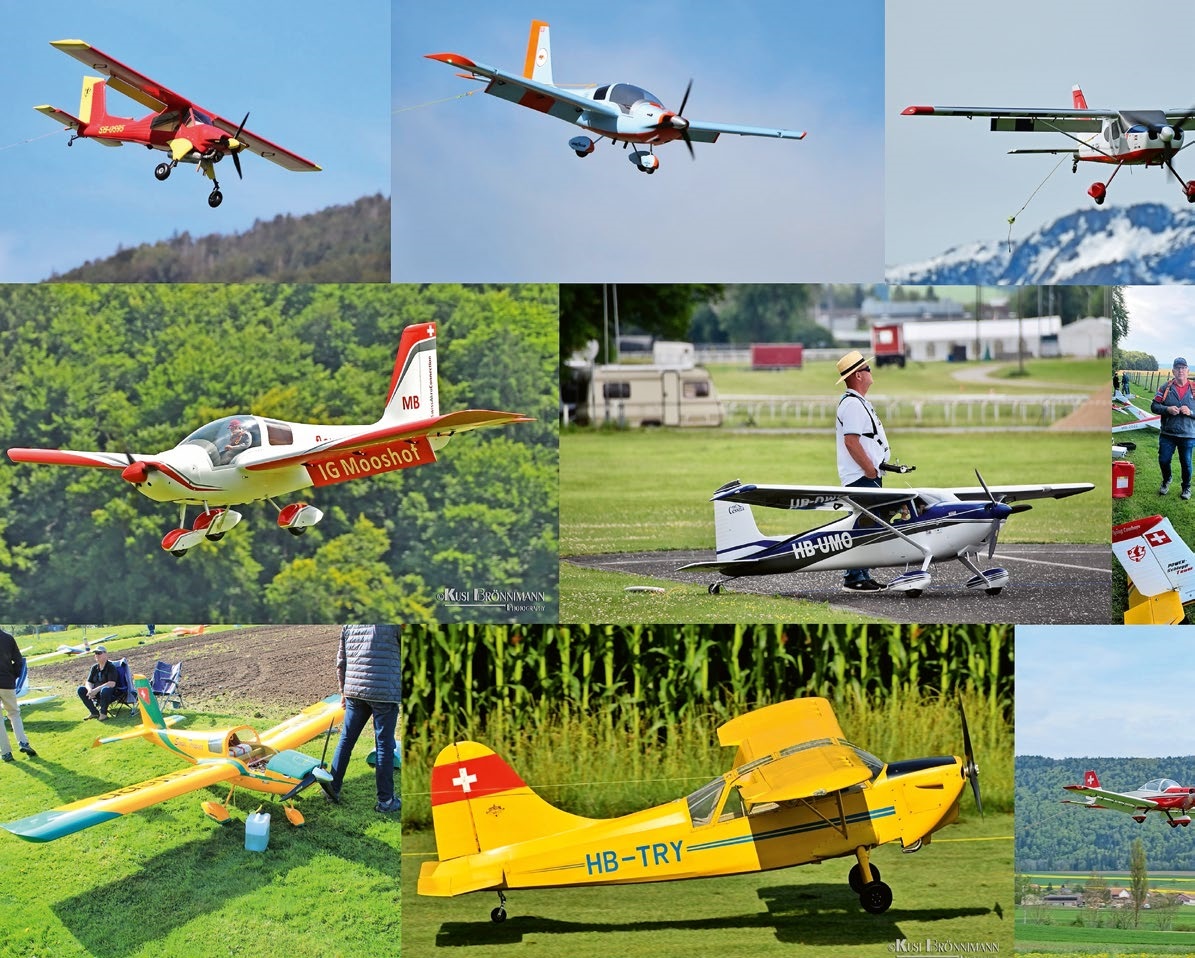
The tow pilots and their aircraft are invaluable to the Swissakro Connection. They enable us to get our aerobatic gliders up to the required altitude, making our hobby possible in the first place. But it wasn't always that way.
As early as the 1960s and 1970s, glider pilots felt the desire to have their models towed to altitude in a manner that mirrored that of their manned counterparts. At that time, however, there was a lack of powerful engines capable of generating the necessary force. There was a great deal of experimentation and trial and error, but this often led to damage and crashes.
The Biglift from Multiplex, with a wingspan of 220 ccm to 240 ccm, was one of the first models to achieve modest success. Thanks to its robustness and load-bearing capacity, it was able to meet the requirements of glider pilots and contributed significantly to the further development of glider towing.
The world of sailplane towing has undergone remarkable development in recent decades. Towing engines, in particular, have made significant advances, making it possible to lift our large and heavy acrobatic gliders to the desired altitudes.
In the 1960s and 1970s, the largest engine available at the time was the Webra, with a displacement of 15 ccm. This engine had only a fraction of the impressive power available today. A little later, model builders were able to purchase SuperTiger engines with displacements of 25 and 30 ccm. However, these engines were not always reliable.
Today, everything is much simpler. Towing models are available in various designs and sizes.
For our purposes, models with a wingspan of 3 meters or more are particularly well-suited, as they are clearly visible at high altitudes. These models are equipped with engines ranging from 150 ccm to 200 ccm that meet specific requirements for ease of maintenance and reliability. Nowadays, 2- or 4-cylinder engines are the most common. Four-stroke engines are less common, as they (still) have less pulling power, are somewhat slower, and have a more complex mechanical design. Despite these differences, all modern engines offer significantly higher performance and reliability compared to those of earlier years.
The development of tow motors has revolutionized our hobby. Thanks to modern technology, we can efficiently and reliably lift our acro gliders to the necessary altitudes. Advances in engine technology have made glider towing safer and more accessible, allowing us to enjoy our hobby to the fullest.



News from HEBU

HORIZON HOBBY/LEMACO NEWS: MICRO OV-10 BRONCO 645 MM BY E-FLITE

PRIDE AND GOOD IDEAS
 Markus Nussbaumer

TEAM MANAGER "THIS" BOSSHARD
 Rodito Nussbaumer

YOU KNOW WHAT I MEAN? 125 YEARS OF THE SWISS AERO CLUB
 Emil Giezendanner

F3A EUROPEAN CHAMPIONSHIPS IN ST-MACAIRE, FRANCE
 Matthias Bosshard

ATOM, THE NEW DOUBLE-DECKER FROM CPLR
Matthias Bosshard
SUMMER FUN 2026 AT MG USTER
Martin Wunderli
What's New at Leomotion.com

52. 2026 ALPS CUP
Emil Giezendanner
TWIN TOWN PARTNERSHIP
Wolfgang Voeller
34th HAHNENMOOS ALPINE MODEL AIRPLANE CAMP
Res Dauwalder
CORSAIR F4U – A WARBIRD WITH A MEMORABLE LOOK
Jürgen Rosenberger, Jürgen Prinz
SMALL, MODEL-LIKE SAILBOATS
Res Dauwalder
TRY-OUT DAY AT MFV WETTINGEN
Urs Keller
WELCOME, NEW MEMBER!
Andrea Bolliger
FREE FLIGHT IN THE MIDDLE OF SUMMER
Urs Muntwyler
COUPE DES ALPES – OBSERVE AND LEARN
Rodito Nussbaumer
EURO CONTEST GLIDER ACRO TOUR AUSTRIA 2026

BY YOUTH, FOR YOUTH
Lorena Betschen
INSIGHTS INTO THE HISTORY OF SEAPLANES

THE PC-21 STORY
Emil Giezendanner
NEWS FROM HEBU
 Julia Bucher

FROM 0 TO 100
Markus Nussbaumer
MEMORIES
Wolfgang Völler
NOS REGION – A HUB FOR ELECTRIC AVIATION
Emil Giezendanner
DO YOU KNOW WHAT I MEAN IN THE LAND OF SMILES?
Emil Giezendanner
Have you almost forgotten about aircraft that take off and land vertically?
Emil Giezendanner