
History of Indoor Aerobatics ...
Until the late 1980s, model flying took place mainly outdoors, and model building was done in the winter. Of course, the first model flying simulators already existed, but they somehow lacked the appeal of real model flying. If only you could just fly indoors in the winter...
In the early 1990s, there were only a few specialists who primarily developed models for indoor aerobatics. In 1998, his “high-tech” powerplant consisted of a ball-bearing brush motor, a 5:1 homemade gearbox, a homemade wooden propeller, and a 9-cell 110-mAh NiCd battery. This laid the foundation for the so-called “torque roll,” in which the model hangs vertically from the propeller.
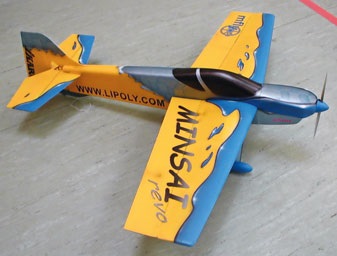
The German Model Aviation Association (DMFV) recognized the potential of model aviation early on and organized the first German Indoor Aerobatics Championship in 2001. A precise roll, a smooth loop, or a half Cuban eight were already pushing the limits for the models of that era, which were equipped with brush motors and NiCd batteries. Since there were almost no commercially available designs at that time, participants flew all sorts of aircraft—some more suitable than others. The models were so heavy, fast, and sluggish that, including takeoff and landing, they required the entire length of a triple-court sports hall. But a start had been made, and further competitions provided incentives to continue developing technology and skills. As early as 2002, the first lithium-polymer batteries from Kokam appeared. Combined with the first small brushless motors, this marked another milestone. In 2003, a so-called AeroMusical (freestyle aerobatics set to music) was flown for the first time as part of the German Indoor Aerobatics Championships and, due to its great popularity, became a permanent fixture. Classified as FAI Class F6B AeroMusicals, it was one of only three model aircraft classes at the 2009 World Air Games in Turin. Hardly any other discipline is better suited to promoting our sport. Even people who have absolutely no interest in technology or aviation are thrilled by the demonstrations, which leave a positive impression. Public acceptance of our hobby is perhaps more important today than ever before.
Based on F3A, the term F3AI was initially used for indoor aerobatics, and the F3AI-A and F3AI-B classes were flown. Using these terms, indoor aerobatics was presented to the FAI (Fédération Aéronautique Internationale) at the end of 2004, and as a result, the initially provisional F3P indoor aerobatics class for motorized models was created.
The submitted proposals now consisted of so-called sequence programs, and the flights were continuously evaluated from that point on. The era of “idle flights” between individual maneuvers was thus over, which caused additional stress not only for the pilots but also for the judges.
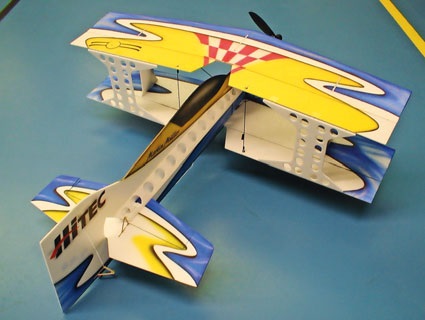
A major challenge at the end of 2002 was the experimental F3A indoor competition in Carvin, France, where participants could compete against top-tier pilots such as Christophe Paysant-Le Roux, his brother Benoît, and other elite pilots. The most difficult maneuver was already a roll sequence with three rolls! It would not be the last time we traveled to Carvin for a competition. The last event took place in 2007.
After a few years’ hiatus, the Indoor Tournament of Paris (IITOP) was launched in 2010. With creative posters, it attracted top international pilots to the area near the French capital. Attendees could experience the latest models and powerplants firsthand, and the group dinners in the hall were always a highlight.
The first World Championship in Coburg in 2013 was another milestone. For the first time, model pilots from outside Europe joined those from Europe for an indoor aerobatics competition. It was a mega-event that set the tone for subsequent World Championships. The development of coaxial propulsion systems and carbon-Mylar models was already on the horizon.

However, the first World Championship also marked the end of the IITOP, which was held for the last time in 2014 ahead of the World Championship in Poland (2015). Afterward, the Swiss took up the idea of an international competition in the form of the Swiss Open Indoor Masters (SOIM). Listed on the FAI calendar as an F3P World Cup competition, this event established itself not only as the venue for the Swiss Championship but also as a popular competition for qualifying for one national team or another.
As part of the F3P World Championships, so-called “Challenges” in the F3P-AFM (Aerobatics Freestyle to Music) class have always been held afterward, but it is only since the 2019 World Championships in Heraklion that pilots have been able to compete exclusively in this class, and world championship titles are awarded.
In this class, which is particularly interesting for spectators and the media, pilots can showcase their entire model-flying repertoire to the music of their choice. →


News from HEBU

TEAM MANAGER "THIS" BOSSHARD
 Rodito Nussbaumer

YOU KNOW WHAT I MEAN? 125 YEARS OF THE SWISS AERO CLUB
 Emil Giezendanner

HORIZON HOBBY/LEMACO NEWS: MICRO OV-10 BRONCO 645 MM BY E-FLITE

PRIDE AND GOOD IDEAS
 Markus Nussbaumer

34th HAHNENMOOS ALPINE MODEL AIRPLANE CAMP
Res Dauwalder
TRY-OUT DAY AT MFV WETTINGEN
Urs Keller
F3A EUROPEAN CHAMPIONSHIPS IN ST-MACAIRE, FRANCE
 Matthias Bosshard

52. 2026 ALPS CUP
Emil Giezendanner
ATOM, THE NEW DOUBLE-DECKER FROM CPLR
Matthias Bosshard
SUMMER FUN 2026 AT MG USTER
Martin Wunderli
What's New at Leomotion.com

THE PC-21 STORY
Emil Giezendanner
COUPE DES ALPES – OBSERVE AND LEARN
Rodito Nussbaumer
TWIN TOWN PARTNERSHIP
Wolfgang Voeller
BY YOUTH, FOR YOUTH
Lorena Betschen
CORSAIR F4U – A WARBIRD WITH A MEMORABLE LOOK
Jürgen Rosenberger, Jürgen Prinz
SMALL, MODEL-LIKE SAILBOATS
Res Dauwalder
WELCOME, NEW MEMBER!
Andrea Bolliger
FREE FLIGHT IN THE MIDDLE OF SUMMER
Urs Muntwyler
EURO CONTEST GLIDER ACRO TOUR AUSTRIA 2026

INSIGHTS INTO THE HISTORY OF SEAPLANES

NEWS FROM HEBU
 Julia Bucher

FROM 0 TO 100
Markus Nussbaumer
MEMORIES
Wolfgang Völler
NOS REGION – A HUB FOR ELECTRIC AVIATION
Emil Giezendanner
DO YOU KNOW WHAT I MEAN IN THE LAND OF SMILES?
Emil Giezendanner
Have you almost forgotten about aircraft that take off and land vertically?
Emil Giezendanner