
The Evolution of Electric Flight into Model Aviation for Everyone
First, I’d like to briefly comment on the term “everyman” model aviation:
It should by no means be understood as an attempt to use electric flight to bring about an explosive growth in the sport of model flying—as if the motto were: “An electric toy for every citizen.” Rather, the idea is that anyone who is more or less seriously involved in model aviation should view electric flight as an equal branch of the sport alongside all the others. And that if you want to fly electric models, you don’t need advanced craftsmanship, extensive technical knowledge, or significant expenses. People who were born with two left hands won’t enjoy any kind of model building. So much for the concept of “everyman” model aviation.
Now a few words on the topic of “development”: Certainly, some model aviators experimented with electric propulsion early on, and these attempts may have been successful here and there—as in the case of the Englishman Taplin, for example. But no name stands out in this history quite like that of Fred Militky. Since 1940, he had worked single-mindedly and with almost dogged determination to bring the electrically powered model aircraft to fruition, and he is therefore often referred to as the “father of electric flight.” By the time of his death in 1976, he had not only developed RC electric model airplanes but had also built an electric-powered manned aircraft. I had been one of his colleagues since the late 1960s. So it will certainly come as no surprise to you that I will illustrate my remarks with examples from his projects that I witnessed firsthand or in which I was personally involved. This is by no means intended to diminish or even deny the achievements of others in this field.
It would be too lengthy to report in full on all the experiments and failures; therefore, I would like to describe in more detail a few notable—if you will—milestones in the development process.
After many experiments and several years during which electric flight remained a dream, Mr. Militky succeeded in making the first climb with a model in 1959. Unfortunately, it was also the last flight with this model, as it vanished never to be seen again. It was powered by saltwater batteries. These are batteries that, after being activated with a few drops of saltwater, can deliver high currents. They can only be used once. The model was the precursor to the “Silentius” free-flight model, which was introduced to the market in 1960. Here are some technical specifications: The wingspan was 780 mm, the flight weight was 140 g, and the total wing loading was approximately 12 g/dm². Power was provided by a Dr. Faulhaber bell-armature motor with a 15:1 gear reduction ratio, which drove a 2-blade balsa wood folding propeller with a diameter of 320 mm. The power source consisted of two Rulag miniature lead-acid batteries.
The input power was approximately 6 watts. The motor was shut off after about 20 seconds by a glow cord that opened a spring-loaded contact. From these figures, it is easy to see that this was not yet something for “everyone.” Consequently, by the late 1960s, there were no longer any electric model airplanes on the market. However, the project hadn’t been shelved; instead, intensive experimentation was underway. The decisive breakthrough came in the summer of 1971 with the “Silencer” model. After initially flying single-engine models only as so-called “meadow gliders”—that is, flights with almost no climb—I was inspired by one of my semi-scale models to try using two engines. Just a few days before the F3A World Aerobatic Championship in Doylestown, Pa., the first truly successful flights were made. In the U.S., H. Militky and I then demonstrated the model to great acclaim. Here are some technical specifications of the model: wingspan 1,600 mm, flying weight 922 g, wing loading approx. 24 g/dm², 2 Dr. Faulhaber bell-armature motors with gearboxes and 320-mm-diameter balsa wood folding propellers, which were left over from the “Silentius” model. The power source consisted of 9.6-V Ni-Cad sintered cells with a capacity of 600 mA/h. The remote control was a Varioprop standard unit stripped down to the bare essentials, which was used to operate the ailerons and elevator and, when coupled with the elevator, to turn the motor on and off.
Now they were fairly certain that, with the right balance of model size, power plant, power sources, and—last but not least—propellers, they could bring a kit to market that even a moderately talented (with the emphasis still on “talented”) model pilot could handle. The result was the “Hi-Fly” model, which was unveiled at the Nuremberg Trade Fair in 1973 and remains in production to this day. It is a glider with a wingspan of 2,300 mm. It is powered by two Jumbo 2000 motors with a 5:1 gear ratio, each driving a 350-mm-diameter plastic folding propeller. The power source consists of 10 Ni-Cad cells rated at 1.0 Ah. The input power is approximately 2 × 35 watts. For short climbs, it was also possible to fly with 12 cells, which was particularly interesting for competitions. During this period, the first competitions for electric model aircraft were already being held, and efforts were being made to create competition programs that were appealing to both spectators and pilots. This clearly shows that electric model aircraft had already found a—albeit still small—following.
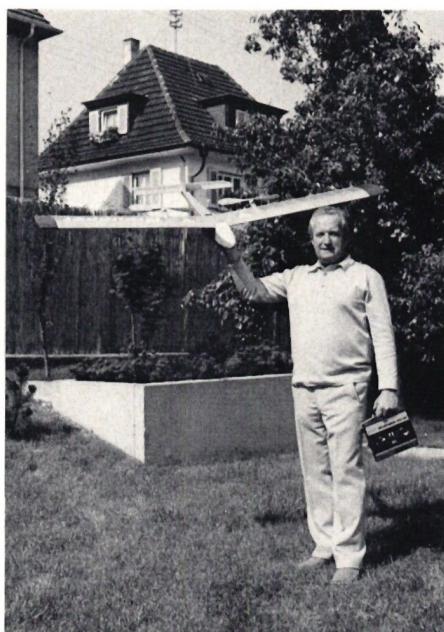
The nearby town of Pfäffikon also has a tradition of electric flight. This year, a competition called the Militky Cup is taking place there for the fifth time. To help you follow the thread of this development, here are a few more notes on the “Hi-Fly” model: It is built using a super-lightweight construction method, so the ratio of airframe weight to payload was very unfavorable. As you may know from your own experience, the “Hi-Fly” is nonetheless an excellent electric glider, and flights lasting about 20–22 minutes are the norm even without thermals. However, due to its lightweight construction, it’s best to avoid ambitious aerobatics.
At that time—in the early 1970s—the topic of electric flight was simply in the air, so it was no wonder that competitors were also offering kits and equipment on the market. There were three main reasons for this sudden surge in popularity:
First, the growing environmental awareness among the public served, in a sense, as a “boost” for electric flight. I sometimes refer to it as “environmental hysteria.” As a result, it suddenly became impossible to fly with internal combustion engines at many model airfields—at least during certain times. This gap could only be filled by electric propulsion. In the process, many model aviators noticed that not only was there no noise, but also none of the familiar oil stains on their shirts and pants.
The second argument was that it had now become feasible to build an electrically powered model aircraft without first having to conduct one’s own experiments with an uncertain outcome. Anyone interested had, after all, seen the success of the “Silencer” showcased in the trade press. This also meant that the costs—which I’ll come back to later—were manageable.
The third reason was that many model aircraft enthusiasts, whenever something new comes along, simply have to have it and try it out. There’s just a certain appeal to being at the forefront of a development. Just think of the parallel development of the model helicopter!
So it was now possible to go to a specialty store, buy a kit with all the accessories, and—after some assembly work—successfully fly the finished model. However, this was still hindered by a rather steep price, since you had to buy two motors right away: what were you supposed to do if thermals suddenly appeared and the model, with its motors turned off, kept climbing higher and higher? There were also some weak points in the motors themselves that became apparent after some time in use.
So, to truly be suitable for “everyone,” electric flight had to become even more affordable and, above all, more robust. This development was once again driven forward in a very decisive way between 1973 and 1975. The greatest improvement by far occurred with the power batteries. But motors, gearboxes, and propellers—not to mention the models themselves—were also redesigned during this period.
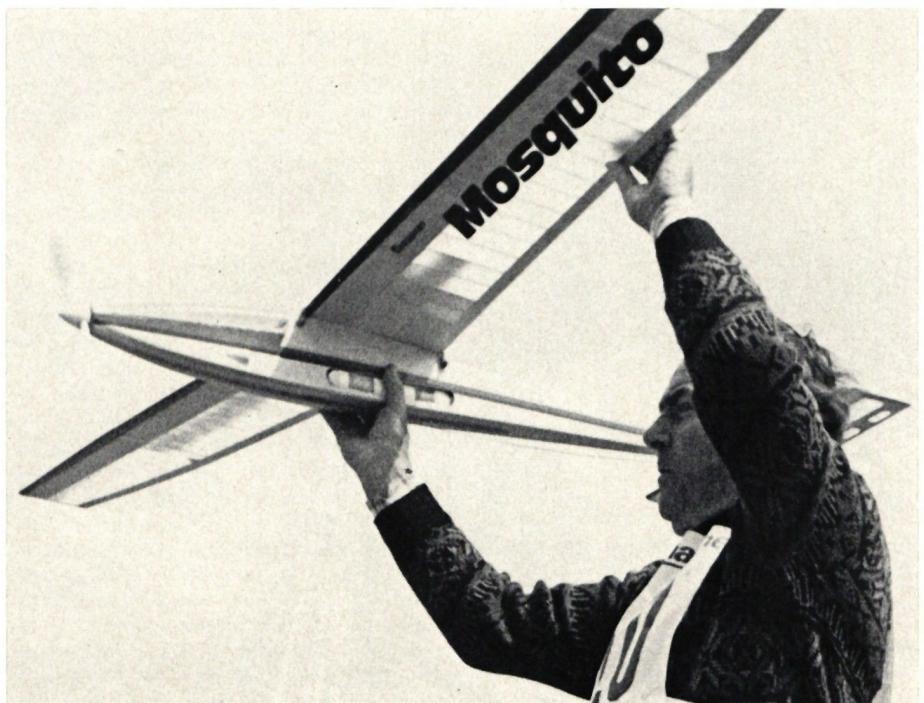
With the release of the “Mosquito” kit at the 1975 trade show, development—it’s safe to say—began to settle down.
This model fulfilled all the previously mentioned requirements: While the “Hi-Fly” power set still cost about DM 238, the now single-engine “Mosquito” cost only about DM 130.
The climb performance was no worse as a result, and the use of additional features—such as the pilot switch—allowed the model to be quickly brought back down to ground level via thrust reversal and, moreover, protected the power battery from deep discharge, since the switch automatically shuts off the motor once a preset voltage is reached.
It is certainly no coincidence that all the early and successful examples were models
which we refer to as gliders—namely, models with a large wing area and a high-lift airfoil, which consequently have a low airspeed and a low rate of descent. These models require very little propulsive energy to climb. Furthermore, the fact that large propellers rotating relatively slowly are more efficient than small, high-speed ones plays a role that should not be underestimated. Unfortunately, however, part of this advantage is negated by the necessary reduction gear.
It was only when lighter radio-control systems and improved power units provided a certain surplus of power that more and more models with direct drive—that is, without a reduction gear—came onto the market. These are primarily so-called sport and aerobatic models, some of which reach remarkable speeds. This variant—I’m thinking, for example, of the “Elektro Max” model—can be equipped with a power unit for as little as about DM 150, despite its good performance. The input power is about 150 watts, depending on the propeller used. The total weight is about 1,700 g. Flight time at full power is approximately 4 minutes; at half power, with the model maintaining the same altitude, it is approximately 10 minutes plus glide time, depending on the starting altitude.
I have now brought my discussion up to the present day. If you visit a well-stocked specialty store today, you’ll find a wide selection of electric model airplanes and power units. What almost all of them have in common is that they function flawlessly within the range for which they are designed and intended. So it’s fair to say that electric flying is now accessible to “everyone.” However, expert advice is essential, because even today you can’t afford to waste performance—for example, due to an incorrectly sized propeller or the wrong choice of motor, etc. And just as an internal combustion engine requires proper adjustment and maintenance, you should do the same with an electric powerplant. Proper care—especially of the power battery—is the key to many trouble-free flights.
Now a few comments on the costs compared to internal combustion engines:
The previously mentioned purchase prices of approximately 130 to 150 DM for an electric powertrain would be roughly the same as those for comparable internal combustion engines if you factor in the fuel tank, starter battery, and other accessories that are absolutely necessary for operation. The only exception to this would be in cases of increased performance requirements, such as for aerobatic models, in which case the electric version would be at a disadvantage. Its costs would then rise much more rapidly.
When it comes to ongoing operating costs, free energy from the car battery is pitted against the recurring expense of purchasing model fuel. This makes the choice in favor of electric propulsion clear. Personally, I don’t believe that the decision for or against electric flight hinges on a difference of a few marks in the purchase price. For many model aviators, it may be a lack of information, or perhaps the necessity of having to charge a battery precisely—or could it even be the lack of noise? Just imagine a Formula 1 car with an electric motor!
Let me conclude by sharing a few thoughts on how I envision future developments:
The most critical issue is probably energy storage—that is, the battery. It is primarily responsible for the high weight, and that will likely remain more or less the same for the time being. Perhaps it will be possible to further reduce its internal resistance and make it less susceptible to overcharging or deep discharge. In any case, improvements will only come in small steps.
The same applies to the motors. Here, one might consider improvements to the magnets, better balancing, better cooling and bearings, and perhaps even a slight reduction in weight. But the direction of development is already becoming clear: everything will come at a price, especially with small production runs.
The easiest improvements will be made to accessories that simplify the handling of the electric drive, such as automatic chargers, universal and lossless switches, and similar items.
As for the model—that is, the airframe—it will still be essential in the future that it be aerodynamically well-designed and that, due to the high payload, it offer good structural strength combined with low weight.
But even today, every serious model pilot and model builder is capable of flying with an electric powerplant without any problems.


News from HEBU

HORIZON HOBBY/LEMACO NEWS: MICRO OV-10 BRONCO 645 MM BY E-FLITE

PRIDE AND GOOD IDEAS
 Markus Nussbaumer

TEAM MANAGER "THIS" BOSSHARD
 Rodito Nussbaumer

YOU KNOW WHAT I MEAN? 125 YEARS OF THE SWISS AERO CLUB
 Emil Giezendanner

F3A EUROPEAN CHAMPIONSHIPS IN ST-MACAIRE, FRANCE
 Matthias Bosshard

ATOM, THE NEW DOUBLE-DECKER FROM CPLR
Matthias Bosshard
SUMMER FUN 2026 AT MG USTER
Martin Wunderli
What's New at Leomotion.com

52. 2026 ALPS CUP
Emil Giezendanner
TWIN TOWN PARTNERSHIP
Wolfgang Voeller
34th HAHNENMOOS ALPINE MODEL AIRPLANE CAMP
Res Dauwalder
CORSAIR F4U – A WARBIRD WITH A MEMORABLE LOOK
Jürgen Rosenberger, Jürgen Prinz
SMALL, MODEL-LIKE SAILBOATS
Res Dauwalder
TRY-OUT DAY AT MFV WETTINGEN
Urs Keller
WELCOME, NEW MEMBER!
Andrea Bolliger
FREE FLIGHT IN THE MIDDLE OF SUMMER
Urs Muntwyler
COUPE DES ALPES – OBSERVE AND LEARN
Rodito Nussbaumer
EURO CONTEST GLIDER ACRO TOUR AUSTRIA 2026

BY YOUTH, FOR YOUTH
Lorena Betschen
INSIGHTS INTO THE HISTORY OF SEAPLANES

THE PC-21 STORY
Emil Giezendanner
NEWS FROM HEBU
 Julia Bucher

FROM 0 TO 100
Markus Nussbaumer
MEMORIES
Wolfgang Völler
NOS REGION – A HUB FOR ELECTRIC AVIATION
Emil Giezendanner
DO YOU KNOW WHAT I MEAN IN THE LAND OF SMILES?
Emil Giezendanner
Have you almost forgotten about aircraft that take off and land vertically?
Emil Giezendanner