
Bringing Back Memories
Zlinska Letecka AS was founded in 1935 in Otrokovice, in what is now the Czech Republic. As a subsidiary of the shoe manufacturer Bata, it produced military training aircraft at the start of the war, such as the two-seater Bücker B181 Bestmann, which was intended for the Luftwaffe. Today, its aircraft are better known under the name Zlin. The Zlin 526 was designed exclusively to meet the requirements of aerobatics. It made its maiden flight in 1966. The 526 F version is the single-seat variant with a metal airframe. By the late 1960s, the various versions of the Zlin 526 routinely took first place in competitions. In Switzerland, one of the fortunate owners was the late Christian Schweizer. While the 726 should not be overlooked, the Zlins were eventually supplanted in competitions by the arrival of the famous Stephens Acro, Laser 200, Acrostar, Pitts, and Cap 21.
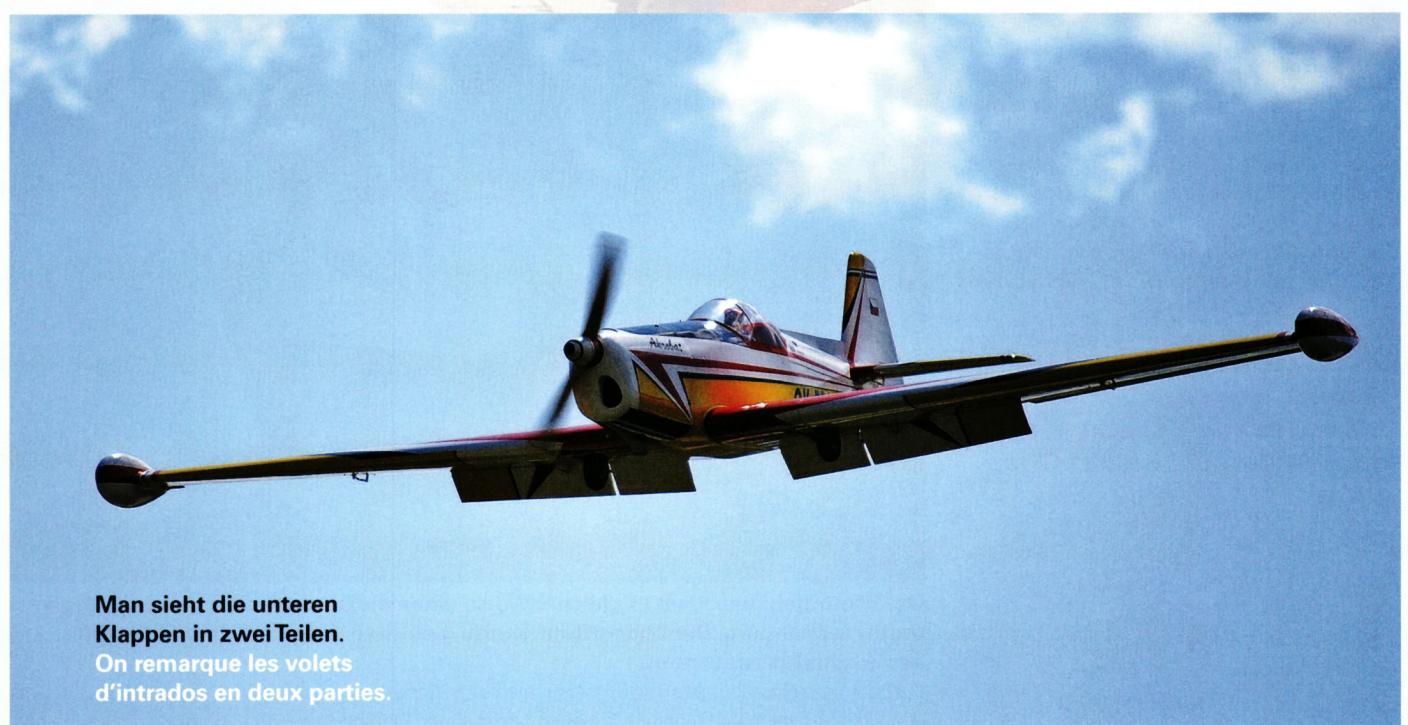
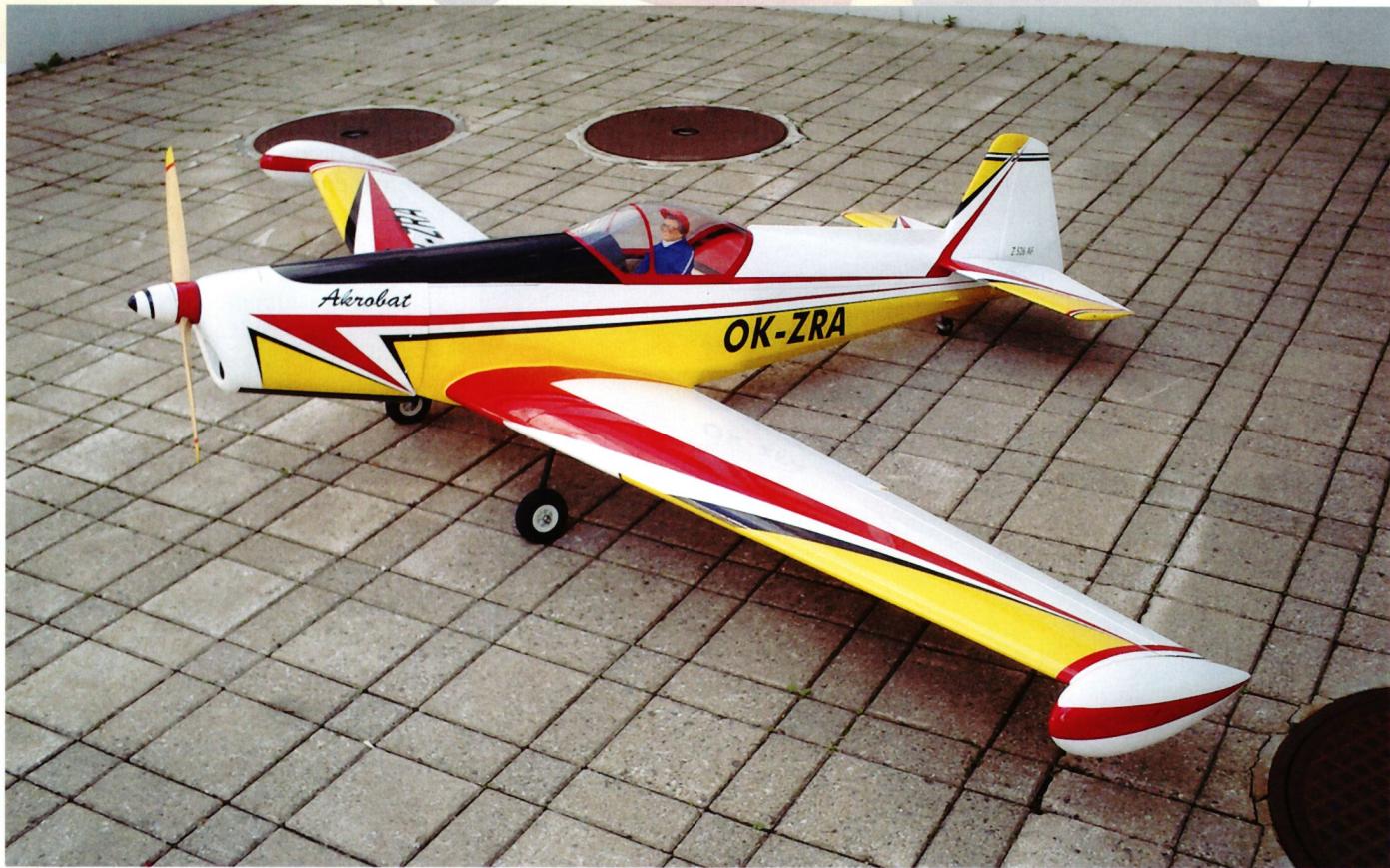
Having grown tired of modern aerobatic aircraft—which have become overly specialized for all sorts of purposes and all look alike—many model builders feel the need for a less aggressive, more fluid, and more aesthetic form of aerobatics. This replica of the aircraft has a wingspan of 3 meters, which corresponds to a scale of approximately 1:3.5. Its construction, made almost entirely of wood, is sure to evoke a sense of nostalgia. This is a large aircraft, yet it’s still easy to transport—ideal for competition demonstrations, but versatile enough for a wide range of uses with a 40- to 50-cm³ engine.
The model is the result of a collaboration between the Czech company Modellstudio CZ, Jaroslav Velisek—who adapts the products for CNC manufacturing—and Jozef Paracka, our Swiss colleague from Le Locle. When they met, each had designed a Zlin in his own way: one with an electric motor, the other with an internal combustion engine. The commercial result is a version of the aircraft with a square canopy and fixed landing gear. The following options will be available: a rounded canopy and wing-tip fuel tanks, as in Jozef’s design. Additionally, retractable landing gear can be installed in either version, depending on preference. The Giezendanner landing gear with a 100° angle for a 15-kg aircraft is perfectly suited for this model. The fuselage is constructed from a spar with ribs strung along it. You then attach the various stringers, followed by the skin on the front and rear of the aircraft. As with the original, the fuselage is only partially paneled and covered. Once this is complete, the base spar can be removed to save weight. The central section of the wing is an integral part of the fuselage and significantly stiffens it. The electrically retractable landing gear is integrated into this central section. It rotates backward, just like in the full-size Zlin, leaving half of the wheel exposed. The landing flaps—of which only the lower part pivots downward—have their pivot axis extended onto the wing via a carbon fiber tube. The control servo for the flaps is located in the wing. The wing spar is an aluminum tube 30 mm in diameter and 1,100 mm long. The wing’s V-angle is created by the angle of the wing bushings, which are incorporated into the design. The ailerons are fitted with semicircular leading edges. The central section of the wing is reinforced with fibers to make it durable for maneuvers. Parts that are susceptible to oil penetration, such as the aileron bearings, are also reinforced with fibers. These are additionally stiffened. The engine cowling is molded from fiber. The instrument panel is an integral part of the canopy, allowing access to the electronics when the canopy is opened. A smoke generator system is installed to make aerobatic displays more exciting.
| Wingspan | 2,970 mm |
| Airfoil at the wing root | NACA 2415 |
| Airfoil at the wingtip | NACA 4412 |
| Weight | 12.5 kg for the version with an internal combustion engine ; 11 kg for the electric version |
| Engine | MVVS 50 IRS, 48 cm³ |
| Electric motor | Axi 5345/16 |
| Battery | LiPo 10S/5000 mAh |
| Commercial version | Model Studio CZ |
| Price | Not specified |
The wing to be built using the Model Studio kit is a fully skinned balsa structure. It features removable wingtips to allow for the optional installation of wing tanks. A controlled hook is provided at the wing tip for towing ribbons. The servos are directly linked to the control surfaces. The airfoil is a biconvex asymmetric NACA 2415 at the wing root, transitioning to a NACA 4412 (hollow!) at the wing tip with a negative twist of 5°. The original’s airfoil was also hollow. The wings and tail are covered with Super Monokote. The fuselage and tail are covered with silk and then spray-painted with Landi Color Works.
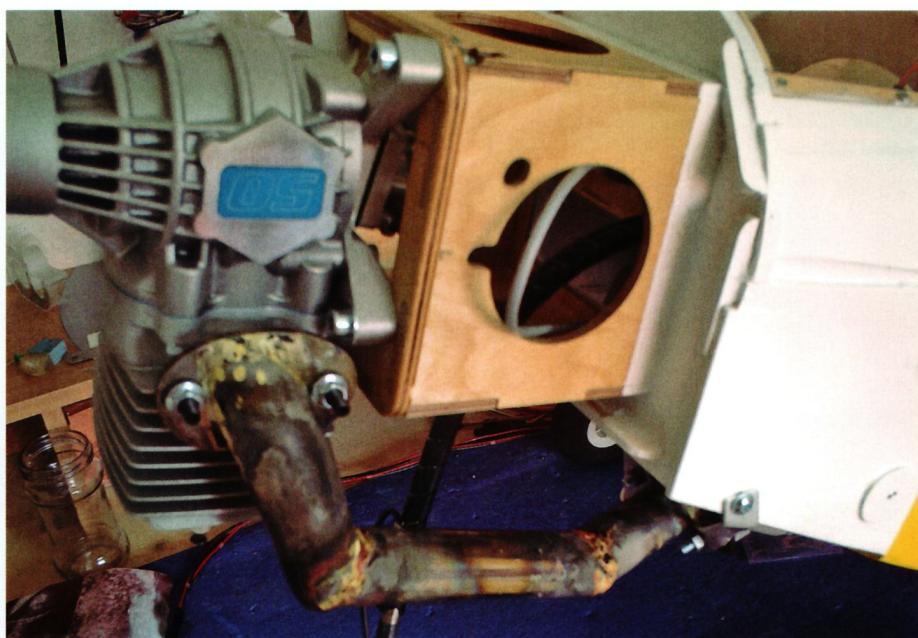
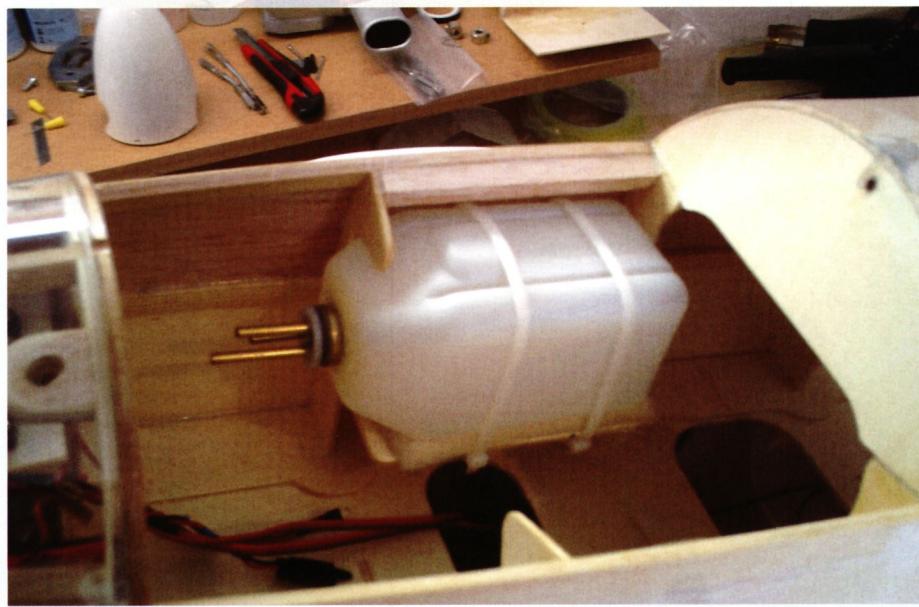
The engine used by Jozef Paracka is the MVVS 50 IRS with a displacement of 48 cm³. It weighs only 1,460 grams. The nose of the Zlin is very long and narrow. The exhaust muffler had to be moved to the rear due to the welded-on pipes. To preserve the aircraft’s external appearance as a model, it is essential to route it outward along the side. The MVVS 50 has a carburetor located behind the engine, which saves space. The engine’s RPM is perfectly normal during aerobatics. The power output is ideal for an aircraft weighing 12.5 kg. The starter flap is connected to a servo controlled by a switch via the radio. The electronic ignition system operates at a voltage of 6.5 to 9 volts, supplied by a battery pack consisting of 6 Sanyo cells rated at 1.2 volts and 250 mAh. The 5 dl fuel tank allows for a flight time of 15 minutes. This is more than enough for a 6- to 7-minute flight in competition. Jozef wanted to leave enough space next to the tank to install a smoke-generating device. In the electric version from Modellstudio CZ, this space also provides access to the batteries. Modellstudio CZ offers this Zlin with the following recommendations: an Axi 5345/16 motor, a 10S/5000 mAh LiPo battery, a Jeti Spin 99 ESC, and a 21"×14" carbon propeller. It is possible to install a gasoline engine as described above without making any modifications. For both versions, the model’s weight is practically the same: approximately 11 kg for the electric version and 12.5 kg for the gasoline version, with weight including fuel.
The digital rudder servo has a pull of 7 kg. It controls the vertical stabilizer via a cable. An analog servo with 4.5 kg of pull, installed in each tail unit, is sufficient for elevator control. The ailerons and flaps are actuated by servos capable of pulling 7 to 10 kg, which is generously sized. There is also a servo for the throttle, one for the starter, and one for controlling the ribbon release. Two 6 V/2500 mAh batteries, connected to a DPSI Emcotec, power the electronics. The retractable landing gear is powered by 4.8 V. The Graupner XR20 IFS 2.4 GHz receiver is mounted as far away from the ignition system as possible.
During acceleration at takeoff, firm pressure must be applied to the vertical stabilizer to counteract the engine’s high torque. The aircraft takes off at an altitude of 40 to 50 meters. Takeoff is possible without applying full throttle. The engine power is perfectly adequate. Aerobatics are flawless, with beautifully straight flight paths. Flying inverted is easy by applying just a little thrust. Spinning can be easily controlled. The takeoff run requires one full turn, or three-quarters of a turn if fuel tanks are installed, due to the inertia, which increases this distance slightly. The flight is very realistic and precise, yet very forgiving. Landing with the flaps is easy, but it takes a very long time. You could extend the flaps further with less throttle and make a nice soft landing. You can find a video of the Zlin in flight at www.aero-magazine.ch.
The dimensions of this Zlin are, in fact, a very good compromise for flying it in competitions, where it’s sure to turn heads. Its ease of transport is a major plus, since the wings and tail surfaces can be removed. On the field, the model displays an elegance that clearly sets it apart from the usual models that perform aggressive aerobatics while hanging from the propeller. This model is suitable for any skilled pilot—it’s that easy to fly. We’re eagerly awaiting its release on the market so that it will be available to everyone.


News from HEBU

TEAM MANAGER "THIS" BOSSHARD
 Rodito Nussbaumer

YOU KNOW WHAT I MEAN? 125 YEARS OF THE SWISS AERO CLUB
 Emil Giezendanner

HORIZON HOBBY/LEMACO NEWS: MICRO OV-10 BRONCO 645 MM BY E-FLITE

PRIDE AND GOOD IDEAS
 Markus Nussbaumer

34th HAHNENMOOS ALPINE MODEL AIRPLANE CAMP
Res Dauwalder
TRY-OUT DAY AT MFV WETTINGEN
Urs Keller
F3A EUROPEAN CHAMPIONSHIPS IN ST-MACAIRE, FRANCE
 Matthias Bosshard

52. 2026 ALPS CUP
Emil Giezendanner
ATOM, THE NEW DOUBLE-DECKER FROM CPLR
Matthias Bosshard
SUMMER FUN 2026 AT MG USTER
Martin Wunderli
What's New at Leomotion.com

COUPE DES ALPES – OBSERVE AND LEARN
Rodito Nussbaumer
TWIN TOWN PARTNERSHIP
Wolfgang Voeller
BY YOUTH, FOR YOUTH
Lorena Betschen
CORSAIR F4U – A WARBIRD WITH A MEMORABLE LOOK
Jürgen Rosenberger, Jürgen Prinz
SMALL, MODEL-LIKE SAILBOATS
Res Dauwalder
WELCOME, NEW MEMBER!
Andrea Bolliger
FREE FLIGHT IN THE MIDDLE OF SUMMER
Urs Muntwyler
EURO CONTEST GLIDER ACRO TOUR AUSTRIA 2026

INSIGHTS INTO THE HISTORY OF SEAPLANES

THE PC-21 STORY
Emil Giezendanner
NEWS FROM HEBU
 Julia Bucher

FROM 0 TO 100
Markus Nussbaumer
MEMORIES
Wolfgang Völler
NOS REGION – A HUB FOR ELECTRIC AVIATION
Emil Giezendanner
DO YOU KNOW WHAT I MEAN IN THE LAND OF SMILES?
Emil Giezendanner
A SPECTACULAR F3A WORLD CUP IN THE PRINCIPALITY OF LIECHTENSTEIN
Emil Giezendanner