
Cap 232 from Hangar 9
While searching for a new aerobatic model with a wingspan of about 2.5 m made of wood, my colleague and I came across the Cap 232 from Hangar 9 online. The Cap is a ready-to-fly model made of wood and covered with Ultra Cote. The model was designed by TOC participant Mike McConville.
When we were able to pick up the model kits from our dealer, we were thrilled; as soon as we got home, we were able to assemble a model right away, since the wings and tail assembly were already pre-installed. The three-color painted fiberglass cowl and the landing gear with painted wheel covers were quickly installed, giving us a first impression of the Cap’s size and appearance.
We had also ordered the Hangar-9 assembly kit, which included wheels, a fuel tank, an aluminum servo lever, and titanium control linkages. Understandably, the screws and threads are designed to American standards, which is why we had to purchase a UNC 4-40 and a UNC 8-32 tap from a specialty retailer.
The construction—or rather, the assembly—is progressing quickly with the help of the illustrated English instructions. I milled the spur gear bearing myself out of aluminum to refine the appearance a bit.
The instructions call for installing a ZG 62 or a ZG 80 Boxer engine; the frame has already been drilled and fitted with drive-in nuts for these engines. However, for cost and weight reasons, we installed the ZDZ 80 RV instead. As a result, we had to design and fabricate an adapter frame and an aluminum plate to accommodate the Hydro-Mount system ourselves, which we finally succeeded in doing after four test plates made of paper-faced plywood. We soldered the mufflers from gas cartridges because the Krumscheid muffler we had originally planned to use was not available.
For the aileron and elevator control systems, we followed the instructions and installed DS 8411 digital servos.
For the rudder control, we chose the DS 14021. To compensate for the weight difference caused by the lighter engine, we installed the rudder servo inside the fuselage using a control disc and cable linkage.
A DS 8025 actuates the throttle cable, and a C 577 was used for the choke flap.
To ensure power to the nine servos and to shield the long servo cables, we installed the Dual Power Servo Interface (DPSI 2001) from Emcotec. Two five-cell NiCd batteries, each with a capacity of 1700 mA/h, provide the necessary power. The electronic ignition is powered by a four-cell NiCd battery with a capacity of 1,100 mA/h.
We adjusted the control surface travel for 3D and standard modes exactly according to the instructions in the manual. We were able to maintain the center of gravity by positioning the batteries appropriately.
On April 30, everything was ready for the maiden flight. After extensive engine and radio tests, a drawing of lots determined who would make the first flight.
After takeoff, only slight adjustments to the ailerons and a little to the elevator were needed.
Even on the maiden flight, we completed a simple aerobatic routine. At first, we were surprised by the quick and direct response of the controls. The engine performance is excellent, but so is the noise level with a 26 × 8 Menz propeller. A 3-blade carbon propeller would certainly be better in this case.
Landing seems easier to us than with smaller models; you can approach the runway with a bit of throttle, slowly reduce the throttle to idle as you reach the runway threshold, and the model lands almost on its own.
We can recommend the Hangar 9 Cap to any pilot who loves aerobatics. At SFR 2,100, the price of the ready-to-fly model is about SFR 1,000 higher than that of a
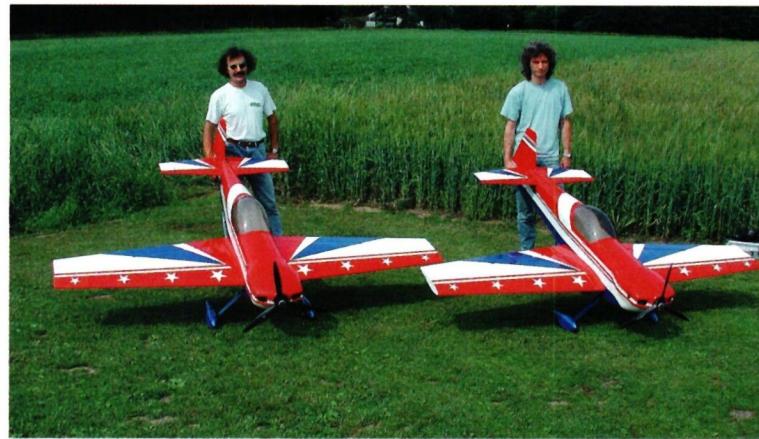
comparable wooden model kit. However, it’s a big advantage when you don’t have to paint it anymore and can just focus on assembly. The flight characteristics are very well-balanced, and with its large control surfaces, the model is also ideally suited for 3D aerobatics—which we haven’t mastered yet, though.
Stefan Möller
| Fuselage (with all internal components) | 8,000 g |
| Wing halves, each | 1,100 g |
| Engine cowling | 400 g |
| Horizontal stabilizer and wing joints | 700 g |
| Total weight | 11,300 g |
| Wingspan | 2,464 mm |
| Length | 2,268 mm |
| Engine | ZDZ 80 RV |
| Muffler | Homemade |
| Fuel tank capacity | 950 ml |

EURO CONTEST GLIDER ACRO TOUR AUSTRIA 2026

THE PC-21 STORY
 Emil Giezendanner

TWIN TOWN PARTNERSHIP
 Wolfgang Voeller

SUMMER FUN 2026 AT MG USTER
Martin Wunderli
CORSAIR F4U – A WARBIRD WITH A MEMORABLE LOOK
Jürgen Rosenberger, Jürgen Prinz
52. 2026 ALPS CUP
Emil Giezendanner
YOU KNOW WHAT I MEAN? 125 YEARS OF THE SWISS AERO CLUB
Emil Giezendanner
News from HEBU

TEAM MANAGER "THIS" BOSSHARD
Rodito Nussbaumer
ATOM, THE NEW DOUBLE-DECKER FROM CPLR
 Matthias Bosshard

F3A EUROPEAN CHAMPIONSHIPS IN ST-MACAIRE, FRANCE
Matthias Bosshard
INSIGHTS INTO THE HISTORY OF SEAPLANES

WELCOME, NEW MEMBER!
Andrea Bolliger
What's New at Leomotion.com

PRIDE AND GOOD IDEAS
 Markus Nussbaumer

SMALL, MODEL-LIKE SAILBOATS
Res Dauwalder
FREE FLIGHT IN THE MIDDLE OF SUMMER
Urs Muntwyler
BY YOUTH, FOR YOUTH
Lorena Betschen
HORIZON HOBBY/LEMACO NEWS: MICRO OV-10 BRONCO 645 MM BY E-FLITE

COUPE DES ALPES – OBSERVE AND LEARN
Rodito Nussbaumer
34th HAHNENMOOS ALPINE MODEL AIRPLANE CAMP
Res Dauwalder
TRY-OUT DAY AT MFV WETTINGEN
 Urs Keller

NEWS FROM HEBU
 Julia Bucher

NOS REGION – A HUB FOR ELECTRIC AVIATION
Emil Giezendanner
MEMORIES
 Wolfgang Völler

70 YEARS OF THE NIDWALDEN MODEL AIRPLANE CLUB
Martin Barmettler
A SPECTACULAR F3A WORLD CUP IN THE PRINCIPALITY OF LIECHTENSTEIN
Emil Giezendanner
FROM 0 TO 100
Markus Nussbaumer