
Large-scale model "almost finished"
The trend is clear—and not good news for woodworms: More and more models are coming onto the market that are almost fully assembled—and at incredibly low prices, to boot. The Jodel Robin from Jamara is one such “model kit.”
It all starts with a wish. And it came about because of this question: Can you tow my 5-meter glider? I had my doubts as to whether my Jodel Robin—a former Hope kit that’s over 10 years old, with a 1.9-meter wingspan and an aging 30-cc Super Tigre engine—would be up to the task.
In addition to outrageously expensive all-FRP racers and a high-quality kit for woodworking enthusiasts with plenty of time on their hands, I found my dream model at Jamara: an affordable, “ready-to-fly” Jodel Robin with a 2.4-meter wingspan.
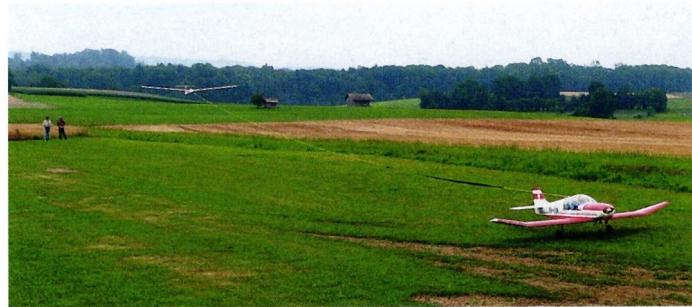
One of the most popular tow planes is the Jodel DR 400/180R Remorqueur, with its distinctive folding wings.
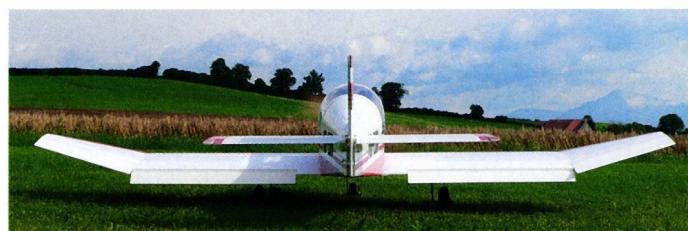
However, our model is based on the DR 300, which has a slightly smaller glass canopy. This model—which is certainly not 100% to scale—is therefore not intended for entry in a scale competition, but rather for realistically towing large gliders and for a relaxed introduction to large-scale models. Since the original has a wingspan of 8.720 m, this results in a slightly irregular semiscale ratio of 1/3.633.
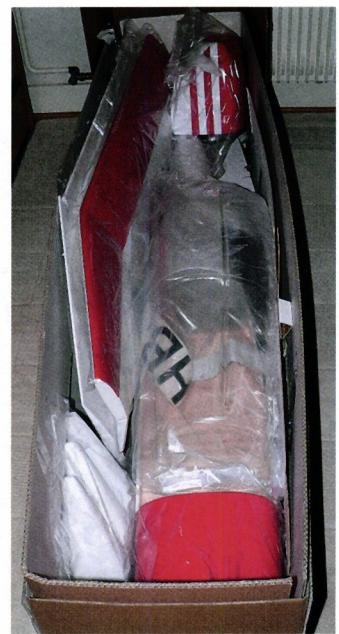
Jamara supplies the model fully assembled and covered in a conventional wooden construction. Two sturdy aluminum tubes connect the two wing halves. Included are the fuel tank, landing gear, wheel covers, wheels, etc. The remaining work is limited to installing the motor and radio control system, adjusting the canopy, and gluing in the tailplane and horizontal stabilizer, as well as possibly mounting the wheel covers, etc.
Depending on your working style and the additional effort involved, this can take between 10 and 30 hours—or, as this story shows, even a little longer.
All control surfaces except the rudder are secured with adhesive tape, which is perfectly fine. On my Hope-Jodel, the control surfaces are also secured with adhesive tape and are still holding up perfectly even after 15 years.
The really nice, spring-loaded telescopic nose landing gear included in the kit wasn’t an option for me, since our grass runway isn’t very well maintained—especially during the colder months—and larger wheels than the maximum size allowed here are recommended. So I bought the largest nose landing gear from Multiplex and mounted a 10-cm wheel on it. I fitted the main landing gear with 12-cm-diameter wheels, which proved to be a very good choice.
Wheel covers are a pet peeve of mine, as they’ve only ever caused me problems. They make it impossible to use larger wheels. Plus, these wheel covers fill up with dirt in the fall on muddy, wet runways, blocking the wheels and adding unnecessary weight. Various Jodels—for example, at Birrfeld and the Mannheim Gliding Club—fly without wheel covers.
Various flaws in the model were reported to the manufacturer. The manufacturer promised that all these defects would be corrected by the time this report was published. These include large gaps in the landing flaps, which were not crafted very precisely, as well as incorrectly glued and stiff Bowden cables.
and elevators that were glued on only on one side, which nearly caused a crash. The assembly instructions were very basic.
The model is generally well-built and neatly covered with high-quality film. The two wing halves fit together perfectly. The fit of the wings to the fuselage is also perfect. As a model builder of only average skill, I probably wouldn't have been able to achieve such precision on my own.
From the very beginning, I knew I wanted to install either a ZG 62 or a ZG 45. The manufacturer informed me that the model hadn’t yet been tested for this engine size. They recommended a 30-cc two-stroke or something similar.
After examining the lightweight fuselage, I and a few colleagues began to suspect that it wasn’t stable enough for large gasoline engines. So, the fuselage had to be reinforced. First, the nose was reinforced on the inside with 100-gram fiberglass cloth. Since I hate it when fuel and oil seep under the film in the engine area, I decided to cover the entire fuselage with 50-gram fiberglass cloth. To do this, I reluctantly removed the beautifully smoothed film from the fuselage.
Covering the fuselage with fiberglass cloth—known in model-building jargon as “fibering”—is quite a labor-intensive process. First, the fuselage is finely sanded, then coated with epoxy, and the fiberglass cloth is stretched over it so that no wrinkles form, which isn’t as easy as it sounds. After curing, it’s sanded down a bit, coated with epoxy again, sanded once more, primed, and then spray-painted. The whole process took me about 15 hours (I didn’t count exactly) and added 600 grams to the weight. In return, the fuselage was now many times more stable.
The main landing gear and the contact surface on the wing are sturdy enough to withstand even a rough landing.
Anyone building a model of this size will quickly realize that the hardest part of the whole process is getting the large, heavy model to the airfield and back to the workshop without damaging it. The problems start with the door openings, which are far too small, and for the first time, I’m running into space issues in my Opel Astra station wagon.
Once at the airfield, however, the model is ready to fly in a matter of minutes.
When engines reach a certain size, the utmost caution is required.
In the ZG 45 owner’s manual, I read the safety precautions written by Gerhard Reinsch with a touch of humor—precautions that are very important for a large-scale model and which I’d like to briefly summarize here:
- When starting the engine, is the throttle really set to ¼ throttle and not, say, full throttle?
- Be sure to secure the model during takeoff, either with the help of an assistant or with well-anchored lines.
- Do not roll the model through a crowd of people to the launch site. Gerhard Reinsch: “How would you feel if the controls suddenly malfunctioned and the model rolled toward your colleagues at full throttle? If the propeller only smashes another model to pieces, you’ll consider yourself lucky!”
- – Dual power supply with two batteries connected via diodes and separate switches.
- – Proper antenna installation (explaining everything about this would go beyond the scope of this report).
Jamara says it weighs about 9 kg, and people are said to have built and flown the model with a 30-cc engine at just 8.8 kg.
The empty fuselage weighs 1.75 kg. After “fiberglassing,” the weight increased to 2.375 kg. The fuselage, fully ready for flight and including the motor, now weighs 7.2 kg, while the two wings, including the connecting tubes, weigh 3.275 kg. Finally, pilot dummies and seats with a total weight of 300 grams were added. This brings the total to 10.775 kg. With a total wing area of 115.5 dm², this results in a wing loading of 93.3 g/dm², which is still within safe limits.
While searching for an affordable ZG 62 or ZG 45, I stumbled upon a used ZG 45. Although it was already 9 years old, it had only a few hours of runtime—but it had survived a pretty nasty crash. Three cooling fins were partially broken off, but otherwise the thing was
still seemed to be in working condition. The previous owner told me that the engine couldn’t be started by hand and that a starter motor with a gearbox was recommended. However, since I was used to something different from my ZG 23, I ordered Tony Clark’s owner’s manual online and read it thoroughly, right down to the very last sentence. In doing so, I realized that you actually have no chance of getting the engine running if you don’t pay attention to two things.
1: With the choke valve closed, the engine must be almost flooded. If there’s too little fuel, you’ll never get it running, and it will backfire. So better too wet than too dry!
2: The propeller must be mounted so that compression begins at the 11 o’clock position. Start the engine at the 1 or 2 o’clock position so that a spark can actually be generated during compression.
Conclusion: Starting a ZG gasoline engine by hand is no problem if you do everything right...
Based on my positive experience with Euroline's very affordable standard servos, I bought some for most of the
Features include the company’s standard power servos, which are also inexpensive and very powerful (5 kp at 4.8 V and 6.2 kp at 6 V). A Euroline servo with a metal gear was used for the nose wheel.
One of the Power Servos had to be discarded right from the start because it only moved in jerky motions. The servo with the metal gear wasn’t up to the rigors of being used as a nose wheel servo and had to be replaced after it was damaged. Another Power servo nearly caused a crash—but more on that later. I am now in the process of replacing all of these servos with different models.
Conclusion: see title!
Equipped only with the necessary functionality—that is, without pilot dummies, cockpit trim, engine cowling, or a final coat of paint—we headed to the airfield.
First, we tried to get gasoline into the ZG45’s completely dried-out diaphragm carburetor. So we closed the choke, opened the throttle, and quickly spun the propeller about 50 times until the engine made “smacking noises.” The long-awaited smacking sound finally materialized, and after a few start-up attempts, the engine began to fire. Gradually, the engine reached its optimal full-throttle performance. During subsequent taxiing tests, it ran with low vibration and remained reliable at all RPMs.
The tachometer read 6,400 rpm with a Menz 21 × 8 wooden propeller. My precision scale showed a static thrust of 8.5 kg. This made it clear that the model couldn’t shoot straight up into the sky indefinitely. But does a tow model really need to be able to do that? A tow combination hurtling steeply toward the sky at a 45-degree angle certainly doesn’t look very true to the prototype.
When testing the slow-flight characteristics—and thus also the stall behavior—
is a real joy. When throttling back or pulling the elevator fully, the model doesn’t respond with a sudden stall, but only with gentle pitching motions.
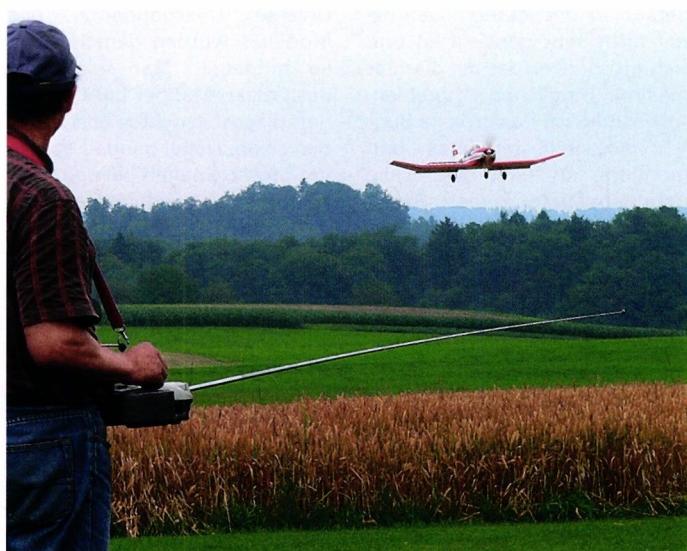
The maiden flight was completely uneventful except for the landing, where I couldn’t reduce speed enough and the tall grass at the edge of the runway had to act as an emergency brake.
Subsequent flights demonstrate absolutely ideal flight characteristics and a beautiful flight profile.
Landing a 10-kg model is a challenge every time, despite its completely non-critical handling characteristics. After all, you have to plan the landing well in advance and very carefully, and dissipate the considerable kinetic energy as elegantly as possible.
To my musical ears, the sound with the original muffler is a bit rattly and not exactly refined. At least, thanks to the carburetor intake through the acoustically dampened body, the bleating and very unpleasant intake noise is gone. For a pleasantly deep sound, though, I’d still need
a larger muffler. None of my colleagues had any complaints about the sound, though, and some even thought it sounded “awesome.”
While the first day of flight, with only two or three short flights, went off without a hitch, on the second day of operation—after 6 flights totaling about 1 hour of flight time—the Zwackers briefly revved the throttled engine to full throttle during the landing approach. In addition, the model began bucking and threatened to spin out of control.
To avoid endangering my colleagues and spectators, I decided to make a field landing in a recently mowed but bumpy meadow. The landing with the engine shut off went smoothly and was as smooth as butter, thanks in no small part to the large wheels.
Was it the unshielded ignition wire of the ZG 45? Was it the battery, the receiver, one of the servos, or interference from a neighboring channel? After this day of flying, the battery showed a remaining capacity of 1,750 mA, so it was still practically full. After further nerve-wracking experiences and desperate
(Manufacturer's specifications)
Wingspan: approx. 2400 mm
Length: approx. 1900 mm
Wing area: approx. 101 qdm
Weight: approx. 9,000 g
RC: 4-channel/7 servos
Engine: 2-stroke 180
Price: CHF 780.–
After some searching, the culprit was finally found: The motor servo—a brand-new Euroline Power Servo—began to twitch when the supply voltage dropped slightly and at a certain low RPM at which the model vibrated a bit more intensely. The newly installed voltage monitor in the model flashed the red warning light for fractions of a second with every twitch. As a result, this servo was replaced with a Robbe standard servo, and from then on, everything was pure joy.
A 5-kg glider with a wingspan of just over 4 meters is pulled swiftly and safely into the air by the ZG 54-powered model. The climb performance is more than adequate, even with the glider’s landing flaps fully extended. I’ll have to wait a bit longer for heavier gliders. According to estimates—and also based on information from Tony Clark—the ZG 45 should be capable of towing 7 kg and even heavier gliders without any problems—we’ll see. If it doesn’t work out, my next wish is already lined up: a ZG 62, of course...
For a relatively affordable price, this “almost-ready-to-fly” model from Jamara offers buyers a full-scale model that allows any model pilot with enough experience to easily enter the world of full-scale models and can serve as an excellent tow plane.
The Swiss importer informed me that this model is being phased out. So anyone who still wants to get their hands on one shouldn’t wait too long. It’s available while supplies last...
Hans Jürg Baum

EURO CONTEST GLIDER ACRO TOUR AUSTRIA 2026

THE PC-21 STORY
 Emil Giezendanner

TWIN TOWN PARTNERSHIP
 Wolfgang Voeller

SUMMER FUN 2026 AT MG USTER
Martin Wunderli
CORSAIR F4U – A WARBIRD WITH A MEMORABLE LOOK
Jürgen Rosenberger, Jürgen Prinz
52. 2026 ALPS CUP
Emil Giezendanner
YOU KNOW WHAT I MEAN? 125 YEARS OF THE SWISS AERO CLUB
Emil Giezendanner
News from HEBU

TEAM MANAGER "THIS" BOSSHARD
Rodito Nussbaumer
ATOM, THE NEW DOUBLE-DECKER FROM CPLR
 Matthias Bosshard

F3A EUROPEAN CHAMPIONSHIPS IN ST-MACAIRE, FRANCE
Matthias Bosshard
INSIGHTS INTO THE HISTORY OF SEAPLANES

WELCOME, NEW MEMBER!
Andrea Bolliger
What's New at Leomotion.com

PRIDE AND GOOD IDEAS
 Markus Nussbaumer

SMALL, MODEL-LIKE SAILBOATS
Res Dauwalder
FREE FLIGHT IN THE MIDDLE OF SUMMER
Urs Muntwyler
BY YOUTH, FOR YOUTH
Lorena Betschen
HORIZON HOBBY/LEMACO NEWS: MICRO OV-10 BRONCO 645 MM BY E-FLITE

COUPE DES ALPES – OBSERVE AND LEARN
Rodito Nussbaumer
34th HAHNENMOOS ALPINE MODEL AIRPLANE CAMP
Res Dauwalder
TRY-OUT DAY AT MFV WETTINGEN
 Urs Keller

NEWS FROM HEBU
 Julia Bucher

NOS REGION – A HUB FOR ELECTRIC AVIATION
Emil Giezendanner
MEMORIES
 Wolfgang Völler

70 YEARS OF THE NIDWALDEN MODEL AIRPLANE CLUB
Martin Barmettler
A SPECTACULAR F3A WORLD CUP IN THE PRINCIPALITY OF LIECHTENSTEIN
Emil Giezendanner
FROM 0 TO 100
Markus Nussbaumer