
3.4 D Telecont RC Remote Controls
| Manufacturer | Reichert Elektronik, Trier |
| Distributor | ROBBE, Grebenhain |
| Year of manufacture | 1961 to approx. 1966 |
| Channels | 3, 5, 9 (10) |
| Frequency | 27.12 MHz and 40.68 MHz |
| Price | 1,200 DM (1956), 9-channel system with superheterodyne receiver and 4 servos |
| Special Features | Expandable from 3 to 5 or 9 (10 with superheterodyne) channels |
The Telecont remote control series immediately catches the eye with its unusual design. It consists of a transmitter—tiny for its time—in a leather case, and huge, heavy receiver units made of red plastic. Rumor has it that the transmitter housing was originally manufactured for a Geiger counter. With their modular design, the transmitters—about the size of a camera—can be quickly expanded from 3 to 5 or 9 channels. Like Lego blocks, the receiver can also be expanded in additional stages up to 9 channels. The control sticks are ingeniously mounted. They can be pulled out of the housing and, thanks to a spring, laid flat at a 90-degree angle against the transmitter casing. The antenna is secured in leather loops on the side, so you can casually sling the transmitter over your shoulder and keep your hands free for other tasks. Transmitters and receivers are relatively easy to find, but the servos seem to have vanished off the face of the earth.
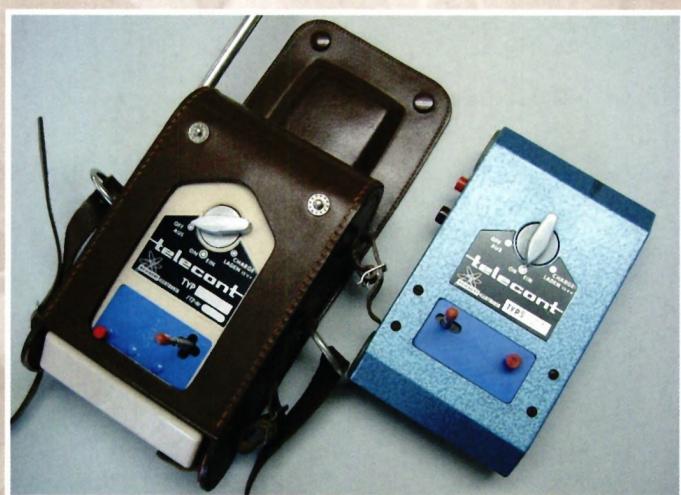
The older version had a blue steel case. The last transmitters were then shipped in a modern plastic case. However, they always came with a leather case.
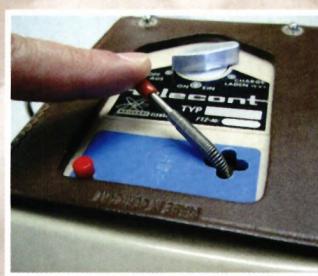
The wands are mounted on a spring and can be folded down 90 degrees. This is necessary to pack the transmitter into the case.
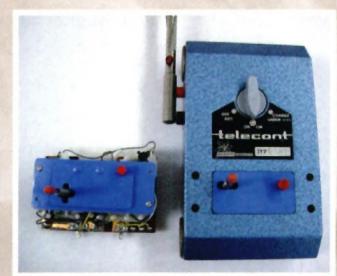
All Telecont transmitters could be quickly upgraded to 5 or 9 channels with new modules.
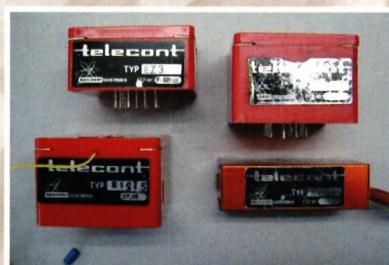
An overview of all receivers. Below are the 3-channel base unit and the 2-channel receiver. Above are the upgrade options for 5 and 9 channels.
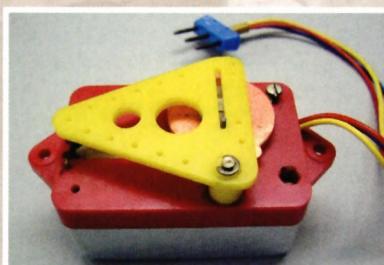
In addition to the original Telecont servo, Robbe also offered several of its own servos for the Telecont.
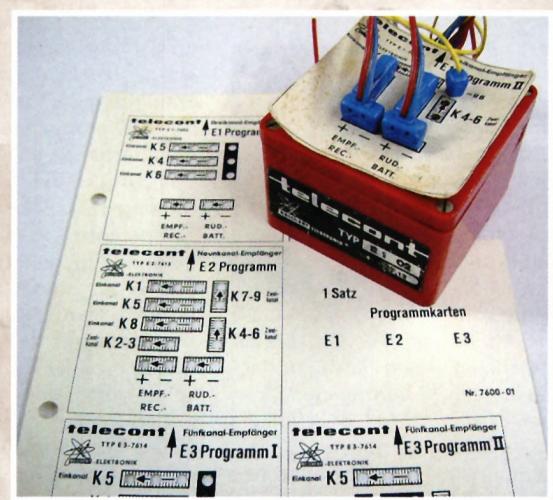
The programming cards are needed to find the correct connection points for the servos in the receiver.

EURO CONTEST GLIDER ACRO TOUR AUSTRIA 2026

THE PC-21 STORY
 Emil Giezendanner

TWIN TOWN PARTNERSHIP
 Wolfgang Voeller

SUMMER FUN 2026 AT MG USTER
Martin Wunderli
CORSAIR F4U – A WARBIRD WITH A MEMORABLE LOOK
Jürgen Rosenberger, Jürgen Prinz
52. 2026 ALPS CUP
Emil Giezendanner
YOU KNOW WHAT I MEAN? 125 YEARS OF THE SWISS AERO CLUB
Emil Giezendanner
News from HEBU

TEAM MANAGER "THIS" BOSSHARD
Rodito Nussbaumer
ATOM, THE NEW DOUBLE-DECKER FROM CPLR
 Matthias Bosshard

F3A EUROPEAN CHAMPIONSHIPS IN ST-MACAIRE, FRANCE
Matthias Bosshard
INSIGHTS INTO THE HISTORY OF SEAPLANES

WELCOME, NEW MEMBER!
Andrea Bolliger
What's New at Leomotion.com

PRIDE AND GOOD IDEAS
 Markus Nussbaumer

SMALL, MODEL-LIKE SAILBOATS
Res Dauwalder
FREE FLIGHT IN THE MIDDLE OF SUMMER
Urs Muntwyler
BY YOUTH, FOR YOUTH
Lorena Betschen
HORIZON HOBBY/LEMACO NEWS: MICRO OV-10 BRONCO 645 MM BY E-FLITE

34th HAHNENMOOS ALPINE MODEL AIRPLANE CAMP
Res Dauwalder
COUPE DES ALPES – OBSERVE AND LEARN
Rodito Nussbaumer
TRY-OUT DAY AT MFV WETTINGEN
 Urs Keller

NEWS FROM HEBU
 Julia Bucher

NOS REGION – A HUB FOR ELECTRIC AVIATION
Emil Giezendanner
MEMORIES
 Wolfgang Völler

70 YEARS OF THE NIDWALDEN MODEL AIRPLANE CLUB
Martin Barmettler
A SPECTACULAR F3A WORLD CUP IN THE PRINCIPALITY OF LIECHTENSTEIN
Emil Giezendanner
FROM 0 TO 100
Markus Nussbaumer