
Indoor Gliding World Championship (F1D)
Background: In early January 1974, four idealists came together to revive the “Saalflug” (F1D) model aircraft category, which had already fallen into obscurity in Switzerland. To make the whole endeavor a bit more exciting, they set their sights on participating in the World Championship. Every spring at the Region 5 chairpersons’ conference, a model category is recommended for promotion. In 1974, it was indoor flying.
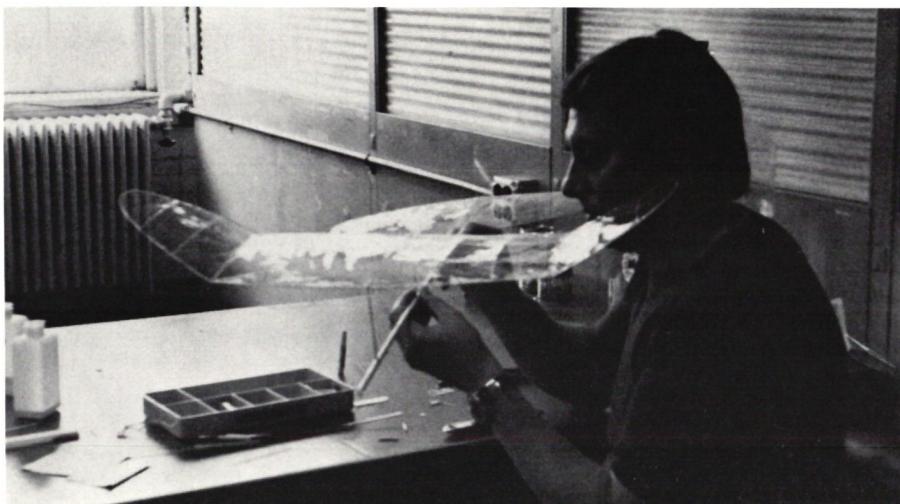
The sheer amount of work that had to be done could fill this entire issue. Just a few examples: We used translations from the magazines *Modelar*, *CSSR / Aero Modeller*, and *GB* as a guide. From books and magazines written in German, we found only older literature. Next came the construction of our own model. We had to make special tools ourselves: 1/100-scale balances, rubber-winding machines, 1:50 scale, etc. This was followed by the production of all the templates—and, due to the short timeframe, a separate set for each competitor. Microfilm experiments. Airframe bracing tests with chromium-nickel steel wire, Ø 0.02 mm. Finding a suitable hangar for the first flight tests and further training. Then came building,
building—flying, flying!! We also had to pay special attention to transport by airplane and delivery van (always with one person present during unloading).
Tuesday, July 2. Departure from Kloten on Balair flight BB 700 at 1:00 a.m. Arrival in New York at 3:00 p.m. We continued our journey in a delivery van and a passenger car provided by the AMA through New York to Lakewood (accommodation for accompanying persons) and Lakehurst (event venue and accommodation for participants in military barracks).
That evening, we would have liked to complete a few training flights. We had to wait three hours because all the beds at the lodging were occupied, and the airship hangar was also closed, so we had no choice but to postpone our plans until the next day.
Wednesday, July 3. After a hearty American breakfast in the Air Naval Station cafeteria, we set up camp in Airship Hangar No. 5. Next to us were the best coaches—the Poles, who were there as both team and individual champions.
Before unpacking our boxes, we took a quick tour to check out the other 11 nations in attendance.
We were particularly struck by the small transport crates with Plexiglas side walls used by the British. Two advantages: 1. The smaller they are, the easier they are to transport. 2. Being able to clearly see the delicate models makes the transporter acutely aware of the need for caution.
The Americans have the largest number of indoor gliders. In the F1D category alone (microfilm-covered models, wingspan 65 mm, minimum airframe weight 1 g), there were approximately 250. This is where the toughest qualifying round for the World Championships took place. For example, after eight competitions, the fourth-place finisher was only 6 seconds behind the third-place finisher on the final team roster. In addition to the team, the most recent world champion, M. Andrews of the USA, aged 61, also competed. This man has 30 years of experience in indoor flying and was one of the pioneers. In 1949, he was the first to break the legendary 30-minute barrier. In my personal opinion, he flew the most beautifully built model. Weight: 1.02 g. Furthermore, two significant innovations could be observed in his model. Normally, the inner wing has approximately $1/2 \text{ dm}^2$ more area when circling, meaning the wing must be built asymmetrically; which results in uneven wing loading when the wing is tensioned, though this has only a slightly noticeable effect during flight. Andrews builds a symmetrical wing and offsets the pylon by approximately 4 cm, thereby achieving better force distribution. Second, he presumably flew the largest propeller in a triple configuration. He achieved the longest flight of this World Championship at 35'44", in the final round. He moved up from 12th to 3rd place. It takes an entire World Championship—or rather, five days from 9:00 a.m. to 9:00 p.m.—to find the most suitable propeller out of 20 different ones, as these were the official hall opening hours. Kalina holds the world record of 38'18", set at the 1972 World Championships in Kington, England. This record has not yet been officially broken. (Andrews’ training flight at the same championship lasted 41 minutes.) Kalina was the 1970 World Champion in Romania and was a member of the Czech World Championship team in 1968, 1970, and 1972. He is the chairman of the free flight association in his country, has been building models for 25 years, and is the world’s best indoor model aircraft pilot.
I noticed that the Czech pilots placed particular emphasis on the propeller. For example, Rybecky brought 20 different propellers, each in triplicate. He achieved the longest flight of this World Championship at 35'44", in the final round. He moved up from 12th to 3rd place. It takes an entire World Championship—or rather, five days from 9:00 a.m. to 9:00 p.m.—to find the most suitable propeller out of 20 different ones, since those were the official hall opening hours. Kalina holds the world record of 38'18", set at the 1972 World Championships in Kington, England. This record has not yet been officially broken. (Andrew’s training flight at the same championship lasted 41 minutes.) Kalina was the 1970 World Champion in Romania and was a member of the Czech World Championship team in 1968, 1970, and 1972. He is the chairman of the free flight association in his country, has been building models for 25 years, and is the world’s best indoor glider pilot.
I can probably write the most about the Poles, since we had the pleasure of being in their immediate vicinity during the World Championships. We didn’t truly realize their strength until the second day.
Thursday, July 4. The temperature in the gym was about 36°, with humidity at 80–85%. My clothes were sticking to my whole body. All the competitors had to overcome this additional challenge as well. Cipala, from Poland, demonstrated a simple but tried-and-true rubber test to me. A 20-cm piece (standard size 6 x 1 mm) is stretched to five times its original length: wait 5 minutes while it remains under tension. Then, the length of the stretched rubber is measured. If the elongation exceeds 15% (3 cm), it is poor-quality rubber.
An elongation of 10–12% indicates mediocre rubber, and less than 10% indicates good rubber. Until now, we’ve used castor oil as a rubber lubricant, but for these fine rubber strands, a specifically lighter and better lubricant had to be developed. Unfortunately, the mixture is still a secret.
What we couldn’t find in Swiss model shops was practically handed to us here. That’s because an American here has made it his mission to supply all indoor model aircraft enthusiasts with the best materials. Balsa wood sheets ranging from 0.12 mm to 0.55 mm, priced at nearly $1/100 \text{ mm}$ for almost any thickness, the lightest grade. Tapered wood for propeller shafts. Metal cones for the rear fuselage section. Propeller bearings made of watch jewels or Teflon. Special adhesives, microfilm mixtures, etc., etc. That would have cut our working hours by at least a third. At this point, I’d like to mention the number of hours we spent on this:
Siebenmann approx. 160 hours,
Tapernoux 300 hours, Heise 375 hours,
Team Captain Reifler: approx. 150 hours.
Reifler was busy practically all day cutting rubber and winding the rubber-powered engines. The rubber cross-section must be cut individually for each model. The weight of the rubber should roughly correspond to the weight of the airframe. All participants flew with two strings. Example: A model airframe weighing 1.7 g requires a rubber strip measuring $1 \times 1.9 \text{ mm} \times 2 = 3.8 \text{ mm}^2$. The length of the rubber band is $2 \times \text{hook spacing} + \text{approx. } 20\%$. On this day, all three Swiss participants broke the existing unofficial Swiss record of 12'30", held by F. Tapernoux, which was set at the University of Zurich (approx. 24 meters high) in the 1960s.
- World Championships only in the F1D category
- Max. wingspan: 65 cm
- Airframe weight: at least 1 g
- 6 flights, unlimited time
- The 4 best flights will be scored
- Control may be applied 3 times during a flight, for 15" each time. This may only be used if the model is about to fly into an obstacle. The organizer has provided various devices for this purpose.
- a) A modified fishing rod with thick Perlon line, from which hangs a gas balloon approximately 1 m in diameter. How is the model controlled? It takes a bit of imagination to visualize this process. The brake on the fishing rod is released, and the balloon rises. Near the flying model, about 3–5 m above its flight path, the balloon is stopped. The competitor must now carefully attempt to guide the vertically extended Perlon line between the wing and the propeller all the way to the nose of the fuselage. The propeller then becomes locked with the Perlon cord, and the competitor must immediately move the model forward along its original flight path. During this process, the timekeeper counts the seconds, as the model must be freed again within 15 seconds at the latest. During this time, the competitor attempts to move the model as close to the center of the hall as possible. If, for example, the competitor fails to move the model forward, the model will literally wrap itself around the Perlon cord due to the torque and the flight will be stopped.
- b) Fiberglass rods 4–5 m long can be used if the model is likely to fly into an obstacle near the ground. In this case, the control method is significantly simpler. Using the rod on the trailing edge of the inner wing, carefully push the model to the desired location within a maximum of 15".
- The second scoring flight may not be attempted until all three team members have completed the first one.
Friday, July 6. Weather conditions: 35–37° C and 85–90% humidity. We’ve slowly gotten used to the heat. The Swiss team was the only newcomer at this World Championship.
I’d like to extend a special thank you to Ray Harlan from the U.S. He recognized that we were beginners and immediately stepped in to help. Our neighbors, the Polish team, were also happy to provide us with any information we needed. They had their lead firmly secured, because something special happened that day.
At 1:45 p.m., a severe thunderstorm broke out. Large raindrops poured through the leaky roof. Just one drop is enough to cause a model to crash, and that’s exactly what happened to the seven models that were in flight at the time. Here, too, the Poles were a step ahead of the others; every quarter of an hour, one man would leave the hangar to monitor the weather, because in these tropical conditions, it can start raining in a quarter of an hour—just as it had just happened.
The jury decided to postpone the 6th flight and the remaining 1½ hours of the 5th flight until Saturday.
Saturday, July 7. For the last time, the competitors had to line up in the gloomy, hot, and humid Hangar No. 5. The mood was somber. Many were dissatisfied with their performances. At one point, I took the time to observe the entire launch preparation process of world champion Ryszard Czechowski from Poland. Depending on the temperature and humidity, he selects either a hard or elastic rubber from his arsenal. He tests it for RPM and torque. He selects the appropriate propeller and gets the model ready for launch. His case has a special device that allows the rubber band to be wound outside the model. Beforehand, the jury checks the model’s weight and wingspan. The general flight path of the models already in flight is observed, and the model is launched from the most favorable spot on its 34-minute journey. If one had to formulate a law regarding a future world champion, it would read as follows:
The world champion is the one who knows how to size the rubber band so that his model scrapes the ceiling for at least one-third of the flight time without getting caught (e.g., strut). Applies to all hall heights.
Subsequently, an international competition was held for various indoor flight categories. We Swiss took the opportunity to raise the record a bit higher. Final results:
Siebenmann 24'25",
Tapernoux 23'46",
Heise 18'06".
Even though we were classified in the “longer flights” category, we can be satisfied with our performances. In just half a year, we achieved a feat that no country had ever accomplished before, as confirmed by the American and German team managers.
Region 5 intends to organize a Swiss indoor flying competition in the near future. We would like to conduct a survey to determine whether the effort is worthwhile. Those interested should send a postcard to: Redaktion Modell-Flugsport, P.O. Box, 8335 Hittnau, with the note: “Indoor Flying.” Everyone can now benefit from the experience gained in the U.S. Construction instructions with a plan will follow.
| PLACE | NAME | COUNTRY | ONE | TWO | THREE | FOUR | FIVE | SIX | TOTAL |
|---|---|---|---|---|---|---|---|---|---|
| 1 | R. Czechowski | Poland | 34:27 | 34:50 | 29:01 | 34:56 | 34:53 | 33:34 | 69:49 |
| 2 | B. Servaites | U.S.A. | 33:59 | 6:56 | 33:40 | 32:44 | 25:54 | 33:51 | 67:50 |
| 3 | K. Rybecky | C.S.S.R. | 21:51 | 31:32 | 14:49 | 19:39 | 30:27 | 35:44 | 67:16 |
| 4 | S. Kujawa | Poland | 29:45 | 32:34 | 9:39 | 28:26 | 34:32 | 9:55 | 67:06 |
| 5 | E. Ciapala | Poland | 27:52 | 31:01 | 32:49 | 17:43 | 34:11 | 30:25 | 67:00 |
| 6 | M. Andrews * | U.S.A. | 31:12 | 20:23 | 33:56 | 0:14 | 32:03 | 31:10 | 65:59 |
| 7 | E. Chlubny | C.S.S.R. | 22:38 | 31:23 | 23:52 | 28:55 | 26:47 | 33:04 | 64:27 |
| 8 | E. Stoll | U.S.A. | 30:56 | 26:07 | 28:59 | 8:43 | 29:01 | 33:08 | 64:04 |
| 9 | J. Blount | England | 10:41 | 12:14 | 0:36 | 29:01 | 28:25 | 33:16 | 62:17 |
| 10 | L. Cailliau | U.S.A. | 6:54 | 8:02 | 33:31 | 26:19 | 13:24 | 28:45 | 62:16 |
| 11 | J. McGillivray | Canada | 29:36 | 19:15 | 32:22 | 12:20 | 28:54 | 00:15 | 61:58 |
| 12 | L. Barr | England | 24:41 | 21:07 | 28:48 | 13:58 | 26:49 | 32:22 | 61:10 |
| 13 | J. Kalina | USSR | 15:05 | 8:33 | 33:02 | 12:35 | 27:15 | 26:45 | 60:17 |
| 14 | P. Nore | Finland | 15:06 | 20:02 | 28:08 | 31:43 | 2:42 | 26:38 | 59:51 |
| 15 | R. Parham | England | 23:48 | 0:20 | 21:32 | 28:20 | 28:11 | 29:30 | 57:50 |
| 16 | H. Raulio | Finland | 22:00 | 11:17 p.m. | 31:20 | 25:54 | 12:24 | 25:17 | 57:14 |
| 17 | T. Minagawa | Japan | 21:15 | 27:13 | 28:52 | 3:58 p.m. | 9:41 PM | 7:13 p.m. | 56:05 |
| 18 | A. DeMello | Canada | 0:14 | 6:33 | 24:35 | 25:56 | 15:51 | 29:07 | 55:03 |
| 19 | C. Cotugno | Italy | 25:29 | 00:05 | 17:40 | 26:16 | 26:06 | 28:10 | 54:26 |
| 20 | A. Frioli | Italy | 7:48 | 25:22 | 12:30 | 15:42 | 7:32 p.m. | 28:44 | 54:06 |
| 21 | W. Wetzel | West Germany | 12:53 | 0:20 | 27:30 | 21:10 | 25:21 | 26:24 | 53:54 |
| 22 | K. Vogler | West Germany | 21:51 | 22:07 | 27:06 | 26:29 | 8:51 | 11:55 p.m. | 53:35 |
| 23 | H. Erofejeff | Finland | 14:58 | 18:51 | 7:54 p.m. | 24:16 | 24:53 | 27:32 | 52:25 |
| 24 | M. Thomas | Canada | 23:01 | 6:34 | 1:22 | 26:48 | 11:29 | 24:12 | 51:00 |
| 25 | F. Migani | Italy | 19:45 | 6:54 p.m. | 26:36 | 7:48 | 11:44 p.m. | 9:19 | 50:20 |
| 26 | B. Felstead | Australia | 21:55 | 25:45 | 21:12 | 0:05 | 10:51 PM | 5:37 p.m. | 48:36 |
| 27 | H. Tiemann | West Germany | 21:07 | 23:18 | 9:35 PM | 9:48 PM | 24:50 | 8:38 | 48:08 |


News from HEBU

EURO CONTEST GLIDER ACRO TOUR AUSTRIA 2026

TEAM MANAGER "THIS" BOSSHARD
 Rodito Nussbaumer

YOU KNOW WHAT I MEAN? 125 YEARS OF THE SWISS AERO CLUB
 Emil Giezendanner

TRY-OUT DAY AT MFV WETTINGEN
Urs Keller
F3A EUROPEAN CHAMPIONSHIPS IN ST-MACAIRE, FRANCE
 Matthias Bosshard

HORIZON HOBBY/LEMACO NEWS: MICRO OV-10 BRONCO 645 MM BY E-FLITE

PRIDE AND GOOD IDEAS
 Markus Nussbaumer

BY YOUTH, FOR YOUTH
Lorena Betschen
34th HAHNENMOOS ALPINE MODEL AIRPLANE CAMP
Res Dauwalder
52. 2026 ALPS CUP
Emil Giezendanner
TWIN TOWN PARTNERSHIP
Wolfgang Voeller
ATOM, THE NEW DOUBLE-DECKER FROM CPLR
Matthias Bosshard
CORSAIR F4U – A WARBIRD WITH A MEMORABLE LOOK
Jürgen Rosenberger, Jürgen Prinz
SUMMER FUN 2026 AT MG USTER
Martin Wunderli
What's New at Leomotion.com

THE PC-21 STORY
Emil Giezendanner
COUPE DES ALPES – OBSERVE AND LEARN
Rodito Nussbaumer
SMALL, MODEL-LIKE SAILBOATS
Res Dauwalder
WELCOME, NEW MEMBER!
Andrea Bolliger
FREE FLIGHT IN THE MIDDLE OF SUMMER
Urs Muntwyler
INSIGHTS INTO THE HISTORY OF SEAPLANES

NEWS FROM HEBU
 Julia Bucher

FROM 0 TO 100
Markus Nussbaumer
MEMORIES
Wolfgang Völler
NOS REGION – A HUB FOR ELECTRIC AVIATION
Emil Giezendanner
DO YOU KNOW WHAT I MEAN IN THE LAND OF SMILES?
Emil Giezendanner
A SPECTACULAR F3A WORLD CUP IN THE PRINCIPALITY OF LIECHTENSTEIN
Emil Giezendanner