
YOUNG SILENT WINGS: SPORTS PROMOTION FOR JUNIORS
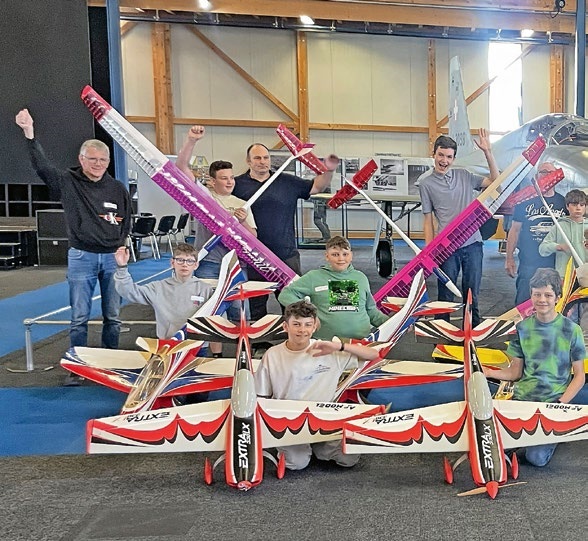
The Young Silent Wings Support Program is aimed at young people between the ages of approximately 12 and 16 who already know how to fly model airplanes and have joined a model flying club. The most recent edition took place from April 23 to 25, 2026, at the Air Force Center Dübendorf with 14 participants.
In the support program, the young people learn how to assemble, program, and test-fly a sailplane or aerobatic model. To participate, they must have at least basic flying skills and be members of a model flying club affiliated with the Swiss Model Flying Association. A few years ago, the course was redefined, evolving from a simple summer camp/model-building course into a program for promoting young talent in the sport. The course does not end with the construction and test flights of the models. “Much more important,” emphasizes Martin Schneebeli, “is that the participants take part in the subsequent training sessions and make progress in model aviation.” Five to six such training days are offered each year and conducted separately by discipline—gliding or aerobatics—with graduates from previous years also able to participate. It is important that the young people motivate one another and are able to learn from and benefit from each other.
The course is organized by the Northeast Switzerland Model Aircraft Association (NOS) primarily for young competitive pilots from the region and takes place during the Zurich school spring break. However, young people from other cantons and regions are also warmly welcome. This year, for example, one young pilot from Obwalden and another from Appenzell made the long trip to attend. With the exception of last year’s course at Technorama in Winterthur, the course is always held at the Air Force Center in Dübendorf, which also provides the necessary facilities (airplanes) for the course.
For the participants and volunteers from clubs in the canton of Zurich, the association receives a financial contribution from the Zurich Cantonal Sports Association. The Swiss Model Flying Association also supports the young people by covering a portion of the cost of the models. In addition, retailers contribute by providing the models and accessories at discounted prices. The 14 young people between the ages of 12 and 16 who participated this year were assisted by about 14 volunteers, who provided varying degrees of hands-on support as they built and set up their models.
Participants could choose between three models, which they could purchase at discounted prices. The course fee is based on the model selected. Included are accessories, a motor, and servos, as well as a simple lunch. Participants must bring their own transmitters and receivers. Three days were set aside for assembling the Marabu glider (F5J) and the Mythos 50E aerobatic model (F3A). For the first time, an “foam model”—the Extra 330—was available as an option; its assembly, completion, and programming could all be accomplished in just one day. Four participants opted for this—also more affordable—model.
To lighten the mood a bit during the day of building, the teens also had access to a model flight simulator. This soon revealed that not everyone was yet fully confident in taking off, flying, and—above all—landing a model airplane. Assembling the glider model also posed a challenge for the 12- to 16-year-olds. While gluing together small wooden pieces and fitting them into place, they quickly learned how essential it is to follow the specified order. “They can’t possibly know what they’ve never done wrong,” says Martin Schneebeli. Programming the models then presents yet another challenge. Each young person must bring their own remote control, which also poses a challenge for the volunteers, who are more or less familiar with the different brands.
While the first two and a half days were set aside for building, equipping, and programming the models, on Thursday afternoon all participants headed to the model airfield in Uster. With so many participants, the logistics of transportation should not be underestimated. Under the expert guidance of the two instructors, Matthias Bossard (aerobatics) and Andreas Schwerzmann (gliding), they learned how to break in the models. This also includes adjusting the correct center of gravity and control surface deflections. Most participants were able to successfully complete the test flights, even though the Bise wind was blowing relatively strongly. “So far, I haven’t seen any of the kids playing with their cell phones,” says Schneebeli, impressed. Not even during the lunch break. The physical experience of “doing something together” clearly still holds appeal today. ■
The interview was conducted by Andrea Bolliger

News from HEBU

TEAM MANAGER "THIS" BOSSHARD
 Rodito Nussbaumer

YOU KNOW WHAT I MEAN? 125 YEARS OF THE SWISS AERO CLUB
 Emil Giezendanner

F3A EUROPEAN CHAMPIONSHIPS IN ST-MACAIRE, FRANCE
 Matthias Bosshard

52. 2026 ALPS CUP
Emil Giezendanner
PRIDE AND GOOD IDEAS
 Markus Nussbaumer

ATOM, THE NEW DOUBLE-DECKER FROM CPLR
Matthias Bosshard
CORSAIR F4U – A WARBIRD WITH A MEMORABLE LOOK
Jürgen Rosenberger, Jürgen Prinz
SUMMER FUN 2026 AT MG USTER
Martin Wunderli
TRY-OUT DAY AT MFV WETTINGEN
Urs Keller
TWIN TOWN PARTNERSHIP
Wolfgang Voeller
BY YOUTH, FOR YOUTH
Lorena Betschen
INSIGHTS INTO THE HISTORY OF SEAPLANES

SMALL, MODEL-LIKE SAILBOATS
Res Dauwalder
What's New at Leomotion.com

HORIZON HOBBY/LEMACO NEWS: MICRO OV-10 BRONCO 645 MM BY E-FLITE

COUPE DES ALPES – OBSERVE AND LEARN
Rodito Nussbaumer
EURO CONTEST GLIDER ACRO TOUR AUSTRIA 2026

34th HAHNENMOOS ALPINE MODEL AIRPLANE CAMP
Res Dauwalder
WELCOME, NEW MEMBER!
Andrea Bolliger
FREE FLIGHT IN THE MIDDLE OF SUMMER
Urs Muntwyler
THE PC-21 STORY
Emil Giezendanner
NEWS FROM HEBU
 Julia Bucher

FROM 0 TO 100
Markus Nussbaumer
MEMORIES
Wolfgang Völler
NOS REGION – A HUB FOR ELECTRIC AVIATION
Emil Giezendanner
Have you almost forgotten about aircraft that take off and land vertically?
Emil Giezendanner
DO YOU KNOW WHAT I MEAN IN THE LAND OF SMILES?
Emil Giezendanner