
SU-ELE 2500: Build, Test, Adapt, and... Succeed
Nowadays, it's fairly easy to buy beautiful, fully finished models. However, I find it more interesting to work on my own original projects from time to time. I'm particularly interested in old model kits forgotten in the back of stores, and I pick up machines that my colleagues no longer want as often as possible.
The story begins at the 2000 Yverdon airshow. While searching for a versatile slope glider, I found an elegant all-wood glider named the Subasio 2500 Acro, still in its original packaging, tucked away under the tables.
The model spent a year on my closet shelf, and then construction began in the fall of 2001. The wings have very generous chord lengths and are made of foam-core, as are the horizontal stabilizer, the vertical stabilizer, and its flap. The fuselage is a pre-built wooden structure with a rear section that’s been neatly milled to give it a circular cross-section. The remaining work is quite substantial, but it will allow for a whole series of modifications and simplifications, since every builder has their own preferences and habits.
The glider was completed around Christmas, and I had to add 100 grams of lead to the nose to achieve the correct center of gravity—which was very different from the manufacturer’s recommendation, as they had not taken the wing sweep into account.
The first flights took place in January 2001. The glider is very stable and highly maneuverable, but it’s not at all acrobatic and flies very slowly due to the chosen airfoil (Eppler 205). It turns out to be a formidable thermal hunter, but it’s not a true slope glider.
Later, my friend Mario kindly gave me his Epsilon, a Formula France motorglider with a wingspan of 1.75 m and a weight of 1,200 g. Powered by a Speed 500 Race gear-reduced motor paired with a 10" × 8" propeller and seven 1,000 mAh cells, the model climbs effortlessly and became my favorite aircraft.
I flew it extensively in 2002 before accidentally breaking the fuselage at the end of the season. I then absolutely had to find a new motor glider by 2003—preferably one that was a little lighter and larger for better visibility.
The solution is obvious: reuse the Epsilon’s powerplant, take the wings from the Subasio, and rebuild a new fuselage over the Christmas break. The fuselage design is slightly different for reasons of strength and ergonomics. The front section consists of two laminated balsa side panels, reinforced by thick triangular spars encasing six pairs of plywood struts. The bottom is made from a single piece of curved plywood, while the back and canopy are made entirely of balsa. The rear section consists of a 14-mm-diameter carbon tube supporting a tapered V-shaped stabilizer. The following features are noteworthy:
- the very short nose includes an air intake and fits as closely as possible around the motor to allow the propeller to fold back properly, aided by a small rubber band
- the canopy opens up to one-third of the wing’s length
- the batteries (7 cells ranging from 1,000 mAh to 2,400 mAh) are located between the two wings, held in place by a spring and secured with custom-cut blue Styrodur blocks
- The elevator and rudder servos are located under a hatch further aft, on either side of the control rods that extend straight out along the fuselage axis
- The antenna extends from beneath the fuselage and does not connect to the tail boom until it reaches the stabilizer (carbon fiber is conductive, and we must take Mr. Faraday’s word for it!)
The first test flights in January 2003 confirmed the validity of the design. The glider, called the Main-
| Subasio | Su-élé | |
| Wingspan: | 251 cm | 251 cm |
| Wing area: | 45 dm² | 45 dm² |
| Profile: | E 205 | E 205 |
| Incidence: | 1.5° | 1.25° |
| Length: | 125 cm | 113 cm |
| Weight: | 1,480 g | 1,600–1,700 g |
| Wing loading: | 33 g/dm² | 36–38 g/dm² |
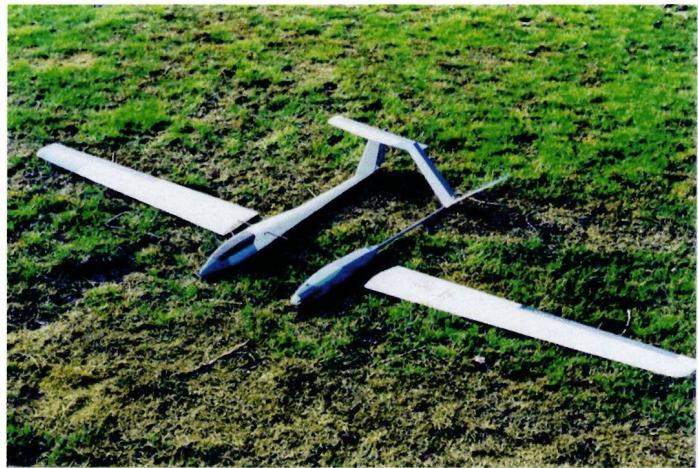
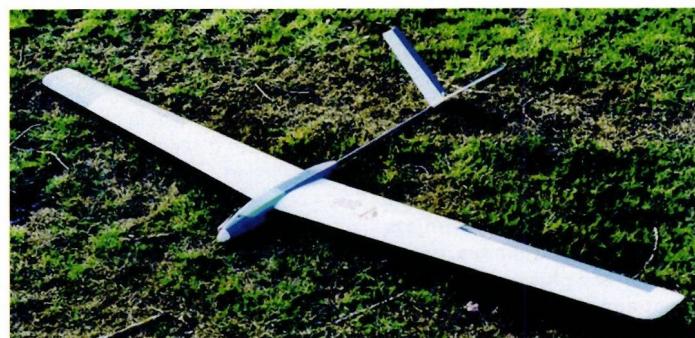
The Su-élé, as always, is a pleasure to fly, but it’s making better progress. The wing can showcase its qualities (large surface area and strong lift) and easily handles the modest overload caused by the propulsion system, since my fuselage is much lighter than the first one. The power is more than sufficient, as the model still climbs easily even when the battery is nearly depleted. A slight throttle-elevator mix for diving (5%) can be used to improve handling and efficiency. It is possible to raise the ailerons to descend, but in this configuration, the roll response decreases significantly.
The goal has been achieved, because the model is well-suited to its flight environment and can demonstrate its capabilities. What’s more, it’s one of a kind, and I must admit I feel a certain sense of satisfaction!
François Croset (CLAM)

EURO CONTEST GLIDER ACRO TOUR AUSTRIA 2026

THE PC-21 STORY
 Emil Giezendanner

TWIN TOWN PARTNERSHIP
 Wolfgang Voeller

SUMMER FUN 2026 AT MG USTER
Martin Wunderli
CORSAIR F4U – A WARBIRD WITH A MEMORABLE LOOK
Jürgen Rosenberger, Jürgen Prinz
52. 2026 ALPS CUP
Emil Giezendanner
YOU KNOW WHAT I MEAN? 125 YEARS OF THE SWISS AERO CLUB
Emil Giezendanner
News from HEBU

TEAM MANAGER "THIS" BOSSHARD
Rodito Nussbaumer
ATOM, THE NEW DOUBLE-DECKER FROM CPLR
 Matthias Bosshard

F3A EUROPEAN CHAMPIONSHIPS IN ST-MACAIRE, FRANCE
Matthias Bosshard
INSIGHTS INTO THE HISTORY OF SEAPLANES

WELCOME, NEW MEMBER!
Andrea Bolliger
What's New at Leomotion.com

PRIDE AND GOOD IDEAS
 Markus Nussbaumer

SMALL, MODEL-LIKE SAILBOATS
Res Dauwalder
FREE FLIGHT IN THE MIDDLE OF SUMMER
Urs Muntwyler
BY YOUTH, FOR YOUTH
Lorena Betschen
HORIZON HOBBY/LEMACO NEWS: MICRO OV-10 BRONCO 645 MM BY E-FLITE

34th HAHNENMOOS ALPINE MODEL AIRPLANE CAMP
Res Dauwalder
COUPE DES ALPES – OBSERVE AND LEARN
Rodito Nussbaumer
TRY-OUT DAY AT MFV WETTINGEN
 Urs Keller

NEWS FROM HEBU
 Julia Bucher

NOS REGION – A HUB FOR ELECTRIC AVIATION
Emil Giezendanner
MEMORIES
 Wolfgang Völler

70 YEARS OF THE NIDWALDEN MODEL AIRPLANE CLUB
Martin Barmettler
A SPECTACULAR F3A WORLD CUP IN THE PRINCIPALITY OF LIECHTENSTEIN
Emil Giezendanner
FROM 0 TO 100
Markus Nussbaumer