
F3B Performance Gliding
In the international F3B competition class for radio-controlled gliders, launches are performed using electric winches.
Teams typically have several winches and different line diameters on hand to be prepared for any wind direction and strength.
It is not uncommon for several launches to be performed within the allotted competition time until the best possible altitude is reached.
During launch, the models are subjected to loads up to forty times their own weight. For this reason alone, high-strength materials such as carbon fiber are used throughout.
Sophisticated flap systems and ballast are used to optimize performance across the three very different disciplines in each round.
Maximum allowable model weight: 5 kg.

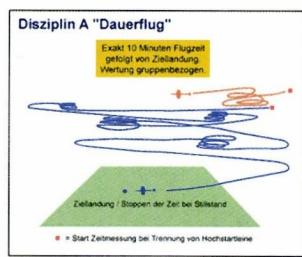
In the endurance flight discipline, several pilots take off more or less simultaneously and aim to stay airborne for exactly 10 minutes after the line is released.
This requires minimal sink rate and a great deal of finesse in finding thermals.
A delicate touch is also required to land the model as close as possible to a specific point on the ground after exactly 10 minutes. Every second of deviation from the flight time and every meter from the landing point results in point deductions.
The group’s best performance is awarded 1,000 points; the remaining scores are calculated based on their ratio to the best performance.
The group-based scoring minimizes the distorting effects of varying weather conditions.
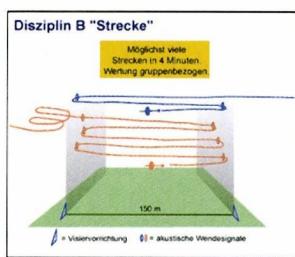
The cross-country flight discipline requires the model to glide as efficiently as possible, for which it is usually moderately ballasted.
The objective is to fly a course defined by two planes as many times as possible. Passing through the planes is monitored using sighting devices on the ground. Before takeoff, each model is assigned an audible signal that alerts the pilot when it is time to turn.
This discipline is also flown in groups and scored on a group basis.
The group’s best performance receives 1,000 points; the scores of the remaining pilots are calculated based on their ratio to the best performance.
The group-based scoring minimizes the distorting effects of varying weather conditions.
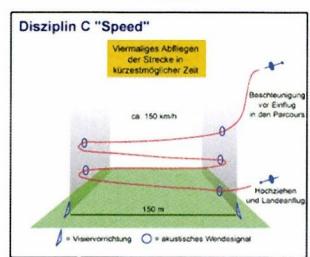
Speed is the only discipline not flown in groups. The goal here is to fly the course between two vertical planes four times in the shortest possible time.
Once again, starting from maximum initial altitude, the model dives toward the first plane. The timer starts when the model passes the plane. The three required turns are initiated before the turn signal is triggered in order to minimize the distance lost.
The models, which are typically heavily ballasted for this discipline, complete the course in as little as approximately 14 seconds, depending on conditions and the pilots’ skill.
Given the total distance of 600 m, this results in a maximum average speed of over 154 km/h!
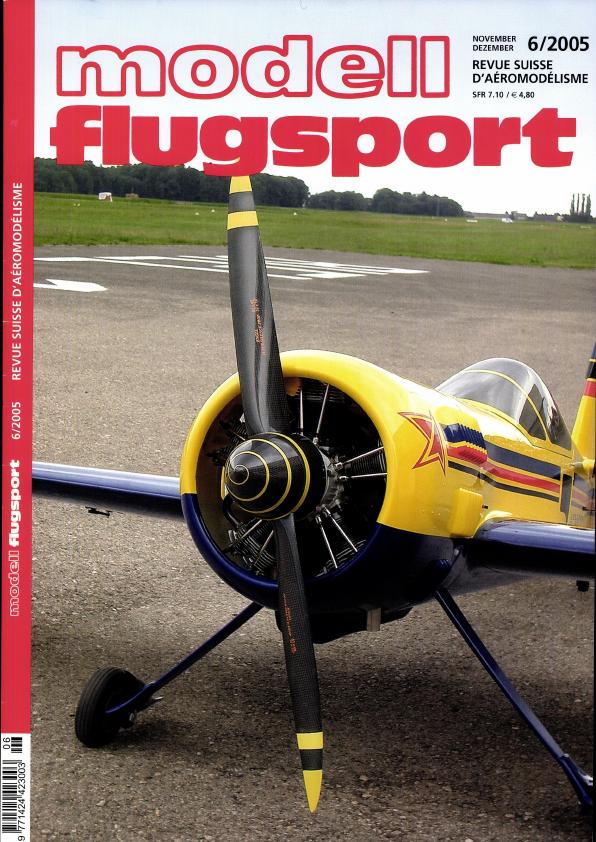

EURO CONTEST GLIDER ACRO TOUR AUSTRIA 2026

THE PC-21 STORY
 Emil Giezendanner

TWIN TOWN PARTNERSHIP
 Wolfgang Voeller

SUMMER FUN 2026 AT MG USTER
Martin Wunderli
CORSAIR F4U – A WARBIRD WITH A MEMORABLE LOOK
Jürgen Rosenberger, Jürgen Prinz
52. 2026 ALPS CUP
Emil Giezendanner
YOU KNOW WHAT I MEAN? 125 YEARS OF THE SWISS AERO CLUB
Emil Giezendanner
News from HEBU

TEAM MANAGER "THIS" BOSSHARD
Rodito Nussbaumer
ATOM, THE NEW DOUBLE-DECKER FROM CPLR
 Matthias Bosshard

F3A EUROPEAN CHAMPIONSHIPS IN ST-MACAIRE, FRANCE
Matthias Bosshard
INSIGHTS INTO THE HISTORY OF SEAPLANES

WELCOME, NEW MEMBER!
Andrea Bolliger
What's New at Leomotion.com

PRIDE AND GOOD IDEAS
 Markus Nussbaumer

SMALL, MODEL-LIKE SAILBOATS
Res Dauwalder
FREE FLIGHT IN THE MIDDLE OF SUMMER
Urs Muntwyler
BY YOUTH, FOR YOUTH
Lorena Betschen
HORIZON HOBBY/LEMACO NEWS: MICRO OV-10 BRONCO 645 MM BY E-FLITE

34th HAHNENMOOS ALPINE MODEL AIRPLANE CAMP
Res Dauwalder
COUPE DES ALPES – OBSERVE AND LEARN
Rodito Nussbaumer
TRY-OUT DAY AT MFV WETTINGEN
 Urs Keller

NEWS FROM HEBU
 Julia Bucher

NOS REGION – A HUB FOR ELECTRIC AVIATION
Emil Giezendanner
MEMORIES
 Wolfgang Völler

70 YEARS OF THE NIDWALDEN MODEL AIRPLANE CLUB
Martin Barmettler
A SPECTACULAR F3A WORLD CUP IN THE PRINCIPALITY OF LIECHTENSTEIN
Emil Giezendanner
FROM 0 TO 100
Markus Nussbaumer