
From Displacement to Gliding and Lifting
For many years now, I’ve been flying mainly gliders and electric gliders—mostly on slopes. Every now and then, I also fly on flat terrain, such as mowed meadows. Unfortunately, we don’t have a great spot for powered flight in the canton of Uri. My colleague Peter Hofer took this into account by saying to himself: We don’t have large open meadows for powered flight, but we do have several square kilometers of lake surface available to us. There are no trees, power lines, or other obstacles there.
When you look at it that way, he’s actually right—and why not try something new for a change? It’s just a 3-minute drive from my house to the lake. Near the lakeside restaurant, the shore is very shallow and perfect for flying over the water. Peter flies his own models, and for my first attempt, I tried the CESSNA Cardinal from ROBBE. This model is made entirely of the plastic material “Arcel” and is waterproof. The kit can be assembled in just a few hours and is controlled via the ailerons and elevator. It comes standard with a budget-friendly Speed 600 motor or similar, complete with a propeller. A Ni-Ca battery with 7 or, better yet, 8 cells serves as the power source. Peter supplied me with a few floats that he makes himself out of Depron and supported me with advice and practical help based on his experience. When mounting the floats, the following must be observed: The floats must lie exactly horizontal on the table with their upper edge. The step must be positioned 1 to 2 cm behind the center of gravity. When placed on the floats in this manner, the wing has an angle of attack of 1 to 2 degrees. If the angle of attack is greater, the model will “stick” to the water and simply won’t take off. To prevent the model from “sticking” to the water, the step edge must be absolutely sharp. If necessary, apply a strip of tape across the float at the step edge. The floats fit the existing landing gear without any modifications. The flight battery is inserted into the fuselage from below and can be replaced in a matter of minutes. The result is an attractive and easy-to-fly water model. One Sunday last November, the time had finally come. The Cessna was set to prove its seaworthiness. I simply brushed off the familiar butterflies in my stomach and the realization that you can’t—or shouldn’t—necessarily go swimming in the lake in November.
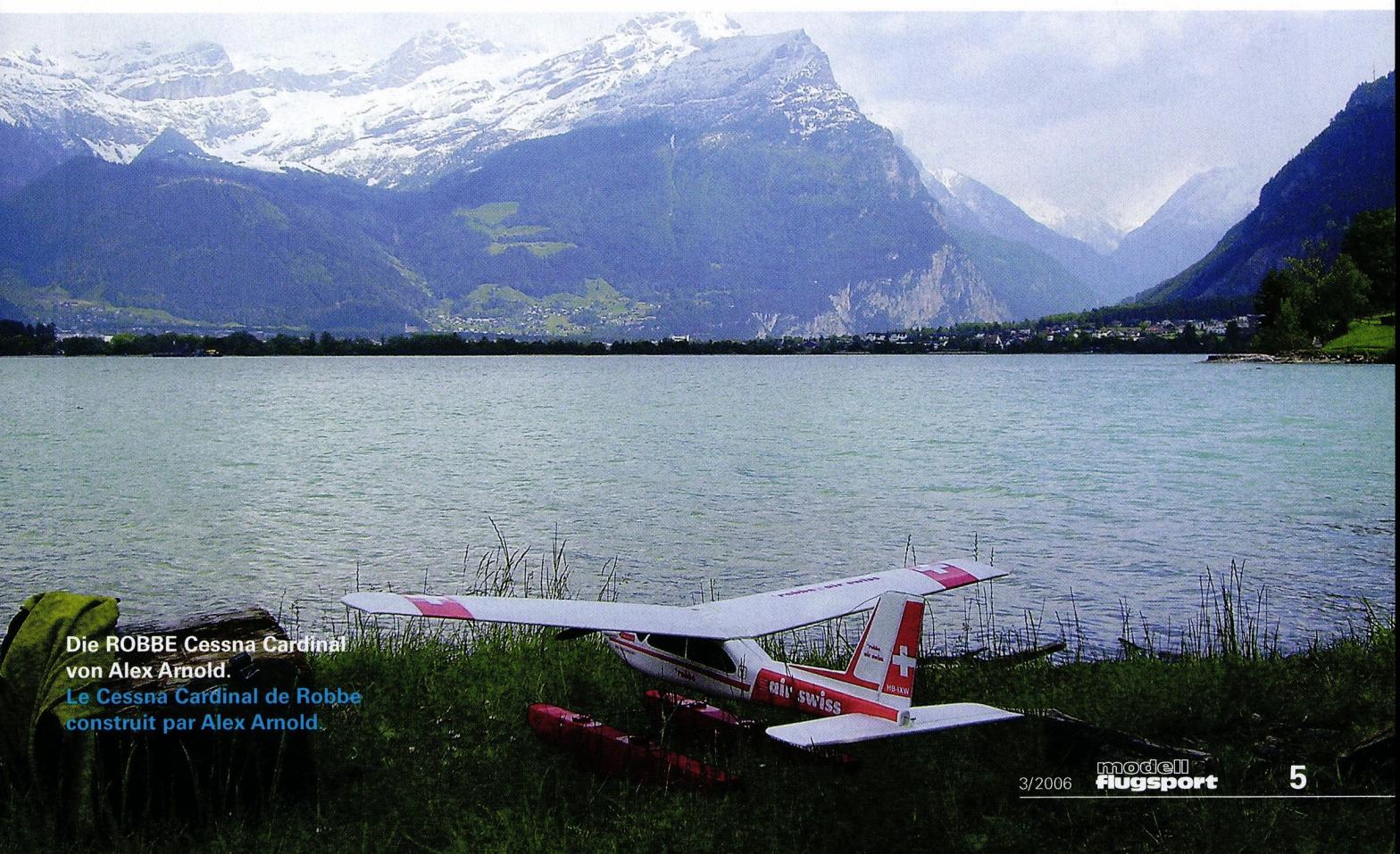
I decided to let the Cessna try out its new element—water—and carefully fly a few turns on the water to test the rudder’s effectiveness. I haven’t installed a water rudder yet. Everything went off without a hitch, so let’s get started. Taxi the Cessna to the takeoff position with the elevator fully back. Slowly apply “throttle” while simultaneously returning the elevator to neutral. The Cessna accelerates well and, after a relatively short period of displacement flight, transitions to the glide phase. Now just a slight tug on the elevator, and the model was airborne. The floats do not affect the model’s flight characteristics in any way. And now, as usual, a few laps to get used to the new model. It hardly needed any trim adjustments. Just in time to ensure I still had enough power to return to shore, I attempted a landing approach. I flew a wide landing turn, letting the Cessna descend evenly with a trailing tail, touched down on the water, and taxied back to shore. It worked out great. Of course, the excitement over something new was immense. In the meantime, Peter had also gotten his model ready for takeoff. It’s an “Aquasport” that he built himself. This model is equipped with a brushless motor and a 4400 mAh LiPo battery and has a flight time of about 28 minutes. My model, with its Ni-Ca battery and a capacity of 1,600 mAh, has a flight time of about 9 minutes. In the meantime, three more colleagues have taken an interest in flying over water and have either built models or are in the process of building one. Of course, for noise and environmental protection reasons, we fly exclusively with electric models at the lake. We also show consideration for the waterfowl. However, we’ve noticed that they aren’t disturbed at all and don’t even take any notice of what we’re doing. The spectators who show up from time to time are always surprised at how quietly we can pursue our hobby.
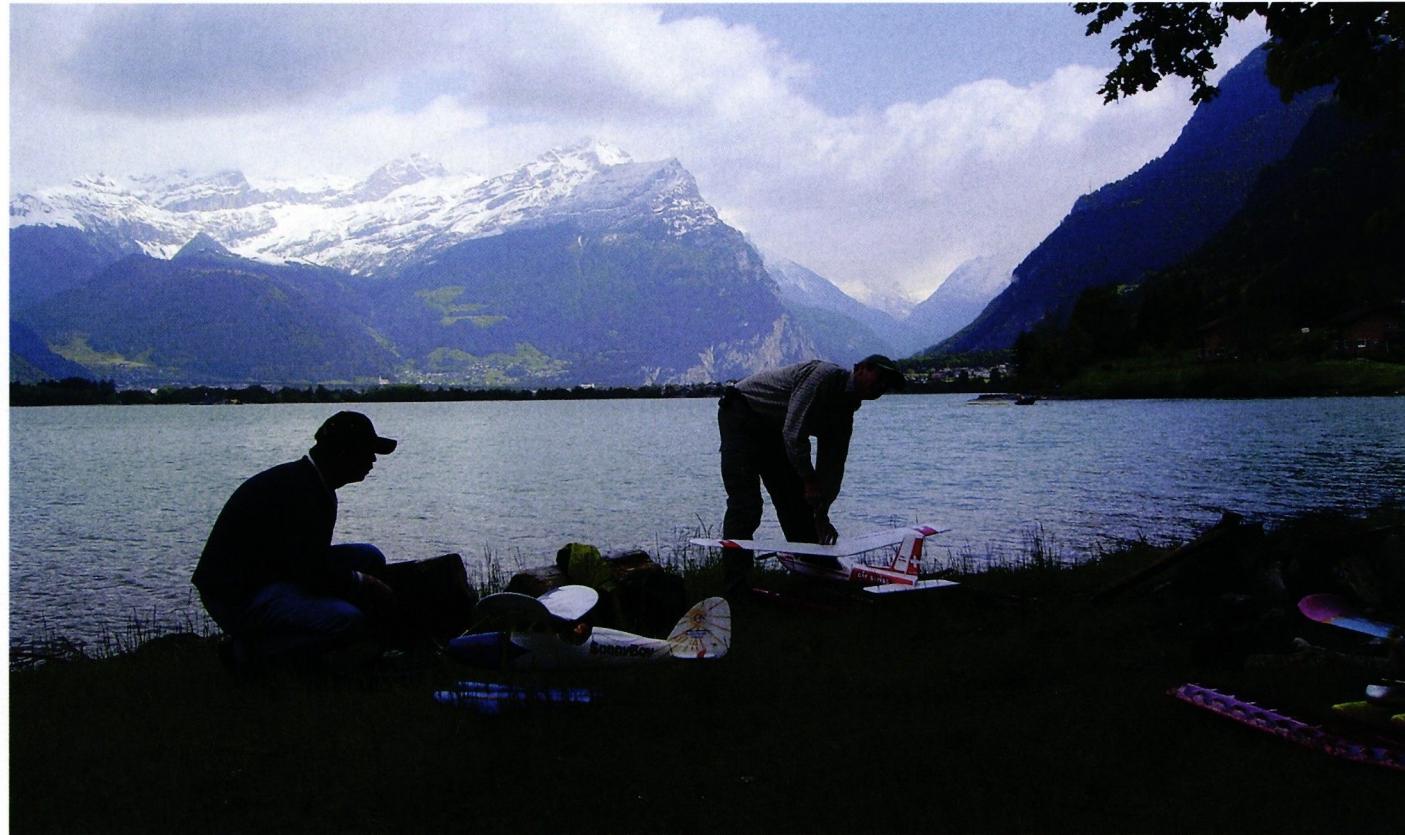
In principle, all models are suitable for seaplane flying. We distinguish between standard high-wing and low-wing aircraft, as we know them from land-based flying, and so-called seaplanes. Aero Naut offers two such seaplanes: the “Catalina” and the “Canadair.” Any other model can be converted into a seaplane by selecting the correct size of floats and ensuring they are properly positioned on the fuselage. In addition, a wide variety of construction plans are available from the FMT catalog. Of course, there are no limits to your own ideas and creations either. We spent practically every Sunday morning this past winter at the lake, deepening our experience with seaplane flying. A very special thank you goes to my colleague Peter Hofer from Altdorf. He has repeatedly helped us with his knowledge and experience.
Finally, I’d like to offer you some well-intentioned advice: Just in case, you should always bring a pair of waist-high fishing boots and/or a rubber boat with you for safety outside of the swimming season. Whether we’ve ever actually needed these items remains our secret. But feel free to draw your own conclusions. I hope this report has sparked the interest of one or two model aviators in the field of seaplane flying, which is relatively unknown in Switzerland. If you’re interested in a fantastic seaplane airshow featuring the F3A and semiscale categories, then be sure to visit the MG Lugano Seaplane Competition. This competition has been held annually for over 45 years and always takes place on the second weekend of September at the Campinplatz in Melano, Ticino.
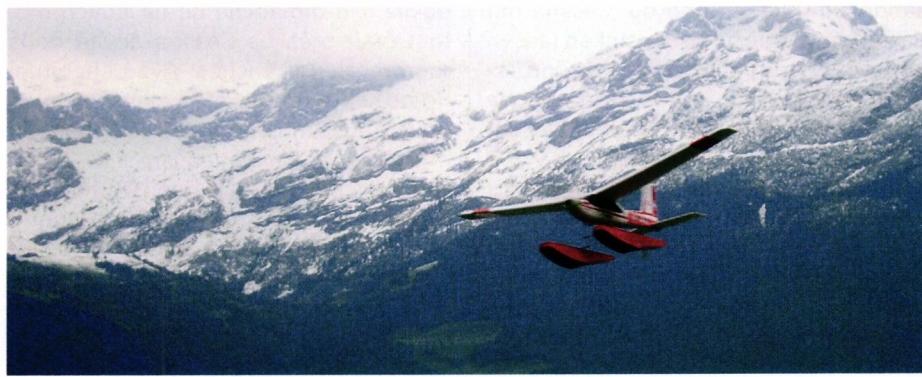
It is a matter of honor to be considerate of the flora and fauna, as well as nesting waterfowl. As a general rule, we fly our model seaplanes exclusively with electric propulsion. This ensures that we can all live together—each pursuing our own interests—along our beautiful bodies of water, enjoy our hobby, and avoid causing each other any trouble.

EURO CONTEST GLIDER ACRO TOUR AUSTRIA 2026

THE PC-21 STORY
 Emil Giezendanner

TWIN TOWN PARTNERSHIP
 Wolfgang Voeller

SUMMER FUN 2026 AT MG USTER
Martin Wunderli
CORSAIR F4U – A WARBIRD WITH A MEMORABLE LOOK
Jürgen Rosenberger, Jürgen Prinz
52. 2026 ALPS CUP
Emil Giezendanner
YOU KNOW WHAT I MEAN? 125 YEARS OF THE SWISS AERO CLUB
Emil Giezendanner
News from HEBU

TEAM MANAGER "THIS" BOSSHARD
Rodito Nussbaumer
ATOM, THE NEW DOUBLE-DECKER FROM CPLR
 Matthias Bosshard

F3A EUROPEAN CHAMPIONSHIPS IN ST-MACAIRE, FRANCE
Matthias Bosshard
INSIGHTS INTO THE HISTORY OF SEAPLANES

WELCOME, NEW MEMBER!
Andrea Bolliger
What's New at Leomotion.com

PRIDE AND GOOD IDEAS
 Markus Nussbaumer

SMALL, MODEL-LIKE SAILBOATS
Res Dauwalder
FREE FLIGHT IN THE MIDDLE OF SUMMER
Urs Muntwyler
BY YOUTH, FOR YOUTH
Lorena Betschen
HORIZON HOBBY/LEMACO NEWS: MICRO OV-10 BRONCO 645 MM BY E-FLITE

34th HAHNENMOOS ALPINE MODEL AIRPLANE CAMP
Res Dauwalder
COUPE DES ALPES – OBSERVE AND LEARN
Rodito Nussbaumer
TRY-OUT DAY AT MFV WETTINGEN
 Urs Keller

NEWS FROM HEBU
 Julia Bucher

NOS REGION – A HUB FOR ELECTRIC AVIATION
Emil Giezendanner
MEMORIES
 Wolfgang Völler

70 YEARS OF THE NIDWALDEN MODEL AIRPLANE CLUB
Martin Barmettler
A SPECTACULAR F3A WORLD CUP IN THE PRINCIPALITY OF LIECHTENSTEIN
Emil Giezendanner
FROM 0 TO 100
Markus Nussbaumer