
7th Cup Flying Competition in Winterthur
At exactly 10:00 a.m., Claudio Menotti opened this year’s Cup Flying competition—which has already become a tradition—at the Hegmatten glider airfield. Of the 35 registered competitors, 31 showed up at the starting line. With very spring-like conditions and temperatures reaching 18°, the weather was absolutely ideal.
The first three rounds were held as a standard competition with groups of five and four competitors. For those unfamiliar with the format, here’s a brief explanation: After three flights, the top finishers from the first half qualify for the Cup, while the rest compete in a consolation tournament. In this tournament, five flights are scored. From each of the four groups of four, the pilot with the slowest time is eliminated. That resulted in 12 pilots. In the 6th round, 8 remained; in the 7th round, 4. The final four competed for places one through four. The sixth round was particularly thrilling, as after flight times of 65 seconds, 60 seconds, and 60 seconds, one more competitor still had to be eliminated. It took two re-runs.
This time, Haller (Dintikon) and Brennwald (Männedorf) made it to the finals. In this final flight of the competition, Haller amazed everyone with an incredible “Schletzflug.” After releasing the line, his model climbed at least another five meters and transitioned into a clean glide without any pumping. He achieved the maximum time of two minutes, as the launch was performed using a 30-meter string.
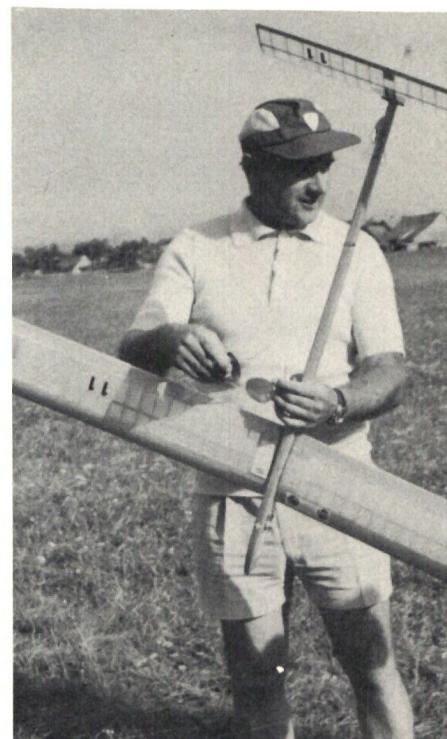
You can never compare theory with practice. For example, no one would have believed that two Kö C models (called “Schindel”) would advance to 2nd and 4th place. Those who flew wide circles were best able to take advantage of the weak thermals. The most impressive comparison flight was probably the one by last year’s winner, Viktor Burtscher. He had an A2 model built according to the latest findings—a double-trapezoidal wing. The wing profile was sanded out of solid balsa wood. The wings had “built-in warping” to take advantage of thermal conditions. After release, his model flew straight ahead until, after about 100 meters, it began circling in a tube. While the other three models in this series were already on the ground after 60–70 seconds, the model in question was still at an altitude of 40 meters after two minutes.
Thanks to the smooth proceedings, the competition was already concluded by 2:00 p.m. The four finalists each received a beautiful silver plate as a prize. A heartfelt thank you to the Winterthur group for the excellent organization and to the disciplined participants.
W. Heise


News from HEBU

EURO CONTEST GLIDER ACRO TOUR AUSTRIA 2026

TEAM MANAGER "THIS" BOSSHARD
 Rodito Nussbaumer

YOU KNOW WHAT I MEAN? 125 YEARS OF THE SWISS AERO CLUB
 Emil Giezendanner

F3A EUROPEAN CHAMPIONSHIPS IN ST-MACAIRE, FRANCE
 Matthias Bosshard

HORIZON HOBBY/LEMACO NEWS: MICRO OV-10 BRONCO 645 MM BY E-FLITE

PRIDE AND GOOD IDEAS
 Markus Nussbaumer

BY YOUTH, FOR YOUTH
Lorena Betschen
34th HAHNENMOOS ALPINE MODEL AIRPLANE CAMP
Res Dauwalder
TRY-OUT DAY AT MFV WETTINGEN
Urs Keller
52. 2026 ALPS CUP
Emil Giezendanner
TWIN TOWN PARTNERSHIP
Wolfgang Voeller
ATOM, THE NEW DOUBLE-DECKER FROM CPLR
Matthias Bosshard
CORSAIR F4U – A WARBIRD WITH A MEMORABLE LOOK
Jürgen Rosenberger, Jürgen Prinz
SUMMER FUN 2026 AT MG USTER
Martin Wunderli
What's New at Leomotion.com

THE PC-21 STORY
Emil Giezendanner
COUPE DES ALPES – OBSERVE AND LEARN
Rodito Nussbaumer
SMALL, MODEL-LIKE SAILBOATS
Res Dauwalder
WELCOME, NEW MEMBER!
Andrea Bolliger
FREE FLIGHT IN THE MIDDLE OF SUMMER
Urs Muntwyler
INSIGHTS INTO THE HISTORY OF SEAPLANES

NEWS FROM HEBU
 Julia Bucher

FROM 0 TO 100
Markus Nussbaumer
MEMORIES
Wolfgang Völler
NOS REGION – A HUB FOR ELECTRIC AVIATION
Emil Giezendanner
DO YOU KNOW WHAT I MEAN IN THE LAND OF SMILES?
Emil Giezendanner
A SPECTACULAR F3A WORLD CUP IN THE PRINCIPALITY OF LIECHTENSTEIN
Emil Giezendanner