
1979 Free Flight World Championships in Taft, California, USA
From October 3 to 9, 1979, the World Free Flight Championships were held in Taft, USA. Switzerland participated with three teams. Unfortunately, the countries of the entire Eastern Bloc declined to participate, which of course meant that at least half a dozen top nations were missing from the free flight competition (USSR, GDR, Bulgaria, Romania, Hungary, Czechoslovakia, Poland, North Korea).
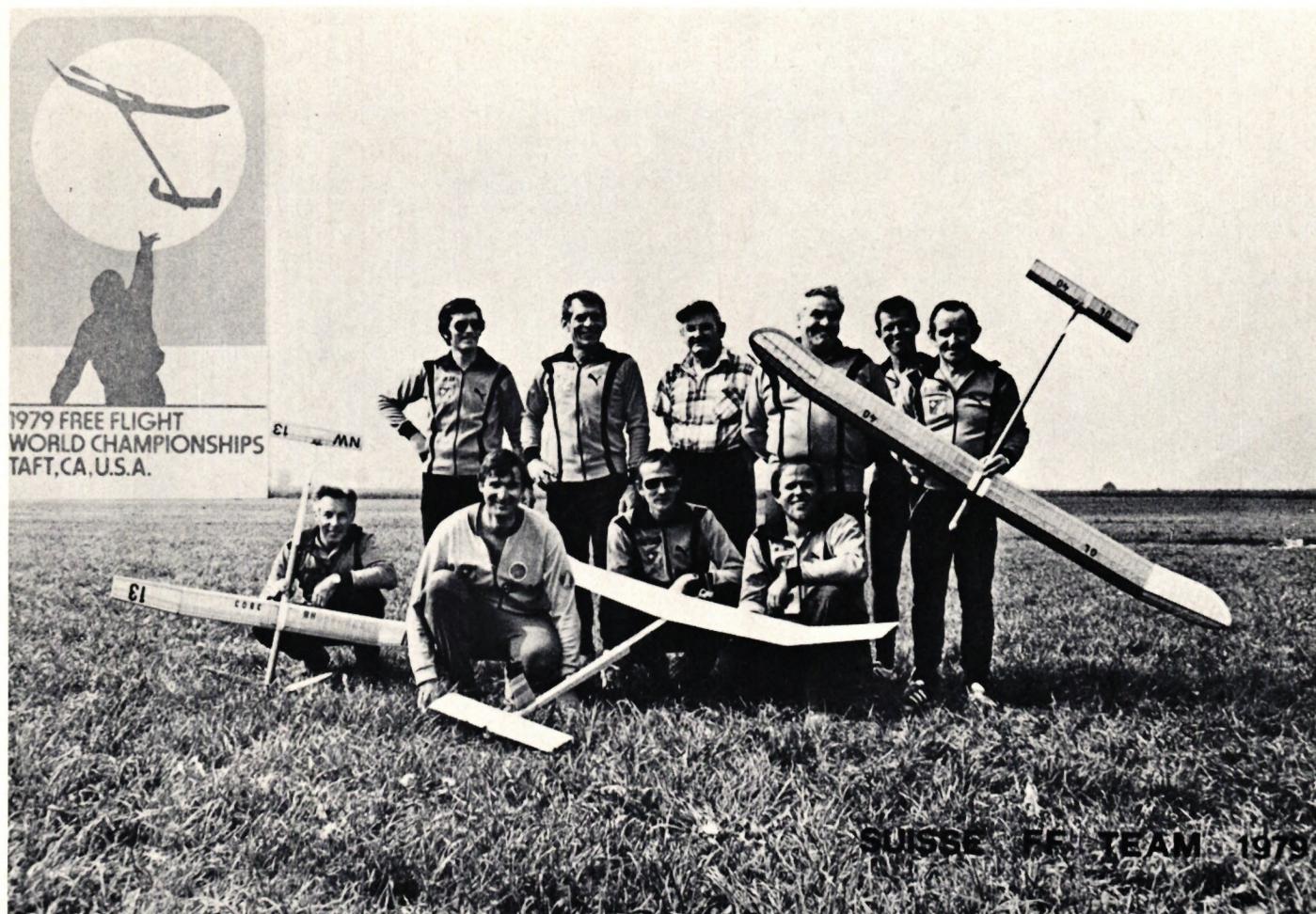
Team Leader: Edward Ernst
Coach: Peter Maurer
Category F1A: Hans Schoder
, Rudolf Erismann
, Walter Haller
Category F1B: Fritz Gaensli
, Josef Waser
, Walter Eggimann
Category F1C: Andres Bärtschi
, Rudolf Schenker
- Wednesday, October 3, 1979 – Arrival and check-in at Bakersfield Headquarters – Unofficial training at the airfield
- Thursday, October 4, 1979 – 5:30 p.m.: Technical inspection at the “Bakersfield Inn” hotel – Official practice at the airfield
- Friday, October 5, 1979 – 5:00 p.m. Opening ceremony at the “Bakersfield Inn” hotel – 7:00 p.m. Team managers’ meeting – Official practice
- Saturday, October 6, 1979 – 7:55 a.m.–4:15 p.m. F1A Glider World Championship – Flyoff 4:45–6:30 p.m.
- Sunday, October 7, 1979 – 7:55 a.m.–4:15 p.m. F1B Rubber-Powered Model World Championship – Flyoff 4:45–6:30 p.m.
- Monday, October 8, 1979 – 7:55 a.m.–4:15 p.m. F1C Motor Model World Championship – Flyoff 4:45–6:30 p.m.
- Tuesday, October 9, 1979 – Day off – 10:00 a.m. Seminar – 5:30 p.m. Banquet, awards ceremony, and announcement of results
- Wednesday, October 10, 1979 – 12:00 p.m. Check-out from the “Bakersfield Inn” hotel – 1:45 p.m. Departure from Bakersfield – Los Angeles – Zurich
Wednesday, October 3, 1979
The Swiss team traveled to the U.S. in two groups. Fourteen people left on September 26, and the remaining four on October 3, 1979. After carefully loading the model airplanes at Zurich-Kloten—a task in which Mr. Stocker from Swissair kindly assisted us—we set off on our journey from Zurich to Los Angeles. After a six-hour flight, we made a stopover in Bangor, where we also completed the entry formalities. After a two-hour layover, we took off for the five-hour flight to Los Angeles. In Los Angeles, we disembarked from the Balair plane and, after a half-hour night flight, arrived at our destination, Bakersfield, at 10:30 p.m. local time.
The team and supporters checked into the “Bakersfield Inn” motel. After a quick inspection of the flight equipment, we were relieved to find that, aside from a few scratches and cracks on the transport crates, all the model airplanes had weathered the long journey well.
In the morning, team leader Edward Ernst, along with coach Peter Maurer, inspected the competition and flying grounds, where they were also able to observe the wind and thermal conditions. At the same time, training and test flights were conducted at the launch sites in all categories.
The flying site in Taft is located 30 miles from Bakersfield. The organizers have provided comfortable, air-conditioned buses for transportation. The flying site exceeded all our expectations. It is a desert area where very little rain falls throughout the year. Because of the low rainfall, weather conditions are almost always predictable, and the surrounding mountains further reduce wind strength. The vegetation consists of scattered, low shrubs; there are no trees. These characteristic features of the terrain extend for miles in all directions.
California—what a state! It seems as though nearly the entire world left its calling card there in passing when it was created.
At 5:30 p.m., the model inspection was still on the day’s agenda. The model inspection went off without any major difficulties. Aside from two weight adjustments, the officials found everything to be in order. After the inspection, it was determined that the models had lost about one gram—or roughly 100 g—in the California climate!
After passing the structural inspection, the teams were cleared for official practice. The weather was warm and sunny, just like summer. The temperature at 8:45 a.m. was about 22 degrees. Coach Peter Maurer gave the team the following task: Carefully fly in the models and trim them optimally. Fly them at full power as much as possible, letting them run out for 3 minutes.
To help the pilots get accustomed to the competition, the first practice session was conducted according to the official schedule. Shortly after 9:00 a.m., an ominous engine noise rang out, followed by a dull thud—Res Bärtschi’s VM had crashed!! Despite this mishap, training continued in all categories. At this point, there was some consolation for the Swiss VM pilots: no fewer than six nations had suffered a crash, including the model of world champion Koster from Denmark! At 10:09 a.m., Rudolf Schenker prepared to launch his motorized model. After takeoff, the model veered to the right; the second motorized model lay on the sandy ground of California with clipped wings and a crushed fuselage! Fortunately, the pilots of the glider and rubber-powered models had fewer difficulties during their test flights. At the end of practice, team leader Edward Ernst was somewhat concerned about the two crashes but hoped that the nerves of the two unlucky pilots hadn’t been too badly shaken.
In the afternoon, we took a look around at the competition. We were particularly interested in the Dutch, French, Danes, and the favorites—the Americans.
At 5 p.m., the opening ceremony for the World Free Flight Championship took place at the “Bakersfield Inn” hotel. The flags of the FAI and the 24 participating nations were raised. The People’s Republic of China participated in a World Championship for the first time. The Eastern Bloc countries, however, did not travel to America.
Following the opening ceremony, the team managers met for a briefing with the competition organizers and the jury. This meeting lasted quite a while, as the issues of line crossings and “0.01-second” motor overruns provided plenty to discuss.
The organization and planning were entrusted to the following gentlemen:
Chair: Earl Witt
; Head of F1A: Juan Livotto
Head of F1B: Irv Aker
Head of F1C: Ed Carroll
Jury: Sandy Pimenoff, Ian Kaynes, George Xenakis
After dinner, the Swiss team met for a team meeting, during which the guidelines for the upcoming competition days were discussed once again and finalized.
At the start: 66 pilots from 24 countries
. Swiss team: Rudolf Erismann, Walter Haller, Hans Schoder
. Wake-up call at 4:45 a.m., breakfast at 5:15 a.m., loading the gliders at 5:45 a.m., departure for Taft at 6:00 a.m. First flight began at 7:55 a.m.
Once again, ideal flying conditions at the airfield: a beautiful blue sky, temperature around 18 degrees at 8:45 a.m., and almost no wind.
The glider team had completed their warm-up flights and was ready for the competition. Within the team, the starting order was set as follows: No. 1: H. Schoder; No. 2: R. Erismann; No. 3: W. Haller.
At exactly 7:55 a.m., the 1979 World Championship was opened with a green flare.
After the first heat, things weren’t looking so good for the sailors. Only W. Haller achieved the maximum time of 3 minutes; H. Schoder recorded 155 seconds, and R. Erismann clocked in at 129 seconds.
A quick glance at the scoreboard showed the following standings: The leading group consisted of the U.S., the Netherlands, and Germany; Switzerland was in 10th place.
But then came the big turnaround; in the following six rounds, the Swiss didn’t give away a single point. At 4:15 p.m., after the seven rounds, nine competitors still had the maximum score, including one Swiss pilot, W. Haller. Bravo, Walti!
The first tiebreaker was scheduled for 4:45 p.m. Seven competitors achieved the maximum of 240 seconds. Eliminated: H. Schmidt (Germany) and D. and P. Deboer (Netherlands). Seven pilots competed in the second tiebreaker, which lasted over 6 minutes. All seven met this flight time requirement, so a third tiebreaker had to be held half an hour later. The decision was finally made in the third tiebreaker.
| World Champion | Grunnet/Koster, DK | 2051 P. |
| 2. | P. Qvarnstrom, S | 2013 P. |
| 3. | L. Hines, USA | 2002 P. |
| 5. | W. Haller, CH | 1902 P. |
| 18. | H. Schoder, CH | 1,235 P. |
| 33. | R. Erismann, CH | 1209 P. |
Team Standings:
| 1. | USA | 3,769 P. |
| 2. | Netherlands | 3,759 P. |
| 3. | Finland | 3,735 P. |
| 4. | Switzerland | 3,704 P. |
Switzerland came from behind to win ...
At the start: 64 pilots from 23 nations
. Swiss team: Fritz Gaensli, Josef Waser, Walter Eggimann
. Wake-up call again at 4:45 a.m., just like the day before. At 6:45 a.m., the F1B team had arrived in Taft. The sun rises rapidly on the horizon; sunrise is at 6:51 a.m. There was a flurry of activity at all the team tents—the second day of competition was about to begin. Launching devices were set up, rubber bands were stretched and threaded, propellers were checked once more, and the rubber bands were tensioned using hand drills. The Swiss pilots carefully test-flew their rubber-powered models and moved to their assigned launch sites at 7:45 a.m.
The weather was nice again, with winds of about 1–2 m; otherwise, conditions were the same as the previous day.
After consulting with the team, the following starting order was determined: No. 1: F. Gaensli; No. 2: W. Eggimann; No. 3: J. Waser.
The first launch in the F1B category took place right on time at 7:55 a.m. After the first flight, the Swiss had established a strong position for the remainder of the competition with times of 180 seconds for F. Gaensli, 157 seconds for W. Eggimann, and 97 seconds for J. Waser. The results were quite good up until the lunch break following the fourth flight. It was just a shame that J. Waser suffered a spiral crash in his second flight (93 seconds).
At the halfway point, the standings are as follows: The Netherlands, New Zealand, and Denmark are in the lead; Switzerland follows in 10th place.
| 1. | Ben-Itzhak, IL | 2160 P. |
| 2. | P. Vanleuven, AUS | 1924 P. |
| 3. | D. O'Grady, Canada | 1,784 P. |
| 19. | W. Eggimann, CH | 1,189 P. |
| 33. | F. Gaensli, CH | 1,121 P. |
| 38. | J. Waser, CH | 1,084 P. |
Team Standings:
| 1. | Italy | 3,655 P. |
| 2. | Denmark | 3,625 P. |
| 3. | United Kingdom | 3,502 P. |
| 9. | Switzerland | 3,394 P. |
At the start: 46 pilots from 20 countries
. Swiss team: Andres Bärtschi, Rudolf Schenker (Urs Schaller had to skip the event in America due to work commitments)
. For the last time, the Swiss delegation was roused from their sleep at 4:45 a.m. Upon arriving at the airfield, there was no need to wonder what category was on the day’s program. Anyone still dozing from the drive from Bakersfield to Taft was finally roused by the howling and roaring of the model engines!
Our F1C pilots flew their motorized models very cautiously and without taking any risks. During the first test flights, the transition from climb to glide didn’t go quite as planned. However, P. Maurer was able to quickly iron out these issues with the help of his competitors. The situation was particularly tricky for Rudolf Schenker, as he had only one model left to fly.
Compared to the previous day, the weather was cloudy until around 9:15 a.m., but it was still warm and offered good flying conditions. Strong thermals in the afternoon.
Launch order: No. 1: R. Schenker; No. 2: A. Bärtschi.
As on the two previous days, the starting signal was fired right on time at 7:55 a.m.
| 1. | M. Rocca, I | 2160 P. |
| 2. | K. Kibiki, J | 2,145 P. |
| 3. | M. Iribarne, F | 2034 P. |
| 12. | A. Bärtschi, CH | 1251 P. |
| 35. | R. Schenker, CH | 1,132 P. |
Team Standings:
| 1. | France | 3,758 P. |
| 2. | Canada | 3,695 P. |
| 3. | Sweden | 3,654 points |
| 14. | Switzerland | 2,383 P. |
During the World Championships, coach P. Maurer had to observe and analyze 56 flights across three categories: 21 F1A launches; 21 F1B launches; 14 F1C launches. As Technical Manager, I can confirm that, with a few minor exceptions, our collaboration with the pilots worked very well. The pilots were able to rely fully on their coach. I would like to extend my sincere thanks to Peter Maurer for this challenging task. His keen sense for thermals worked with precision and accuracy even in California. In our opinion, all tactical possibilities were fully exploited. It’s worth noting that most points were lost in the first round because the thermal conditions were quite weak.
At the launch sites, the team worked with great focus throughout the entire World Championship.
Just like last year at the European Championships, the team members and supporters gave their all to the search and rescue service. Thanks to this great teamwork, the pilots were able to focus entirely on the competition. The organizers assigned each nation a motorcycle that was particularly well-suited to this terrain. It was also always fun to cruise around the steppe, each doing so as they pleased.
I would like to take this opportunity to extend my heartfelt thanks to all competitors and supporters for their help and dedication. Special thanks to our “assistant team leader,” K. Sager, who took excellent care of the Swiss team during my absence (he also served as an interpreter for international teams ranging from China to Argentina).
Given the performances they’ve shown, the Swiss team can claim to have met its goals. And this is no small feat for a national team that tried to keep pace with developments in model aviation in terms of results.
But thanks to improved performance resulting from intensive training, they’ve managed to keep pace on the international stage. In response to the vocal criticism that we didn’t field our strongest lineup, I’ll say this: “They can pin anything on us and accuse us of anything, but not the team.”
It is to be hoped that this encouraging development in Swiss free flight will continue and that our competitors will be able to deliver equally good results at future international competitions. As national coach, I stand fully behind my team.
We have now laid a foundation on which we can continue our work. Thankfully, there’s still plenty of room for improvement.
High-Launch Category (F1A)
1. | Grunnet/Koster | DK | 2051 |
2. | P. Qvarnstrom | S | 2013 |
3. | L. Hines | USA | 2002 |
4. | J. Wilson | USA | 1930 |
5. | H. Tahkapaa | SF | 1902 |
| W. Haller | CH | 1902 |
7. | G. Zach | A | 1851 |
8. | H. Schmidt | D | 1460 |
9. | P. Deboer | NL | 1422 |
10. | K. Kulmakko | SF | 1254 |
Also:
18. | H. Schoder | CH | 1235 |
33. | R. Erismann | CH | 1209 |
Total 66 competitors
Rubber-Powered Category (F1B)
1. | I. Ben-Itzhak | IL | 2160 |
2. | P. Vanleuven | AUS | 1924 |
3. | D. O'Grady | CDN | 1784 |
4. | P. Lagan | NZ | 1497 |
5. | R. Pollard | GB | 1415 |
6. | G. Cassi | I | 1259 |
7. | J. Petiot | F | 1234 |
8. | H. Chmelik | A | 1231 |
9. | J. Kristensen | DK | 1229 |
10. | P. Rasmussen | DK | 1229 |
Also:
19. | W. Eggimann | CH | 1189 |
33. | F. Gaensli | CH | 1121 |
38. | J. Waser | CH | 1084 |
Total 61 competitors
Internal Combustion Engine Category (F1C)
1. | M. Rocca | I | 2160 |
2. | K. Kibiki | J | 2145 |
3. | M. Iribarne | F | 2034 |
4. | M. Keinänen | SF | 2022 |
5. | F. Schlachta | CDN | 1998 |
6. | G. Qinfei | PRC | 1954 |
7. | D. Ferrero | F | 1717 |
8. | R. Truppe | A | 1675 |
9. | P. Harris | GB | 1260 |
10. | J. Akesson | S | 1253 |
Also:
12. | A. Bärtschi | CH | 1251 |
35. | R. Schenker | CH | 1132 |
Total 63 competitors
Rankings (Teams)
F1A: 1. USA, 2. Netherlands, 3. Finland, 4. Switzerland (24 teams)
F1B: 1. Italy, 2. Denmark, 3. Great Britain, 9. Switzerland (23 teams)
F1C: 1. France, 2. Canada, 3. Sweden, 14. Switzerland (only two competitors, 20 teams)


News from HEBU

TEAM MANAGER "THIS" BOSSHARD
 Rodito Nussbaumer

YOU KNOW WHAT I MEAN? 125 YEARS OF THE SWISS AERO CLUB
 Emil Giezendanner

HORIZON HOBBY/LEMACO NEWS: MICRO OV-10 BRONCO 645 MM BY E-FLITE

PRIDE AND GOOD IDEAS
 Markus Nussbaumer

TRY-OUT DAY AT MFV WETTINGEN
Urs Keller
F3A EUROPEAN CHAMPIONSHIPS IN ST-MACAIRE, FRANCE
 Matthias Bosshard

52. 2026 ALPS CUP
Emil Giezendanner
ATOM, THE NEW DOUBLE-DECKER FROM CPLR
Matthias Bosshard
SUMMER FUN 2026 AT MG USTER
Martin Wunderli
What's New at Leomotion.com

COUPE DES ALPES – OBSERVE AND LEARN
Rodito Nussbaumer
TWIN TOWN PARTNERSHIP
Wolfgang Voeller
34th HAHNENMOOS ALPINE MODEL AIRPLANE CAMP
Res Dauwalder
CORSAIR F4U – A WARBIRD WITH A MEMORABLE LOOK
Jürgen Rosenberger, Jürgen Prinz
SMALL, MODEL-LIKE SAILBOATS
Res Dauwalder
WELCOME, NEW MEMBER!
Andrea Bolliger
FREE FLIGHT IN THE MIDDLE OF SUMMER
Urs Muntwyler
EURO CONTEST GLIDER ACRO TOUR AUSTRIA 2026

BY YOUTH, FOR YOUTH
Lorena Betschen
INSIGHTS INTO THE HISTORY OF SEAPLANES

THE PC-21 STORY
Emil Giezendanner
NEWS FROM HEBU
 Julia Bucher

FROM 0 TO 100
Markus Nussbaumer
MEMORIES
Wolfgang Völler
NOS REGION – A HUB FOR ELECTRIC AVIATION
Emil Giezendanner
DO YOU KNOW WHAT I MEAN IN THE LAND OF SMILES?
Emil Giezendanner
Have you almost forgotten about aircraft that take off and land vertically?
Emil Giezendanner