
Bern – Oberland – Valais Region: Pure Nostalgia
Armin Röthlisberger’s interesting article in *Modellflugsport* (No. 2/2009) reminded me of similar experiences in our Langenthal model aircraft club and inspired me to write about them as well.
Our interest in model flying was sparked when a kind neighbor gave my brother and me a small, ready-to-fly glider with a wingspan of about 1 m. Fly—crash—repair—irreparable damage—build a new model—that’s roughly how the story went, in a nutshell. But soon after came designing—drawing—building, and flying our first self-built model. Unfortunately, we also learned that after a Sunday of flying, hardly any model ever made it home undamaged. It wasn’t uncommon for one or the other to have even “called it quits” for good—that is, to have suffered a total loss or flown off never to be seen again. So it was almost inevitable that we would increasingly dream of remote-controlled models.
Only against this backdrop can one understand the fascination that gripped us when our friend and group member Max Wälchli, quite unexpectedly one evening in the winter of 1951–52, showed us the essential components of a remote-control system. Based on a small English booklet with instructions and circuit diagrams that had just been published, he had already assembled a transmitter and a receiver. The crucial element, however, was an electric servo that he had designed and built himself. Max Wälchli was a trained precision mechanic and worked as a foreman at Wesa Inkwil, where they manufactured small toy trains—ideal conditions for bringing our plans to life. This first servo (*Fig. 1*) 1) worked as follows: It moved autonomously through three positions, each with a 120° rotation of the drive shaft. A pulse from the transmitter to the receiver and its relay briefly closed the circuit, allowing the servo to advance to the next position on its own. The motion was transmitted from a crank on the shaft via a lightweight
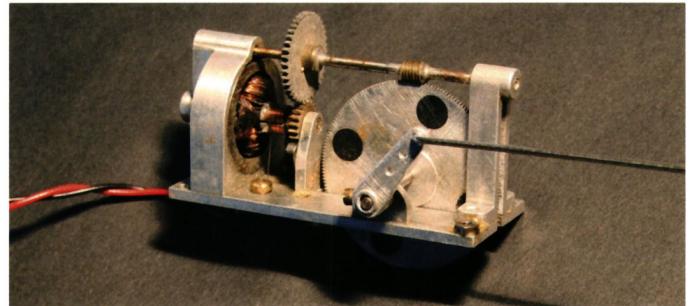
The control linkage connects directly to the rudder. So, with one press of the button, it goes from “straight” to “right”; with the next press, to “left”; and with another, back to “straight.”
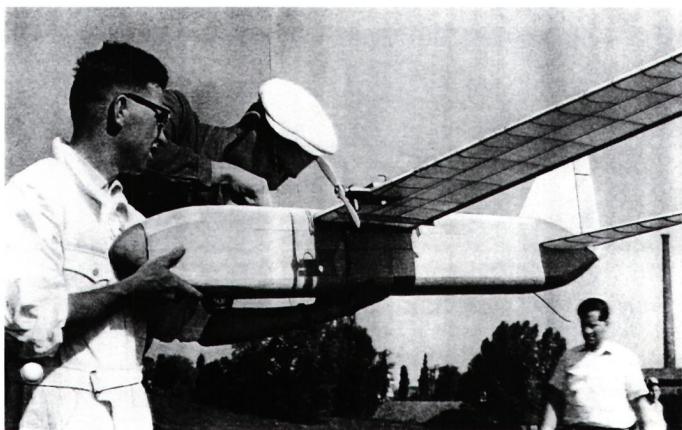
At the time, I was in a fairly demanding degree program and could only devote limited time to my hobby of model flying. In any case, that wouldn’t have been enough to also design and build a suitable model. A year earlier, I had equipped one of my gliders with a compass-controlled system and flown it successfully. Unlike today’s compass-controlled systems, the compass needle would touch a contact whenever it deviated from the set course, and the resulting electrical current would electromagnetically actuate the rudder. So this glider model, with a 2-meter wingspan, simply needed to be retrofitted. (*Fig. 2*).
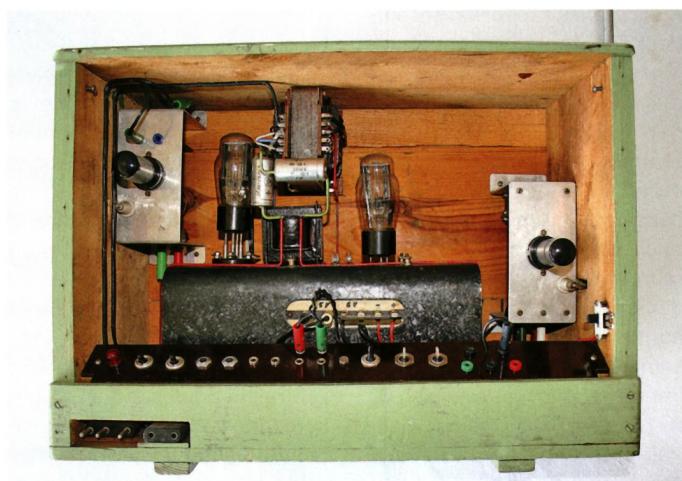
Since our weekend model flying took place almost exclusively at the Langenthal-Bleienbach airfield, I opted from the start to run the transmitter on AC power. This meant we didn’t have to buy expensive anode batteries. A tube rectifier from an old radio supplied the direct current for the push-pull circuit with a 6N7 tube (*Fig. 3*). The calculated wavelength of 11.2 m was tuned using a Lecher line. The first receiver, featuring the XFG1 gastriode, was quickly built and, after some empirical testing, operated at the target range of approximately 500 m. After a few nearly sleepless nights, everything was ready for the first flight during our now-traditional Pentecost camp at Schmidematt (the first Jura range above Rumisberg-Farneren). After
The trip on the Jurabahn to Oberbipp involved a 600-meter climb—and that was with a hefty load. The transmitter alone weighed 10 kg; on top of that, a cable reel and plenty of tools. And for camp life, as usual: a sleeping bag, rain gear, and provisions. Last but not least, the controllable (?) model in my hand. My brother Ernst, who had already helped me a great deal during the countless long-distance tests, took on half the load. Once we reached the top, we were able to set up quickly. Permission to use the power outlet in the restaurant had been granted without any trouble. Then came the great excitement and anticipation. A final check of the control system just seconds before the slope launch: rien ne va plus. Deep disappointment set in once it became clear that the receiver was no longer working. We didn’t yet know that the lifespan of this gastriode was limited to just a few hours, and we hadn’t brought a spare.
Back home, we decided to take the bull by the horns. A new circuit diagram for the receiver had emerged, featuring a so-called “hard tube” (3Q4). Anode voltage was also 45 volts (*Fig. 4*). For the power source for the heater and servo, we used exclusively Säntis “Zwerg” batteries (rechargeable lead-acid batteries). However, this circuit was much more challenging. Persistent tinkering, followed by consultations with friends knowledgeable in radio technology, eventually yielded a reception range of approximately 500 m once again. The first
flight, featuring a high launch at the Langenthal-Bleienbach airfield, was barely scheduled in time for the last Sunday before I reported for basic training. And once again, a severe—though fortunately only temporary—disappointment. Everything worked perfectly on the ground, even at a distance. But as soon as the model was 2–3 meters above the ground, the reception cut out. As electronics novices, we called this phenomenon “capacitive coupling to the ground.” There was no expert nearby who could have helped us. Walter Müller, then chairman of the Langenthal Model Flying Club, suggested we try shielding the receiver’s tube as a test and immediately handed us some suitable aluminum foil from his cigarette pack. And lo and behold, everything worked—even at altitude. It was an indescribable thrill for everyone involved. We almost danced like a soccer player after scoring the decisive penalty kick at the end of an international soccer match.
It wasn’t just the purchases—the expensive anode batteries for the receiver were particularly costly—that wiped out our meager and hard-earned allowance. There were also unforeseen complications. The expensive, borrowed measuring instrument had to be repaired twice at a cost of nearly 100 francs. A brief lapse in concentration—usually after midnight—led to the volt range being confused with the mA range, and just like that, the moving-coil meter went up in smoke again. The instruments of that time did not yet have overload protection. We had to save money wherever possible, including on the receiver side. A continuous signal from the transmitter reduced the anode current in the receiver to 0.5 mA. When the pushbutton was pressed (i.e., the signal was interrupted), it briefly rose to 1.5 mA, which caused
the relay—now switched differently—to move the control rudder to the next position. In this way, the expensive anode batteries lasted practically three times as long.
A small rotary converter was available from U.S. Army surplus that could be connected to a 12-V car battery and supplied 200 V DC. This allowed our transmitter to operate off the grid when necessary.
Basic training and the rigorous winter semester of my studies that followed forced me to set the remote control aside for half a year. The following summer, in 1953, everything was quickly brought back online. The Langenthal Model Aircraft Club had applied to host the national competition for radio-controlled models and was selected by the relevant authority. The event took place on a Sunday in June at our airfield. Of the 6 models registered, only 3 showed up at the field. One model’s control system failed irreparably, so only two models were able to take off. Hans Cataruzza’s motorized model became uncontrollable in the air and landed on a tall fir tree in the nearby forest beyond the airfield. Our old glider, on the other hand, performed quite well. As an exception, we used Max Wälchli’s transmitter here, since he already held a license and we seriously expected an inspection by the PTT. After a 200-meter high launch, my brother Ernst flew the required program quite well. Because of the large crowd present, he had to fly from a small stepladder. Just before landing, in the middle of a good approach, a child ran into the control line, which was torn from the transmitter; the model crashed but could be repaired.
The jury approved a second landing attempt, which then did not go perfectly for other reasons. Due to a lack of competition, first prize went to the Roth brothers—a somewhat subdued sense of accomplishment. At least the large audience was able to witness that remote-controlled model aircraft had become a reality. Our final showcase of remote-controlled competition flying unfolded in a manner strikingly similar to that described in Armin Röthlisberger’s article mentioned at the beginning—also at the National Competition in Zurich in June 1957. The twin-engine model had been completed just in time for this event; the engine cowlings, for example, had only just been designed (*Fig. 5*). The same transmitter and receiver were still in use, though now equipped with a so-called flutter control system. After some experimentation and a sketch I provided, Max Wälchli had built such a servo (*Fig. 6*), which now allowed for direct, proportional control, though it also had the disadvantage that, if the receiver failed, the rudder would remain at its extreme position and the model would go into a spiral dive to the ground. With the help of a colleague, the two diesel engines, each with a displacement of 1.4 cm³ (built by Max Wälchli), were quickly started and propelled the very lightweight model into a surprisingly good climb. The engines could neither
throttled back nor stopped. However, the loss of power on one side could be well compensated for by the relatively large rudder. In Zurich, we first attempted a ground launch, which would have earned us additional points. It was unsuccessful. So the model was launched by hand. Just as it began to climb, about 1.5 m above the ground, half of its wing was sheared off. A fellow competitor had—presumably without any ill intent—left his sturdy antenna, nearly 3 m long, standing there; it was practically invisible against the greenery. Thus, our team was unexpectedly demoted from active participants to spectators.
There is a faint hope that these antiques, which illustrate our early days of remote-controlled model aircraft, will be on display at the Transport Museum in Lucerne in the not-too-distant future.
With this publication, I would also like to pay a small tribute to my dear friend Max Wälchli (1924–1999). He not only had numerous original ideas but also the necessary technical know-how and craftsmanship to bring them to life immediately. And with his unparalleled generosity, he always provided us with everything he built—servos, pulse generators, model aircraft engines, and much more—free of charge.
Friedrich Roth
1) A complete description of this first servo was published in Issue 1/1952 of *Modellflugsport*.

EURO CONTEST GLIDER ACRO TOUR AUSTRIA 2026

THE PC-21 STORY
 Emil Giezendanner

TWIN TOWN PARTNERSHIP
 Wolfgang Voeller

SUMMER FUN 2026 AT MG USTER
Martin Wunderli
CORSAIR F4U – A WARBIRD WITH A MEMORABLE LOOK
Jürgen Rosenberger, Jürgen Prinz
52. 2026 ALPS CUP
Emil Giezendanner
YOU KNOW WHAT I MEAN? 125 YEARS OF THE SWISS AERO CLUB
Emil Giezendanner
News from HEBU

TEAM MANAGER "THIS" BOSSHARD
Rodito Nussbaumer
ATOM, THE NEW DOUBLE-DECKER FROM CPLR
 Matthias Bosshard

F3A EUROPEAN CHAMPIONSHIPS IN ST-MACAIRE, FRANCE
Matthias Bosshard
INSIGHTS INTO THE HISTORY OF SEAPLANES

WELCOME, NEW MEMBER!
Andrea Bolliger
What's New at Leomotion.com

PRIDE AND GOOD IDEAS
 Markus Nussbaumer

SMALL, MODEL-LIKE SAILBOATS
Res Dauwalder
FREE FLIGHT IN THE MIDDLE OF SUMMER
Urs Muntwyler
BY YOUTH, FOR YOUTH
Lorena Betschen
HORIZON HOBBY/LEMACO NEWS: MICRO OV-10 BRONCO 645 MM BY E-FLITE

34th HAHNENMOOS ALPINE MODEL AIRPLANE CAMP
Res Dauwalder
COUPE DES ALPES – OBSERVE AND LEARN
Rodito Nussbaumer
TRY-OUT DAY AT MFV WETTINGEN
 Urs Keller

NEWS FROM HEBU
 Julia Bucher

NOS REGION – A HUB FOR ELECTRIC AVIATION
Emil Giezendanner
MEMORIES
 Wolfgang Völler

70 YEARS OF THE NIDWALDEN MODEL AIRPLANE CLUB
Martin Barmettler
A SPECTACULAR F3A WORLD CUP IN THE PRINCIPALITY OF LIECHTENSTEIN
Emil Giezendanner
FROM 0 TO 100
Markus Nussbaumer