
"Indoor flying" is a great way to get through the cold days
Indoor pilots regularly gather for exhibition events, and so the MG-Wald club hosted its 2nd International Indoor Flying Event. The organizer, Patrick Häusler, really knew how to plan the event meticulously and, ultimately, ensure an exemplary and flawless schedule for the day.
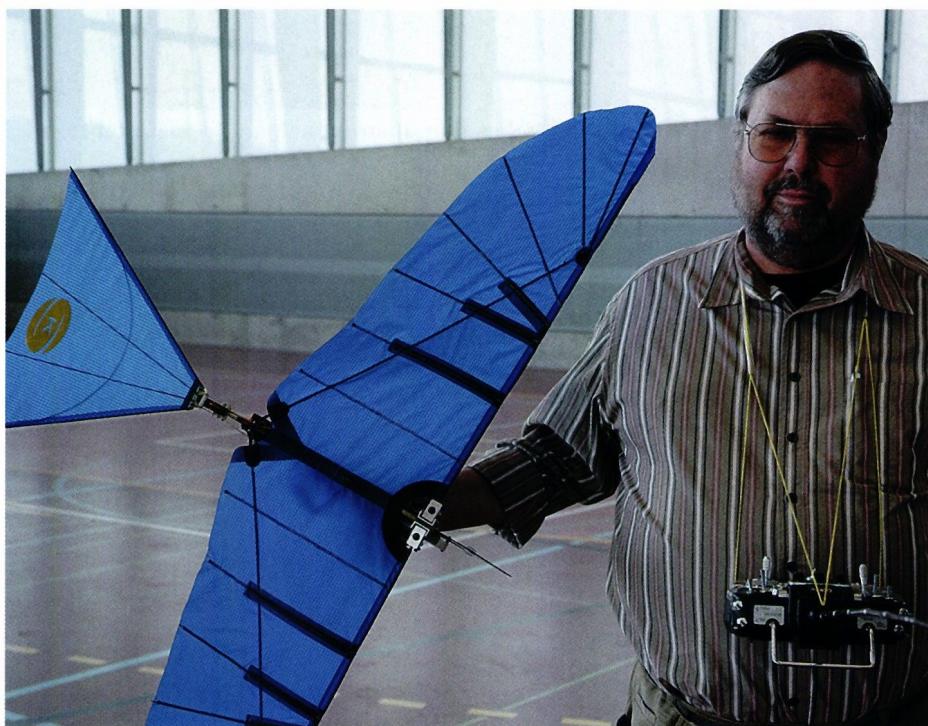
During the briefing, he explained to the nearly 30 pilots—including 7 German colleagues—how to use a large magnetic board on which each pilot could “sign in” using a magnetic tag. This allowed the pilots to showcase their skills in solo or synchronized flight in a flexible, yet orderly takeoff sequence, which the newcomers to indoor flying particularly appreciated, as they often had to contend with the “cramped” space, even though a triple-width hall was available. Throughout the day, Patrick never tired of providing expert commentary—spiced with a healthy dose of humor—on the pilots’ performances to the large crowd gathered on the well-secured grandstand. From 10 a.m. to 4 p.m., the action came thick and fast, with Thomas Wäeckerlin and Matthias Fischer welcoming the spectators at the opening with a banner tow. A colorful variety of aircraft followed, including monoplanes, biplanes, flying carpets, Mickey Mouse planes, and various indoor helicopters. One of the highlights was undoubtedly the synchronized flight demonstration by Sergio Waldmeier and Andi Haller, who put on a successful show with their custom-built aircraft “Fashion.” When, during the rolling circle maneuver, you find yourself thinking each time that the wing is surely about to hit the ground in its inverted flight position, it proves once again that Andi’s demonstrations are not just spectacular flukes, but the result of rigorous training. It’s always striking to see the enthusiasm and perseverance with which the so-called “joystick generation” has embraced the hobby, ensuring that there is considerable potential among the next generation. And so it was left to the younger generation to showcase their skills with flying colors in the balloon-popping competition, where two pilots competed against each other in a single-elimination format. Using a spike attached to the rudder, the task was to pop five balloons while hovering in the shortest time possible. This wasn’t a test of recklessness; rather, pure precision, combined with calm and composure, led to success, which Jan Siebenhaar ultimately claimed for himself.
Another crowd-pleasing attraction was a fox hunt, in which each participant’s model was fitted with a “tail,” so that every pilot embodied both the hunter and the hunted. The fact that there was only one minor crash during this “daring bumblebee flight” spoke once again to the discipline and skill of the participants, which the audience rewarded with thunderous applause.
A survey of the pilots revealed that the average slowflyer has a wingspan of about 80 cm, weighs just under 200 g, and is powered by a set of three 350 LiPo batteries. As for the motors, no clear trend emerged; everything the market has to offer was on display and used successfully.
The “Fashion” was an exception. With a wingspan of 83 cm and a length of 90 cm, this model weighs just under 130 g and is powered by an excellently crafted, 24-g specialty motor using only two 350 Kokam batteries and an 8×4.3 GWS propeller. The design of the model and motor is the work of Andi Haller and Sergio Waldmeier. At www.funmodels.ch, Sergio now sells not only the motor and model but also select accessories.
A food and beverage stand with a wide selection of drinks and food kept both pilots and spectators in good spirits all day long, and at the cozy tables, many new friendships were formed and old ones were rekindled. This engaging, entertaining, and informative event came to a close around 4 p.m., and Patrick Häusler made sure to give each participant an MG-Wald pilot’s cap as a parting gift, wishing them a safe journey home and expressing the hope that the pilots’ word-of-mouth promotion would once again make the next international indoor flying event in Wald a success. Finally, a heartfelt thank you to all the volunteers and members of MG-Wald who, both on and off the field, helped organize and ensure the smooth running of the meeting.
Dieter Meier
Photos: Werner Caviezel, René Berger, and “modell flugsport”
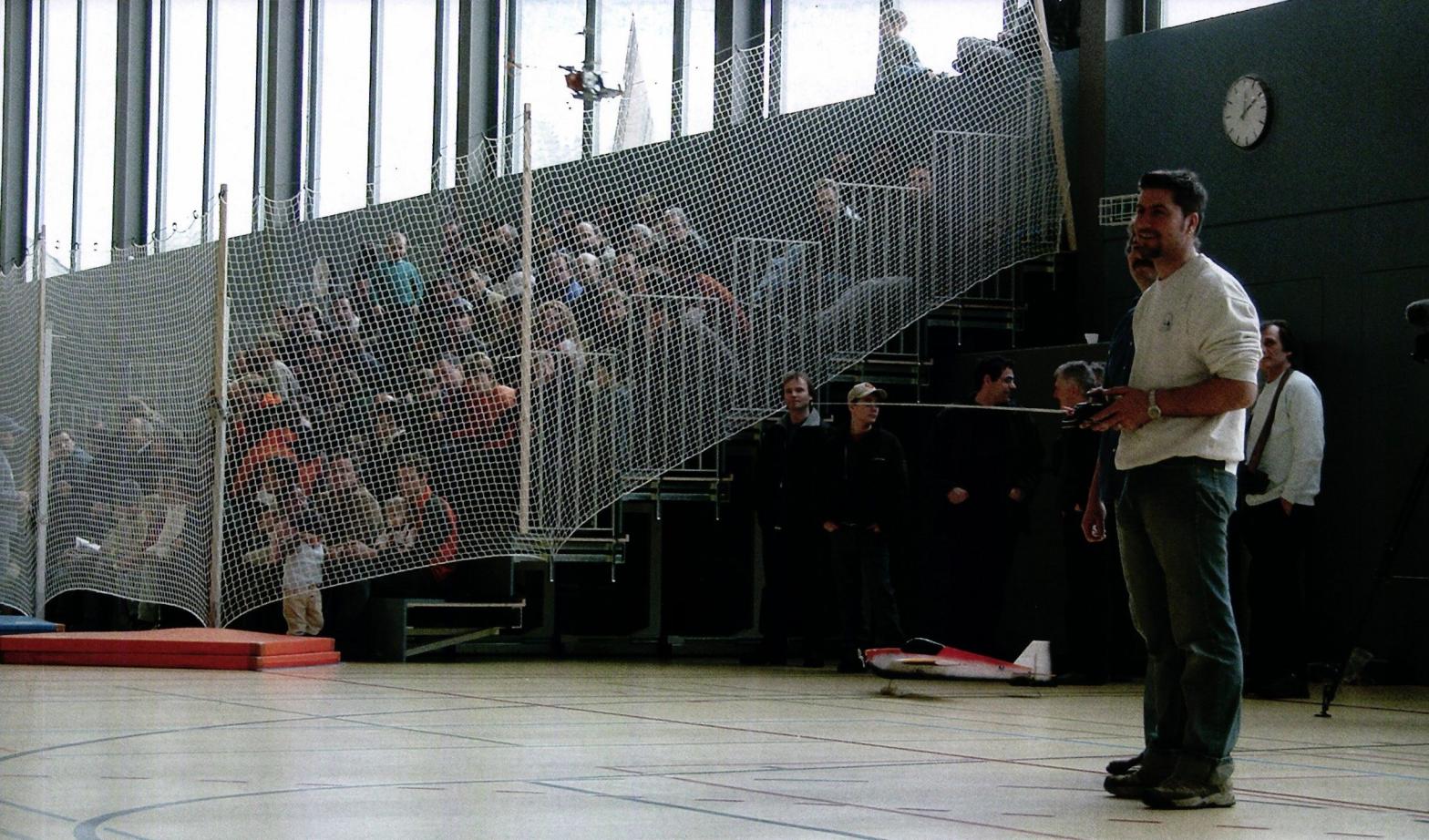
After some time, indoor flying has made a comeback in Uster. Originally founded by the MG Fehraltorf, it was revived this year by the Päffik Model Flying Club under the leadership of Urs Leodolter. Some of these photos are therefore from the meeting in Uster.
The pioneering countries in indoor flying are the Netherlands and Belgium. However, many years ago, models made of harder or softer foams weren’t used there; instead, they flew airplanes made of high-tech materials, outrageously expensive electronics, and adventurous gear-driven propulsion systems. Today, almost everything is commercially available and—viewed from a distance—looks largely similar. Fortunately, a group of DIY modelers has remained—and there are even very young people at work among them. This is a joy to see.
After decades of development in electric flight, even the most skeptical are now realizing that electric flight really works, and the powerful F3A scene is already turning its attention to indoor flying. They say they want to “merge” everything, as if there were anything to merge in indoor aerobatics—except that combustion engines would be allowed. In outdoor aerobatics, combustion engines and electric flight have coexisted peacefully for many years, with the latter beginning to outpace the nitro enthusiasts and putting noise meters out of work. Well, early adopters of electric flight are unlikely to let themselves be “merged” and will, one way or another, remain hooked on the ampere virus.
Emil Giezendanner
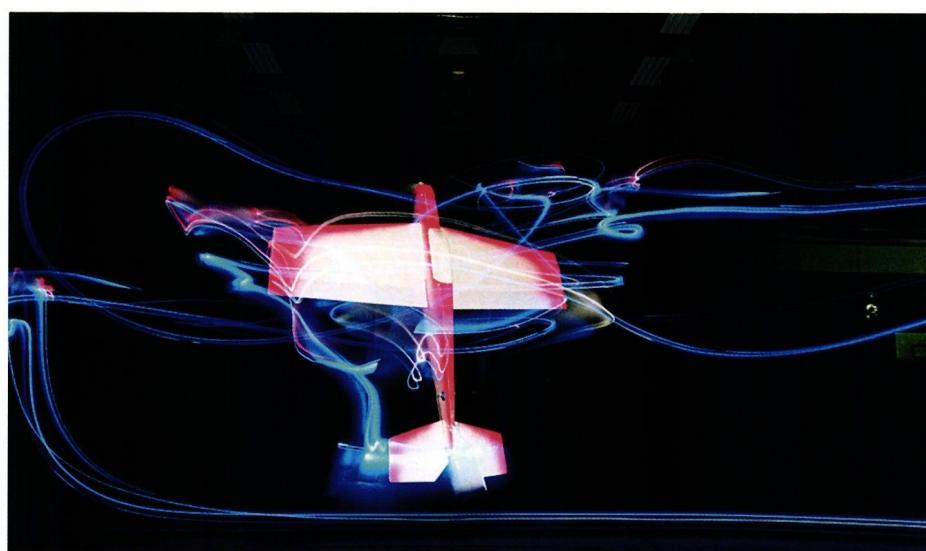
Night flying with illuminated model airplanes has become very popular in recent years. It was only a matter of time before the increasingly brighter and lighter LEDs would also prove suitable for illuminating indoor airplanes. The indoor night flying took place in the gym of the Baden Cantonal School. Bruno Geissmann was the pilot, and René Berger took photos with a Nikon F5 and an AF 24-120 lens; the exposure times ranged from 35 to 45 seconds. Ed.

EURO CONTEST GLIDER ACRO TOUR AUSTRIA 2026

THE PC-21 STORY
 Emil Giezendanner

TWIN TOWN PARTNERSHIP
 Wolfgang Voeller

SUMMER FUN 2026 AT MG USTER
Martin Wunderli
CORSAIR F4U – A WARBIRD WITH A MEMORABLE LOOK
Jürgen Rosenberger, Jürgen Prinz
52. 2026 ALPS CUP
Emil Giezendanner
YOU KNOW WHAT I MEAN? 125 YEARS OF THE SWISS AERO CLUB
Emil Giezendanner
News from HEBU

TEAM MANAGER "THIS" BOSSHARD
Rodito Nussbaumer
ATOM, THE NEW DOUBLE-DECKER FROM CPLR
 Matthias Bosshard

F3A EUROPEAN CHAMPIONSHIPS IN ST-MACAIRE, FRANCE
Matthias Bosshard
INSIGHTS INTO THE HISTORY OF SEAPLANES

WELCOME, NEW MEMBER!
Andrea Bolliger
What's New at Leomotion.com

PRIDE AND GOOD IDEAS
 Markus Nussbaumer

SMALL, MODEL-LIKE SAILBOATS
Res Dauwalder
FREE FLIGHT IN THE MIDDLE OF SUMMER
Urs Muntwyler
BY YOUTH, FOR YOUTH
Lorena Betschen
HORIZON HOBBY/LEMACO NEWS: MICRO OV-10 BRONCO 645 MM BY E-FLITE

34th HAHNENMOOS ALPINE MODEL AIRPLANE CAMP
Res Dauwalder
COUPE DES ALPES – OBSERVE AND LEARN
Rodito Nussbaumer
TRY-OUT DAY AT MFV WETTINGEN
 Urs Keller

NEWS FROM HEBU
 Julia Bucher

NOS REGION – A HUB FOR ELECTRIC AVIATION
Emil Giezendanner
MEMORIES
 Wolfgang Völler

70 YEARS OF THE NIDWALDEN MODEL AIRPLANE CLUB
Martin Barmettler
A SPECTACULAR F3A WORLD CUP IN THE PRINCIPALITY OF LIECHTENSTEIN
Emil Giezendanner
FROM 0 TO 100
Markus Nussbaumer