
The Militky Principle
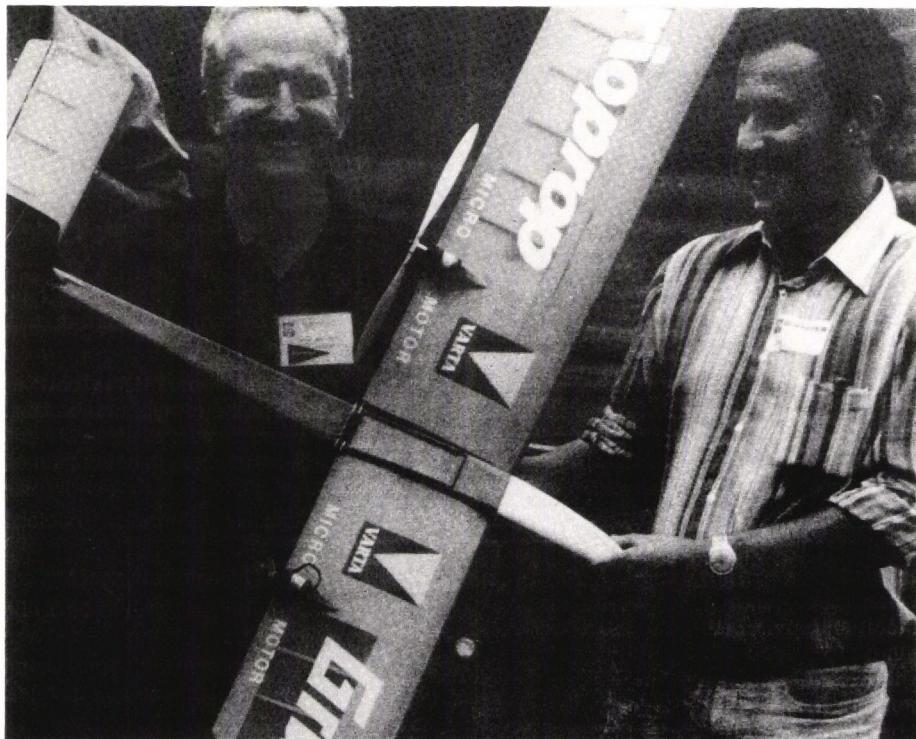
I call this concept the “Militky Principle” because Fred Militky was the first to develop a practical, widely available electric RC model—which, as is well known, is now sold by Graupner as a kit (Hi-Fly).
The model from Multiplex (not yet available) is also essentially based on Militky’s ideas. However, designer Schenk (see MFS 12/73) has made some improvements to it, and it appears that his testing is not yet complete. But on the whole, the Multiplex model hasn’t broken any new ground either. This design is actually based on a fairly standard glider model, which, of course, should ideally be kept as light as possible—
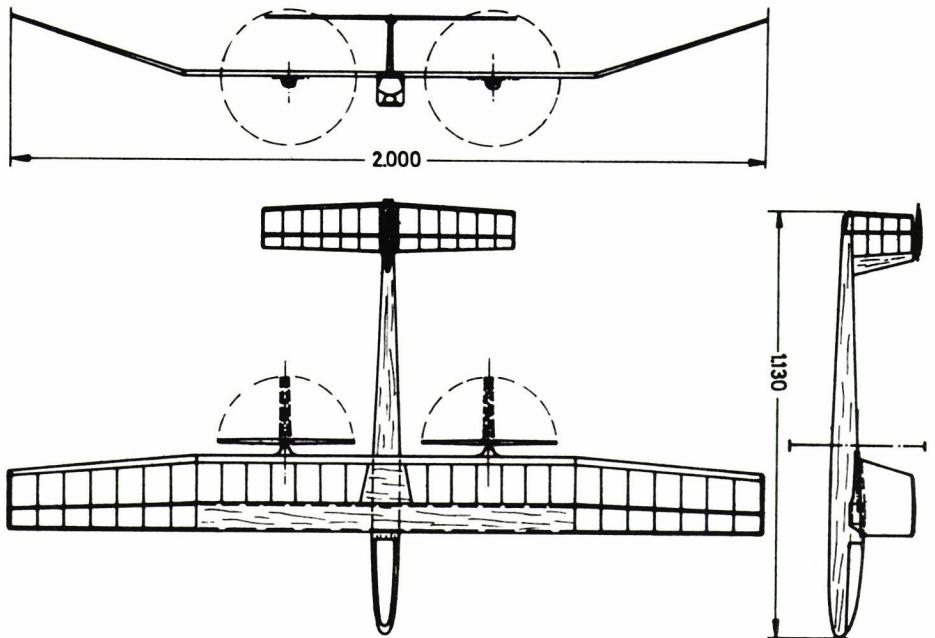
but only light enough that the batteries don’t “fly out” through the fuselage with every landing. The power battery is housed as close to the center of gravity as possible. Propulsion is provided by two electric motors, which drive two large-bladed, slow-rotating folding propellers via a gearbox (reduction gear). The propulsion units (motor and gearbox) are retrofitted to the wing. The propeller can be compared to that of a rubber-powered model, but is significantly simpler in design and more primitive in construction. Since the propeller folds backward due to the airflow when the motor is turned off, thrust screws had to be used, and the motor had to be placed immediately in front of the wing’s trailing edge. This way, relatively little damage occurs during landings on meadows and stubble fields. But is the effort involved in the prefabricated, foldable giant propellers—which are, of course, prefabricated—justified in this case? Militky knew, of course, that for a slow-flying RC glider, large propellers that rotate slowly offer better efficiency. In addition, the electric motor can operate within its optimal, high-efficiency speed range. For these reasons, the solution adopted by Militky was an obvious choice. During gliding flight, the propellers folded backward offer minimal drag.
Despite a power loss due to the gearbox—which is likely around 20%—both electric models, the one from Graupner and Helmut Schenk’s E-1, have tremendous climb performance, which is likely greater than is generally typical for motor gliders. Any skeptic will be amazed by a Hi-Fly “scooping” its way silently upward, even though its flying weight is 2,000 grams. Despite this great success by Militky, the search for new designs is in full swing, as the “Militky principle” apparently also has some drawbacks.
In issue 7/73 of the MFS, we provided a brief historical overview of the development of electric flight. Another important milestone to add would be the first manned electric flight in the summer of 1973. Fred Militky, who is considered a long-time specialist in electric flight, played a key role here as well. The aircraft in question is a motor glider capable of taking off under its own power. This achievement should have convinced even the last skeptics of the “technical feasibility” of electric flight.
In the aforementioned report, I had also pointed out that it was a great pity that electric flight was not being embraced by free-flight enthusiasts. Electric free flight could become an incredibly interesting category of free flight. I remain convinced that electric flight is close to the heart of the free-flyer. The model aircraft enthusiast and the VM pilot bring with them nearly all the necessary theoretical and design experience.
Although the electric aircraft sector is still in its infancy in the field of remote-controlled flight—having been available to the general public in kit form for barely a year—two distinct directions are already beginning to emerge. It seems to me to be extremely important that every future electric model aircraft enthusiast—before venturing to build an electric model—has a clear understanding of the concept:
I’m thinking in particular of the large folding propellers, which will never be entirely trouble-free, not to mention the unfamiliar flight characteristics. As for the actual technical problem, however, I’d like to point out the issue of starting the engine. The moment the motor is turned on, centrifugal force causes the propellers to swing outward, and due to their enormous size and pitch, they must overcome significant air resistance right from the start—even at relatively low RPMs. At this moment, the motors will draw a great deal of current, which in turn has an adverse effect on their commutators. This “shock treatment” significantly shortens the service life of an otherwise virtually wear-free electric motor. Of course, this problem can be solved. Radio control technology, which already offers stepless electronic speed controllers (e.g., Digi-Fly), provides a solution to these issues. The device is connected to the receiver in place of the throttle servo, and you can adjust the drive or flight current as desired using the throttle on your transmitter. Another solution would be a two- or three-position switch. An interesting, though complex, option would be the automatic variable-pitch propeller, as has been used by Gummeler for years, with the difference that the pitch would need to be low at the start. In the next report, we’ll have quite a bit to say about gearless electric propulsion and its pros and cons, since we dedicated today’s experiments entirely to this principle.
Emil Giezendanner


News from HEBU

HORIZON HOBBY/LEMACO NEWS: MICRO OV-10 BRONCO 645 MM BY E-FLITE

PRIDE AND GOOD IDEAS
 Markus Nussbaumer

TEAM MANAGER "THIS" BOSSHARD
 Rodito Nussbaumer

YOU KNOW WHAT I MEAN? 125 YEARS OF THE SWISS AERO CLUB
 Emil Giezendanner

F3A EUROPEAN CHAMPIONSHIPS IN ST-MACAIRE, FRANCE
 Matthias Bosshard

ATOM, THE NEW DOUBLE-DECKER FROM CPLR
Matthias Bosshard
SUMMER FUN 2026 AT MG USTER
Martin Wunderli
What's New at Leomotion.com

52. 2026 ALPS CUP
Emil Giezendanner
TWIN TOWN PARTNERSHIP
Wolfgang Voeller
34th HAHNENMOOS ALPINE MODEL AIRPLANE CAMP
Res Dauwalder
CORSAIR F4U – A WARBIRD WITH A MEMORABLE LOOK
Jürgen Rosenberger, Jürgen Prinz
SMALL, MODEL-LIKE SAILBOATS
Res Dauwalder
TRY-OUT DAY AT MFV WETTINGEN
Urs Keller
WELCOME, NEW MEMBER!
Andrea Bolliger
FREE FLIGHT IN THE MIDDLE OF SUMMER
Urs Muntwyler
COUPE DES ALPES – OBSERVE AND LEARN
Rodito Nussbaumer
EURO CONTEST GLIDER ACRO TOUR AUSTRIA 2026

BY YOUTH, FOR YOUTH
Lorena Betschen
INSIGHTS INTO THE HISTORY OF SEAPLANES

THE PC-21 STORY
Emil Giezendanner
NEWS FROM HEBU
 Julia Bucher

FROM 0 TO 100
Markus Nussbaumer
MEMORIES
Wolfgang Völler
NOS REGION – A HUB FOR ELECTRIC AVIATION
Emil Giezendanner
DO YOU KNOW WHAT I MEAN IN THE LAND OF SMILES?
Emil Giezendanner
Have you almost forgotten about aircraft that take off and land vertically?
Emil Giezendanner