
A pioneer of model aircraft from the very beginning
Model aircraft pioneers never truly die! This may be a source of comfort as we mourn the loss of a fellow enthusiast. Model aircraft are nothing more than the embodiment of (intellectual) ideas—in other words, “models.” If Paul Schmitter devoted himself intensively to model aviation for more than half a century, then this was also a part of his heart, and together with his outstanding craftsmanship, it resulted in the union of mind, heart, and hand—a principle—or philosophy—for the education of young people that Heinrich Pestalozzi established as early as 200 years ago.
If they were able to overcome all obstacles in order to devote themselves to model aircraft flying, then these were in and of themselves extraordinary achievements with—as we would say today—“lasting” effects. Until 1940, Paul Schmitter worked as a mechanic in Rothrist. Then, after completing his training to become a master craftsman, he sought a new challenge at the Federal Construction Workshops in Thun as the training supervisor for the apprentices. For more than forty years, as an apprentice trainer, he helped countless young people develop professional skills and get off to a good start in their careers—literally and figuratively, with his head, heart, and hands. In the biography written by one of his granddaughters, it is noted that
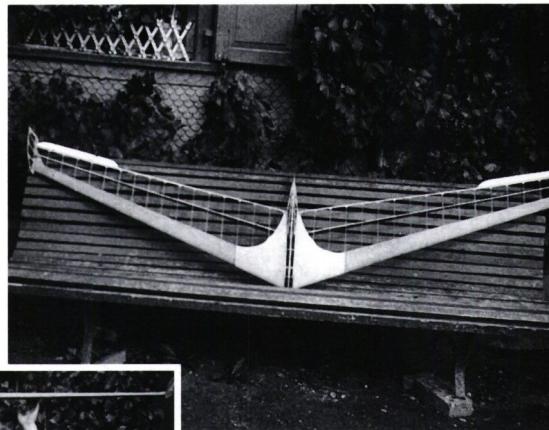
Paul Schmitter (1914–2001) was not only an outstanding model aircraft pilot—a multiple member of the national team and team captain—but also an excellent instructor, president of MG Thun, and regional president of what was then Region 2 (now Bern–Oberland–Valais).

As recorded: “He was not only a great teacher and master to his apprentices and employees; to his children and grandchildren, too, he was the man to ask. Whether the topic was Pythagoras, geology and botany, building dollhouse furniture, or simply how to hang a picture perfectly straight—Paul Schmitter never just gave a simple answer; he would deliver a detailed lecture. His wealth of knowledge was nearly inexhaustible.”
As a designer and model aircraft enthusiast, Paul Schmitter made a name for himself not only in Switzerland but also internationally. He was one of the most renowned free-flight enthusiasts and an outstanding expert on flying-wing glider models. His series of national and inter-
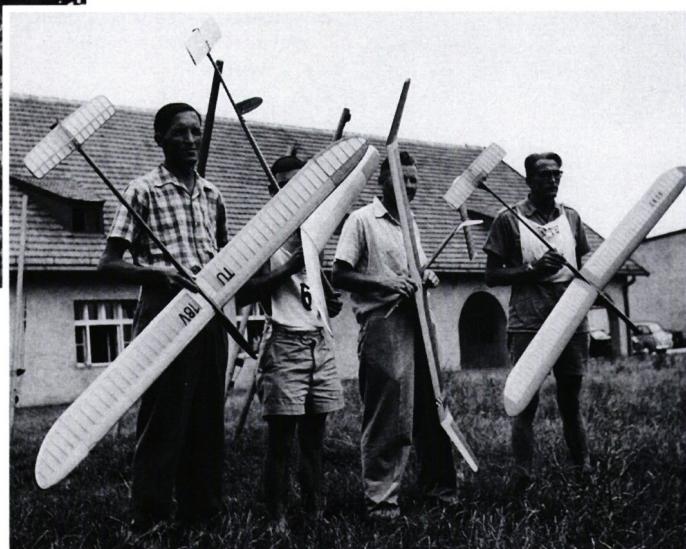
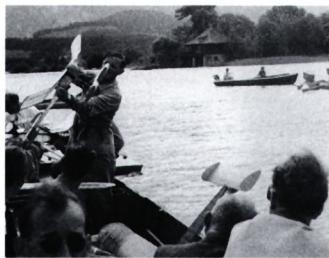
His record of top national finishes is almost immeasurable. As early as 1947, he placed 4th in the high-launch category and 5th in the slope category with his flying-wing model. Starting in 1950, he almost exclusively placed 1st or 2nd in national competitions! As late as 1983—the year his records, as provided to me, end—he successfully defended his title as Swiss F1A/SK Champion in Buochs. That was when he was nearly 70 years old. Added to this were his designs and successful athletic achievements in motorized (free-flight) models as well as water-launched free-flight models. Even throughout this extraordinary athletic career, he always remained modest. He wasn’t one for victory “theatrics” or big celebrations; rather, he is said to have quietly withdrawn after such successes. Perhaps he was almost a kind of solitary athlete. What is certain is that he meticulously analyzed the rankings—as well as his own performances and those of his competitors—and was thus able to compile highly interesting statistical data over the years.
Paul Schmitter was neither a braggart nor a modern-day show-off. He never felt the need to promote himself or put on a show. He exuded a “natural” authority based on his extraordinary expertise. Back then, it was only logical that he would soon be entrusted with leadership roles in the model aviation community as well. From 1948 to 1958, he served as chairman of the Thun Model Aviation Club, and from 1954 to 1968 as regional—
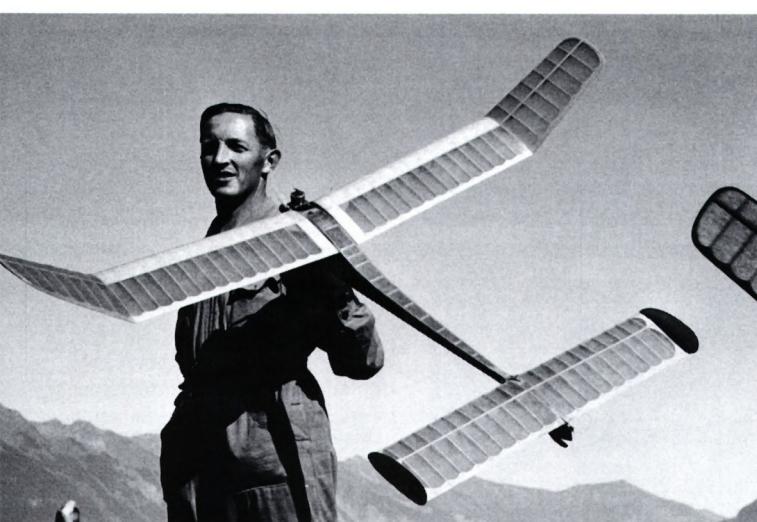
He was the regional chairman of what was then Region 2. In addition, he held the position of “section model aircraft director” for many years, a role that no longer exists today. As the free flight team leader, he led the Swiss World Championship expeditions to Finland (1965) and to what was then Czechoslovakia (1967). He also served as an aerobatics judge for RC powered flight (now F3A) at numerous competitions.
His skills as an instructor—how could it be otherwise—benefited many
dedicated commitment as a group leader in model aircraft building. When I think back to how there were young leaders for whom the youth camp model was unsuitable—the balsa wood too hard or too soft, the slope too low or too high, and so on— whereas a highly motivated man in his seventies tackled his tasks flexibly without much fanfare—with his head, heart, and hands—this still deeply impresses me to this day.
Paul Schmitter passed away on June 30, 2001. Time and again, when I’m busy writing words of farewell and thereby processing a piece of the past—or even the history of Swiss model aviation—I realize how limited our ability is to truly honor a person’s life’s work. That, depending on our perspective, we can ever know only a small segment of it—and understand even less. In this sense, such sentences are almost presumptuous. I write them nonetheless: First, so that we may express our gratitude—
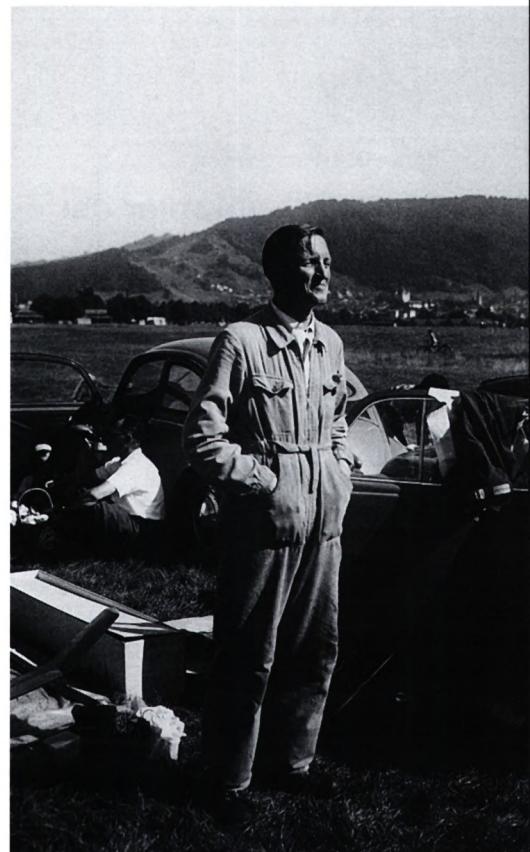
First, because it reminds me of Paul Schmitter, and second, because I am becoming increasingly convinced that our youth urgently need role models—athletic and professional figures who remain humble despite their success.
*Emil Giezendanner*

EURO CONTEST GLIDER ACRO TOUR AUSTRIA 2026

THE PC-21 STORY
 Emil Giezendanner

TWIN TOWN PARTNERSHIP
 Wolfgang Voeller

SUMMER FUN 2026 AT MG USTER
Martin Wunderli
CORSAIR F4U – A WARBIRD WITH A MEMORABLE LOOK
Jürgen Rosenberger, Jürgen Prinz
52. 2026 ALPS CUP
Emil Giezendanner
YOU KNOW WHAT I MEAN? 125 YEARS OF THE SWISS AERO CLUB
Emil Giezendanner
News from HEBU

TEAM MANAGER "THIS" BOSSHARD
Rodito Nussbaumer
ATOM, THE NEW DOUBLE-DECKER FROM CPLR
 Matthias Bosshard

F3A EUROPEAN CHAMPIONSHIPS IN ST-MACAIRE, FRANCE
Matthias Bosshard
INSIGHTS INTO THE HISTORY OF SEAPLANES

WELCOME, NEW MEMBER!
Andrea Bolliger
What's New at Leomotion.com

PRIDE AND GOOD IDEAS
 Markus Nussbaumer

SMALL, MODEL-LIKE SAILBOATS
Res Dauwalder
FREE FLIGHT IN THE MIDDLE OF SUMMER
Urs Muntwyler
BY YOUTH, FOR YOUTH
Lorena Betschen
HORIZON HOBBY/LEMACO NEWS: MICRO OV-10 BRONCO 645 MM BY E-FLITE

COUPE DES ALPES – OBSERVE AND LEARN
Rodito Nussbaumer
34th HAHNENMOOS ALPINE MODEL AIRPLANE CAMP
Res Dauwalder
TRY-OUT DAY AT MFV WETTINGEN
 Urs Keller

NEWS FROM HEBU
 Julia Bucher

NOS REGION – A HUB FOR ELECTRIC AVIATION
Emil Giezendanner
MEMORIES
 Wolfgang Völler

70 YEARS OF THE NIDWALDEN MODEL AIRPLANE CLUB
Martin Barmettler
A SPECTACULAR F3A WORLD CUP IN THE PRINCIPALITY OF LIECHTENSTEIN
Emil Giezendanner
FROM 0 TO 100
Markus Nussbaumer