
Electric Aviation Is Taking the World by Storm
An Overview of the State of Development by Emil Ch. Giezendanner
by Emil Ch. Giezendanner
; Photos: Andreas Schelling
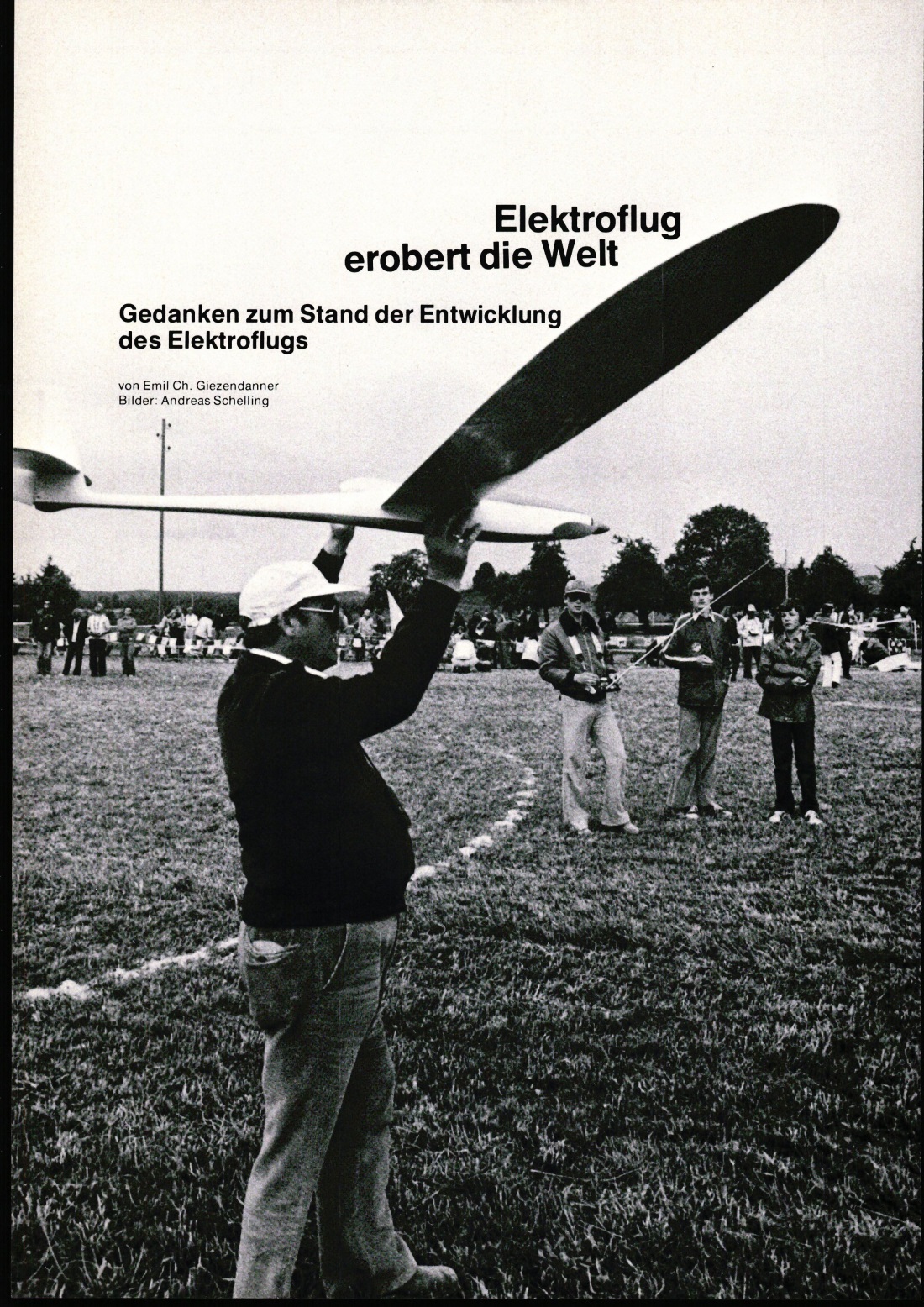
The fact that electric flight has not yet become a category in either free flight or circuit flying, but instead appeals almost exclusively to RC model aviators (with a few modest exceptions in scale modeling that should be explicitly mentioned), provides a rather stark analysis of the current state of modern model aviation. Although in both free flight and circuit flying, the electric motor could have long since been implemented as an alternative power source to the “knalltreiberling” with far fewer technical problems, everything has remained the same. (Even the muffler, now standard in RC flying, seems to be far from universally adopted in that field.)
In contrast, the number of participants in electric flight competitions is steadily increasing. The oldest electric flight competition in Europe (and presumably the world), the International Militky Cup, had over 70 participants in 1979 for its sixth edition, and the Swiss Electric Flight Championship—which was also held for the first time last year—had already brought together more than 20 competitors at the Winterthur Gliding Club airfield. These are not numbers that would lead us straight into a delusion of grandeur, and it is far from my intention to give the impression here that I consider what large crowds do to be more valuable than what is done by just a few. On the other hand, I would like to share here my experiences as a member of the AeCS Model Aircraft Commission—specifically, the struggle it took to raise the minimum number of participants required for Swiss Championships and the awarding of AeCS medals in certain categories from three to five. I hope everyone understands the extraordinarily complex tension involved: From the model aircraft category that has, so to speak, been placed under
“heritage protection,” to the excessive innovations and the tendency to introduce two to three new categories with Swiss Championships every year, until we can no longer find enough organizers or weekends.
This understanding is necessary if one wants to grasp why, in our country (and, incidentally, in other countries and within the CIAM as well), not all categories of electric flight—from gliding (F3E), to pylon racing and even certified aerobatics—were elevated to official categories overnight. To the best of my knowledge, Switzerland was the first country to introduce electric flight as an official category. German championships will take place for the first time this year.
Electric flight is subject to just as few limitations as aviation with internal combustion engines is today. That may sound presumptuous—at first glance—but anyone who takes a closer look at the issue will soon come to realize this. When, perhaps more than ten years ago, I saw a 5-meter glider-mobile with a 10-cm³ motor whiz past at an air show in Frauenfeld, it was quite a spectacle for me, given my own rather small, agile aircraft. If someone had told me back then that in 1979 I’d also be soaring across the field in a 5-meter large glider—albeit equipped with a small electric “motor”—they probably wouldn’t have had to go out of their way to make me laugh!
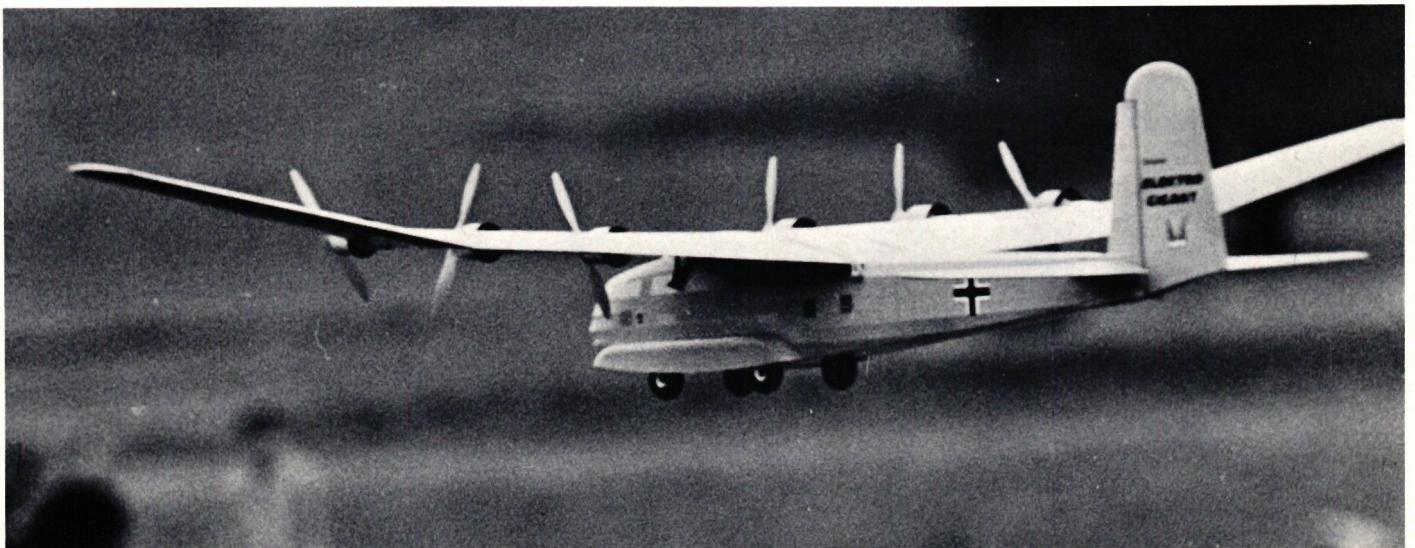
Multi-engine models of any size can be easily replicated and equipped with electric motors. The vexing takeoff problem—by the time the last engine is running, the first one has already stalled due to a lack of fuel... The tedious process of adjusting and tuning all the engines can easily throw the entire schedule of an air show into disarray. With electric flight, all you need to do is push the control stick forward, and all the motors spin in reassuring unison. The “Electric Giant,” as demonstrated by Wolfgang Schwarze at various air shows, is likely a worthy example with its six small motors. In most cases, large models—unless they were designed from the ground up to be very heavy—can be converted to electric propulsion without difficulty. Especially in the scale and stand-off-scale categories, electric flight still has a bright future ahead. It will take some time for electric propulsion systems to truly gain a foothold among model aviators. Perhaps one day, when building a powered model, people will always think of an electric motor first and only consider other options in very specific cases. Among the general public, however, this shift in thinking would take about twice as long. The perception that model flying—except for gliding—is always associated with the whirring sound of an engine is difficult to counter and requires patience. At least in Switzerland, for example, a promising start has been made with the AeCS’s PR campaign in connection with the International Militky Cup.
The internal combustion engine will never disappear. There will always be engine enthusiasts. But the internal combustion engine is about to face stiff competition, especially in Switzerland. The use of internal combustion engines will also be limited to just a few applications due to purely external constraints (e.g., environmental protection). Specialized applications such as heavy scale models, RC aerobatics, helicopters, and pylon racing certainly won’t be dominated by electric propulsion anytime soon. That said, in aerobatics in particular, the introduction and acceptance of electric flight could finally help this wonderful sport break free from its self-destructive trend (of getting faster and bigger all the time). The best pilots would perform well there, too.
The manufacture and distribution of electric model kits, motors, and accessories now account for a very significant market share within the model-making industry in Europe. Developments similar to those already seen in other model-making sectors are now clearly emerging in the field of electric flight: While major manufacturers are using industrial production methods to make electric flight “accessible to the general public” as a mass-market trend, absolutely foolproof, and, above all, at extremely affordable prices, specialists are producing, on a smaller scale, technically and qualitatively highly sophisticated—and correspondingly expensive—equipment for the discerning competition pilot. All of Germany’s renowned manufacturers offer electric aviation enthusiasts a well-curated and versatile range of models and accessories, with Graupner, Kirchheim—with its undeniably most versatile line of electric flight accessories—deliberately carries on Fred Militky’s great tradition of electric flight and continues to hold a clear leading position. Carrera also seems to be devoting a great deal of attention to electric flight; however, I personally find the direction taken following the “Primus”—with pre-built wings and fiberglass fuselages—too one-sided, although, and this is undisputed, it appeals to a large customer base. The Robbe company strikes a balance between Carrera’s nearly ready-to-fly models and Graupner’s very affordable wooden kit models. Here, the fuselages are supplied in fiberglass, while the wings—constructed using the standard, sophisticated rib method—must be built by the modeler.
Smaller manufacturers such as Tscheulin, Gewalt, Geist, Keller, etc., as mentioned earlier, tend to focus on promoting development in the field of competitive flying. What is surprising is that these smaller companies can compete on price with a major manufacturer such as Carrera (though it is not immediately clear under what conditions and at what cost).
There has been tremendous progress in the accessories sector in recent years. These accessories mainly consist of batteries, motors, chargers, propellers, and switches. There is still much to look forward to in this area in the future. Whoever can offer the most practical, versatile, and durable accessories—
while keeping the price reasonable—will come out on top in the world of electric flight.
When it comes to price, it’s important to recognize that not everyone, for example, is willing to pay as much for a propeller as a competition pilot would—yet they still don’t want to forgo the benefits of the latest advancements in propeller design, and so on. For the manufacturer, this means consistent research and development, but also a dynamic and flexible product lineup. This dynamism has largely been lost in the “established” model categories, since the market is simply too small for highly specialized competition models.


News from HEBU

EURO CONTEST GLIDER ACRO TOUR AUSTRIA 2026

TEAM MANAGER "THIS" BOSSHARD
 Rodito Nussbaumer

YOU KNOW WHAT I MEAN? 125 YEARS OF THE SWISS AERO CLUB
 Emil Giezendanner

F3A EUROPEAN CHAMPIONSHIPS IN ST-MACAIRE, FRANCE
 Matthias Bosshard

HORIZON HOBBY/LEMACO NEWS: MICRO OV-10 BRONCO 645 MM BY E-FLITE

PRIDE AND GOOD IDEAS
 Markus Nussbaumer

34th HAHNENMOOS ALPINE MODEL AIRPLANE CAMP
Res Dauwalder
TRY-OUT DAY AT MFV WETTINGEN
Urs Keller
52. 2026 ALPS CUP
Emil Giezendanner
ATOM, THE NEW DOUBLE-DECKER FROM CPLR
Matthias Bosshard
CORSAIR F4U – A WARBIRD WITH A MEMORABLE LOOK
Jürgen Rosenberger, Jürgen Prinz
SUMMER FUN 2026 AT MG USTER
Martin Wunderli
What's New at Leomotion.com

THE PC-21 STORY
Emil Giezendanner
COUPE DES ALPES – OBSERVE AND LEARN
Rodito Nussbaumer
TWIN TOWN PARTNERSHIP
Wolfgang Voeller
BY YOUTH, FOR YOUTH
Lorena Betschen
SMALL, MODEL-LIKE SAILBOATS
Res Dauwalder
WELCOME, NEW MEMBER!
Andrea Bolliger
FREE FLIGHT IN THE MIDDLE OF SUMMER
Urs Muntwyler
INSIGHTS INTO THE HISTORY OF SEAPLANES

NEWS FROM HEBU
 Julia Bucher

FROM 0 TO 100
Markus Nussbaumer
MEMORIES
Wolfgang Völler
NOS REGION – A HUB FOR ELECTRIC AVIATION
Emil Giezendanner
DO YOU KNOW WHAT I MEAN IN THE LAND OF SMILES?
Emil Giezendanner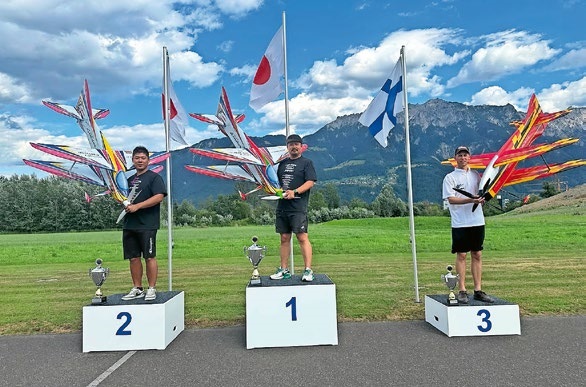
A SPECTACULAR F3A WORLD CUP IN THE PRINCIPALITY OF LIECHTENSTEIN
Emil Giezendanner