
F3A Aerobatic Model CONDOR
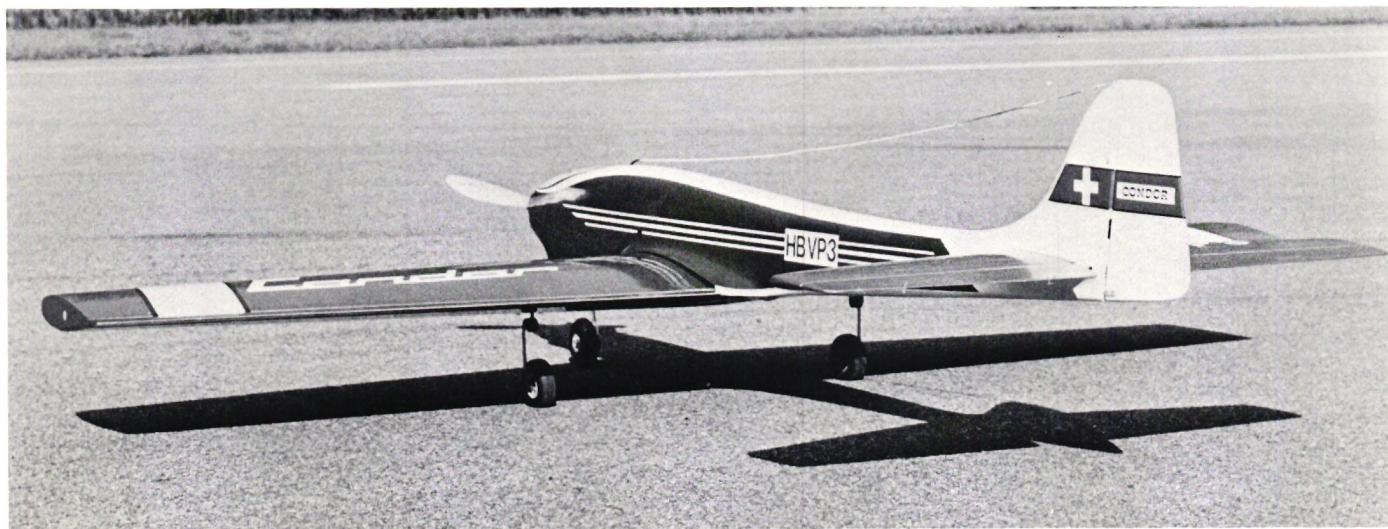
The elegant CONDOR by Schumacher
| Wingspan | 1,630 mm |
| Overall length | 1,480 mm |
| Wing area | 46.13 dm² |
| H-tail surface area | 11 dm² |
| Total area | 57.13 |
| Wing-to-tail ratio | 4.19 |
| Wing profile | 18.8% specific |
| Total weight | 3,400–3,500 g |
| Wing loading | 60.39 g/dm² |
| Motor | Webra-Speed |
| Control | Simprop-Contest spec. |
| Retractable landing gear | Giezendanner |
| Silencer | Super-Silent |
The first prototypes of the Condor were built in mid-1973. My goal was to design a model that, thanks to its aerodynamic shape, could effortlessly perform all the maneuvers in the aerobatic program using standard engine power, thereby keeping flight noise within tolerable limits. These considerations led to the design of the Condor’s current fuselage. This fuselage is very slender and thus has very little unnecessary drag. Based on testing, the lateral area of the fuselage was distributed so that the largest area is located as close as possible to the center of gravity and tapers toward the tail unit. In addition to the clean aerodynamic shape, this provided significant advantages during knife-edge flight and, above all, made the model very insensitive to crosswinds.
To prevent the Condor from becoming too fast due to its small fuselage cross-section, I chose a relatively thick airfoil (18.8%) for the wing. In addition to excellent low-speed flight characteristics, this produced the expected speed-stabilizing effect. For example, during a loop, the speed does not increase significantly during the second half of the maneuver, even when flown at full throttle.
The sweep, wing shape, and clipped wingtips have not changed significantly since the Condor’s prototypes. After numerous tests, a polyester fuselage was built in early 1974, with its halves glued together in a bolted mold. The cowl is a single piece with the fuselage, and the aluminum engine mount is subsequently glued into the fuselage. Since the motor mount and motor recess are already milled into the fuselage nose, the motor only needs to be aligned with the fuselage nose when installing the mount, ensuring that the mount is installed in the correct position within the fuselage.
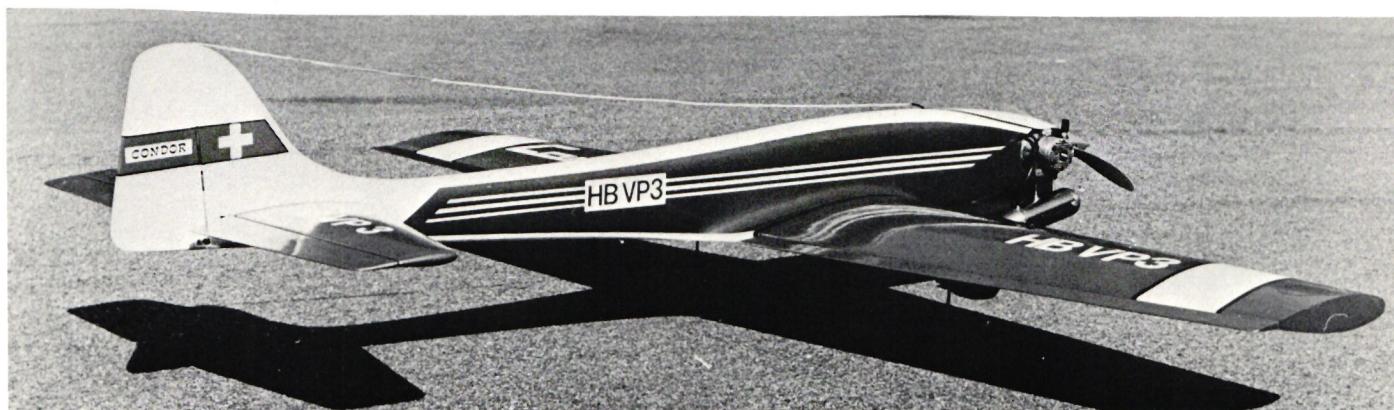
The wing consists of a lightweight Styrofoam core covered with 1.5 mm thick balsa wood skin. The exact sweep and V-shape are already incorporated into the wing halves, so no further work is required here. The wing is available for either retractable or fixed landing gear. The tail section is also included in the kit, fully covered. The polyester fuselage, coated with a specially toughened Cel-Cote, is available in blue, white, and orange. The kit also includes the plan, motor mount, and aerobatic fuel tank.
Price:
Complete kit for retractable landing gear: 312.
— Complete kit without retractable landing gear: 305.—
The author will be happy to provide further information. Please contact:
René Schumacher, 3902 Glis/VS
, Tel. 028/3 25 50


News from HEBU

TEAM MANAGER "THIS" BOSSHARD
 Rodito Nussbaumer

YOU KNOW WHAT I MEAN? 125 YEARS OF THE SWISS AERO CLUB
 Emil Giezendanner

HORIZON HOBBY/LEMACO NEWS: MICRO OV-10 BRONCO 645 MM BY E-FLITE

PRIDE AND GOOD IDEAS
 Markus Nussbaumer

34th HAHNENMOOS ALPINE MODEL AIRPLANE CAMP
Res Dauwalder
TRY-OUT DAY AT MFV WETTINGEN
Urs Keller
F3A EUROPEAN CHAMPIONSHIPS IN ST-MACAIRE, FRANCE
 Matthias Bosshard

52. 2026 ALPS CUP
Emil Giezendanner
ATOM, THE NEW DOUBLE-DECKER FROM CPLR
Matthias Bosshard
SUMMER FUN 2026 AT MG USTER
Martin Wunderli
What's New at Leomotion.com

COUPE DES ALPES – OBSERVE AND LEARN
Rodito Nussbaumer
TWIN TOWN PARTNERSHIP
Wolfgang Voeller
BY YOUTH, FOR YOUTH
Lorena Betschen
CORSAIR F4U – A WARBIRD WITH A MEMORABLE LOOK
Jürgen Rosenberger, Jürgen Prinz
SMALL, MODEL-LIKE SAILBOATS
Res Dauwalder
WELCOME, NEW MEMBER!
Andrea Bolliger
FREE FLIGHT IN THE MIDDLE OF SUMMER
Urs Muntwyler
EURO CONTEST GLIDER ACRO TOUR AUSTRIA 2026

INSIGHTS INTO THE HISTORY OF SEAPLANES

THE PC-21 STORY
Emil Giezendanner
NEWS FROM HEBU
 Julia Bucher

FROM 0 TO 100
Markus Nussbaumer
MEMORIES
Wolfgang Völler
NOS REGION – A HUB FOR ELECTRIC AVIATION
Emil Giezendanner
DO YOU KNOW WHAT I MEAN IN THE LAND OF SMILES?
Emil Giezendanner
A SPECTACULAR F3A WORLD CUP IN THE PRINCIPALITY OF LIECHTENSTEIN
Emil Giezendanner